By ATGL
Updated April 26, 2026
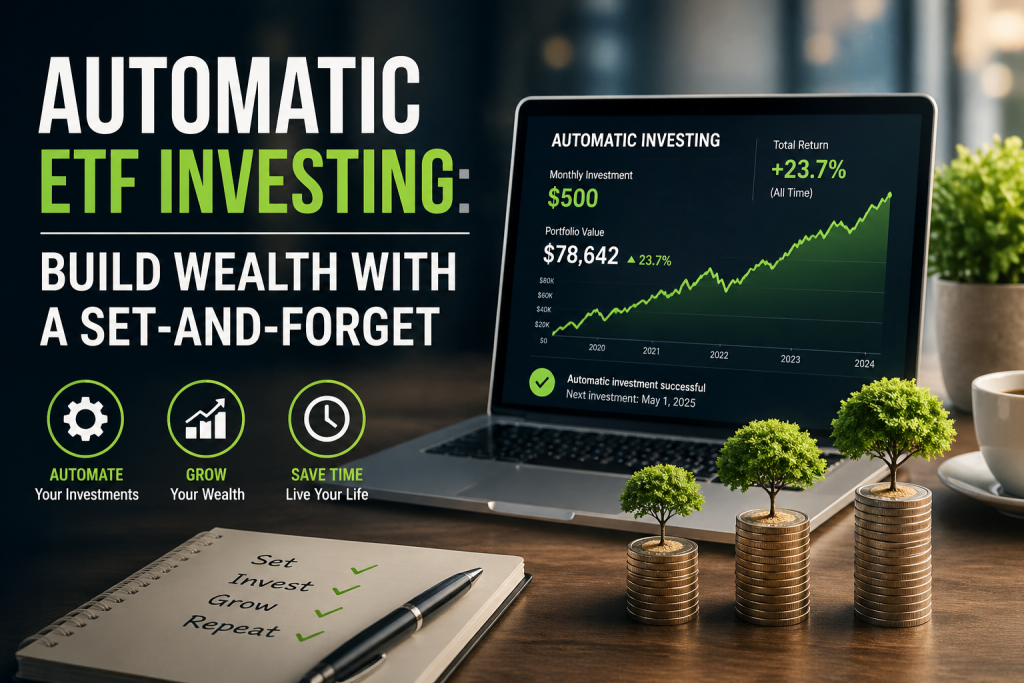
Automatic ETF investing has become one of the most disciplined methods for building long-term wealth, offering a systematic path to portfolio growth without the constant demands of active management. By scheduling recurring contributions into exchange-traded funds, investors at every experience level can maintain consistent market exposure, reduce behavioral biases, and capture the compounding effect over time. This article covers the mechanics of automation, the psychological and mathematical advantages it provides, and how integrating technical analysis can further refine performance.
For investors looking to build a broader foundation before automating contributions, our comprehensive ETF Investing Guide explores ETF fundamentals, portfolio construction strategies, risk considerations, and how exchange-traded funds fit into a long-term wealth-building plan.
The Mechanics Of Automatic ETF Investing And Recurring Contributions
Can you automate ETF investing? Yes, most major brokerage platforms allow investors to schedule automatic purchases of ETFs at defined intervals: daily, weekly, bi-weekly, or monthly. A recurring investment is a pre-scheduled transaction that draws funds from a linked bank account and purchases a specified dollar amount or share quantity of a selected security.
Modern platforms also support fractional shares, meaning investors are not required to purchase whole units of a fund. This is particularly valuable when contributing to high-priced ETFs, as it allows full capital deployment regardless of share price. For example, if an ETF trades at $450 and an investor contributes $100 per week, approximately 0.222 fractional units are purchased automatically.
Direct bank transfers serve as the primary funding mechanism for these strategies. After linking a checking or savings account to a brokerage, recurring transfers can be configured to coincide with a pay schedule. This structure applies to a range of account types, including taxable brokerage accounts and Roth IRA automatic investment setups, where contributions are made with after-tax dollars and grow tax-free.
Reviewing the pros and cons of ETF funds versus mutual funds is a valuable early step when selecting the right vehicle for an automated strategy, as the two differ meaningfully in tax treatment, tradability, and minimum investment requirements.
Eliminating Emotional Bias Through Systematic Dollar-Cost Averaging
One of the most significant advantages of automated stock investing is the removal of emotional decision-making from the investment process. Market volatility often provokes impulsive reactions — buying aggressively during rallies and selling prematurely during corrections. Automation neutralizes this tendency by executing purchases on a fixed schedule, independent of short-term market conditions.
This systematic approach operationalizes dollar-cost averaging (DCA), a strategy in which a fixed dollar amount is invested at regular intervals. The mathematical effect is that more shares are acquired when prices are lower and fewer when prices are higher, reducing the average cost per share over time.
Consider this illustration: an investor contributes $500 monthly into a broad-market ETF over three months at the following prices:
- Month 1: $100/share → 5.00 shares purchased
- Month 2: $80/share → 6.25 shares purchased
- Month 3: $90/share → 5.56 shares purchased
Total invested: $1,500 | Total shares: 16.81
Average cost per share = $1,500 ÷ 16.81 = $89.23
Had the investor purchased all shares at the Month 1 price of $100, the same $1,500 would have acquired only 15 shares. The DCA average cost of $89.23 per share is meaningfully lower, demonstrating the mathematical advantage of systematic investing during periods of price fluctuation.
Top Brokerage Platforms For Implementing Automated ETF Strategies
Selecting the right platform is a practical and foundational decision for executing a successful auto invest ETF strategy.
Vanguard
Vanguard is well-suited for long-term, cost-conscious investors. The platform supports automatic investment plans across its lineup of broad index ETFs and carries some of the lowest expense ratios in the industry. While the interface is functional rather than feature-rich, its fee structure has a compounding positive effect on returns measured over decades.
Fidelity
Fidelity supports automated investing through its recurring investment feature, applicable to a wide range of ETFs and mutual funds. The platform’s “Stocks by the Slice” program extends fractional share purchasing to ETFs, allowing full capital deployment at lower contribution amounts. Fidelity’s integrated research tools also offer investors an analytical layer for supplementing automation with fundamental and technical review.
M1 Finance
M1 Finance is purpose-built for automated portfolio management. Its “Pie” system allows investors to construct a portfolio of ETFs and individual stocks at target percentage allocations. When new contributions are deposited, M1 automatically directs funds toward underweighted holdings, maintaining the desired allocation without manual rebalancing. This design makes M1 particularly effective for investors managing multi-ETF strategies across taxable and retirement accounts.
Setting Up Your Automated Investment Blueprint In Four Steps
Understanding how to automate your investments begins with a structured setup process.
Step 1: Select Low-Cost, Broad-Market Funds. The most widely recommended starting point for automated strategies involves broad index ETFs—funds tracking major benchmarks such as the S&P 500, total U.S. stock market, or international developed markets. These funds offer built-in diversification, low expense ratios, and substantial historical performance data. When evaluating ETF versus index fund options, note that ETFs offer intraday tradability and typically lower minimum investment thresholds, both of which support automated contribution strategies. For investors seeking the best auto ETFs to build around, broad market and S&P 500-tracking funds serve as reliable core holdings for most long-term strategies.
Step 2: Define Contribution Frequency and Amount. Set a contribution schedule that aligns with your income cycle. Bi-weekly or monthly schedules tend to perform well under DCA principles. The contribution amount should be sustainable and consistent, as the primary advantage of automation is uninterrupted market participation.
Step 3: Link a Stable Funding Source. Connect a bank account with reliable, recurring cash availability. Many investors align automated transfers with payroll deposits, removing any manual decision point from the process entirely.
Step 4: Establish Rebalancing Parameters. Portfolio drift occurs when market movements shift asset allocations away from the intended targets. Configuring automatic or threshold-based rebalancing maintains the desired allocation over time—a particularly relevant step for investors holding multiple ETFs or combining equity exposure with fixed income or alternative assets.
Analyzing Long-Term Returns And The Impact Of Automation Fees
The long-term compounding effect of automated investing is substantial, but net returns depend significantly on the expense ratios and platform fees associated with the chosen funds.
To address a common question among prospective investors: how much capital is required to generate $3,000 per month in investment income? At an average annualized return of 7% on a diversified ETF portfolio, the required portfolio size is approximately $514,286. The formula for this calculation is:
Required Portfolio = (Monthly Income × 12) ÷ Annual Return Rate
Required Portfolio = ($3,000 × 12) ÷ 0.07 = $514,285.71
Reaching that figure through automated investing depends on initial capital, ongoing contribution amounts, and the investment time horizon. An investor contributing $500 per month into a diversified ETF portfolio at a 7% average annual return would accumulate approximately $405,000 over 25 years. Increasing that contribution to $800 per month under identical parameters produces approximately $648,000 over the same period.
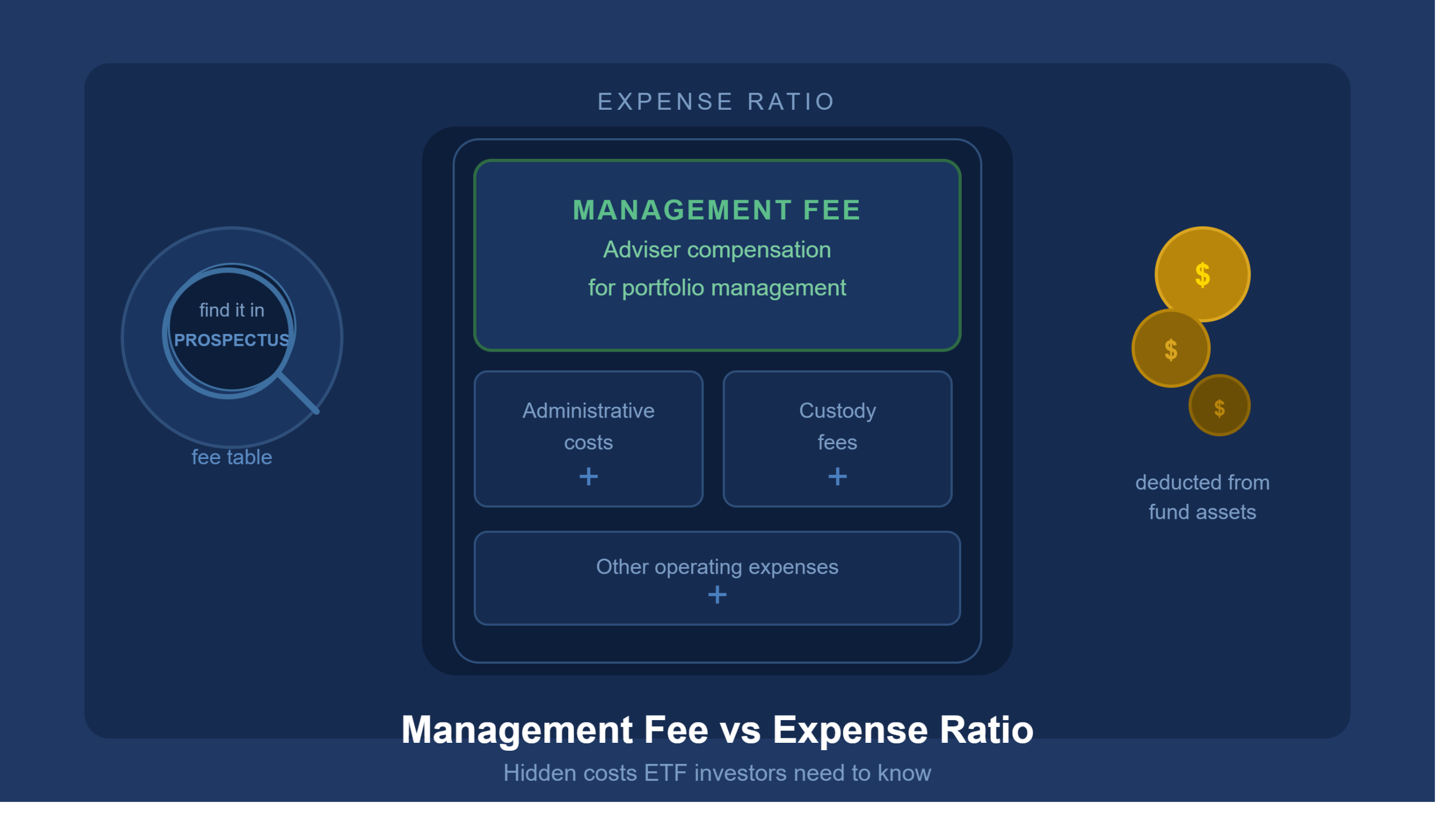
Expense ratios exert a compounding drag on portfolio growth. A 0.03% expense ratio on a $500,000 portfolio costs $150 per year, while a 0.75% ratio on the same portfolio costs $3,750 annually. Over a 20-year period, this difference can represent a six-figure divergence in terminal portfolio value.
For investors considering higher-risk structures, reviewing the implications of using leveraged ETFs within an automated framework is advisable before implementation, as leverage amplifies both gains and losses.
Optimizing Your Automated Strategy With Above The Green Line
Automation provides consistency and removes emotional interference, but it does not replace the strategic advantage of systematic technical analysis. Above the Green Line (ATGL) offers a structured, model-driven approach to portfolio management that complements automated investing. ATGL’s sector rotation strategy identifies the five strongest-performing ETFs on a quarterly basis, allowing investors to direct their automated contributions toward sectors with demonstrated relative strength rather than distributing capital indiscriminately.
By integrating ATGL’s technical signals with an automated contribution framework, investors capture the discipline of regular investing while aligning entries with data-driven market analysis. This combination addresses one of the primary limitations of pure automation — its indifference to prevailing market trends — without reintroducing subjective decision-making into the process.
To explore how ATGL’s tools can refine your automated ETF strategy, reach out to the team to learn more about available membership options and systematic investment models.

Related Articles
[pt_view id=”fb2451fm3r”]