By Andrew Stowers
Updated June 15, 2026
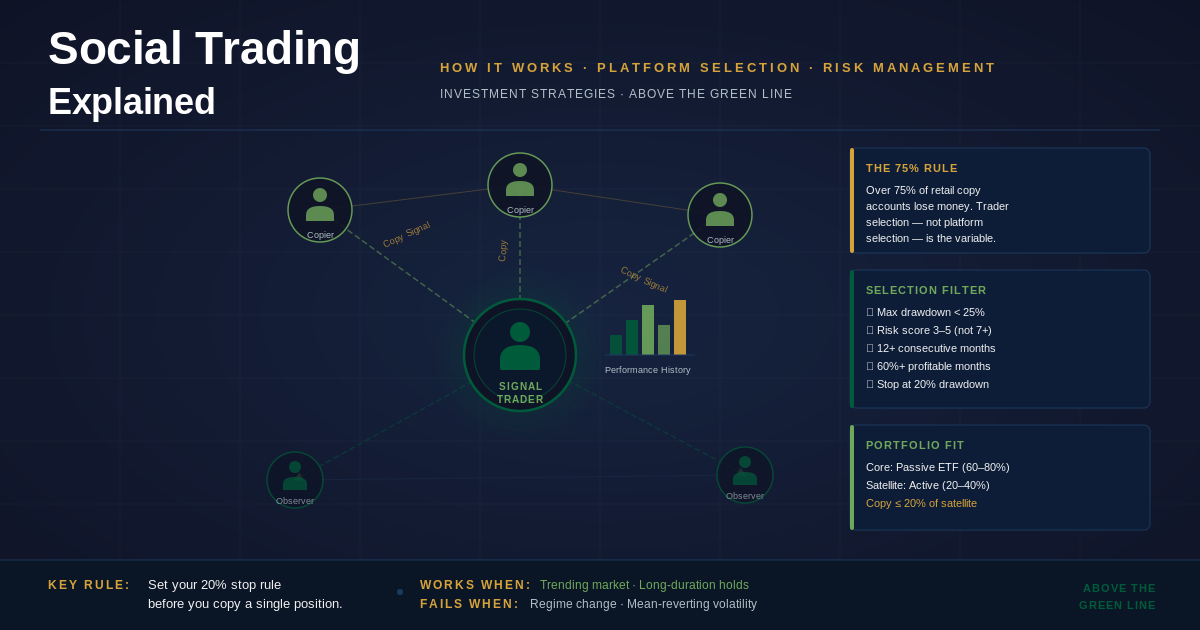
Here is what social trading platforms advertise: find a top-performing trader, click copy, and let the profits accrue automatically. Here is what the regulatory disclosures buried in the footer say: more than 75% of retail investors who copy trade on these platforms lose money.
Social trading itself is not the problem. The default way most people use it is. The difference between the 25% who benefit and the 75% who do not comes down to one variable — trader selection — and it is a discipline that can be applied systematically with verifiable criteria before a single trade is copied.
This article covers what social trading is, how the mechanics actually work, how to evaluate traders using rules-based criteria, and the specific market conditions under which the entire model breaks down. Before deploying any capital in an active strategy, ATGL’s investment strategy guide builds the framework that makes this approach executable.
What Is Social Trading?
| Quick Answer: What Is Social Trading?
Social trading is an online investment approach where traders share strategies and performance on a community platform, allowing others to observe, learn from, and — in many cases — automatically copy their trades in real time. |
The Definition
Social trading emerged in the early 2010s as platforms recognized that retail investors wanted more than a brokerage account — they wanted community. The concept bridges social networking and financial markets: experienced traders share their strategies, performance data, and trade commentary on a public feed, while newcomers use that information to inform independent decisions or replicate those trades directly.
The defining feature of a social trading platform is transparency of live trader performance data. Unlike a private fund, a social trader’s real-time positions, historical return curve, risk score, and maximum drawdown are visible to anyone considering copying them. That transparency is the platform’s core value proposition — and also its primary risk factor, because it turns recent return rankings into a selection mechanism that rewards luck as often as it rewards skill.
The Social Trading Spectrum
Social trading exists on a spectrum of user involvement. At one end is pure community engagement: reading trade ideas, following market commentary, and making independent decisions based on shared insight. At the other end is fully automated copy trading, where you choose a trader and the platform replicates every position they open in your account, scaled proportionally to the amount you allocate.
Understanding where you want to sit on that spectrum before opening an account is the first and most consequential decision you will make — because each level carries materially different risk and ongoing management requirements.
Social Trading vs. Copy Trading vs. Mirror Trading: What Is the Difference?
The Three-Way Distinction
Social trading, copy trading, and mirror trading are used interchangeably in platform marketing and incorrectly in most financial media. They describe three distinct levels of user involvement and automation, and conflating them leads investors to take on more or less active management responsibility than they anticipate.
| Feature | Social Trading | Copy Trading | Mirror Trading |
|---|---|---|---|
| Control Level | Full — you retain all entry and exit decisions | Partial — you choose the trader; automation handles execution | None — you select an algorithmic strategy model |
| Automation | Low — manual decisions at every step | High — positions mirror the signal trader automatically | Highest — fully algorithmic, no active input required |
| Ideal User | Active learner seeking community insight and strategy ideas | Beginner or time-constrained investor | Investor preferring full delegation to a rules-based model |
| Primary Risk | Own decision-making errors | Trader selection error and execution timing gap | Algorithm failure or strategy model collapse |
Why the Distinction Matters for Risk
The automation level determines where your risk management responsibilities begin and end. In pure social trading you remain the decision-maker — the platform gives you information but you control entries and exits. In copy trading you delegate execution but retain the ability to stop copying at any time. In mirror trading you cede nearly full control to an algorithmic strategy, which effectively outsources both the strategy logic and its risk management to a third party.
The practical consequence: copy trading and mirror trading require more rigorous upfront selection discipline precisely because your ongoing management role is diminished once a copy is initiated. For a broader perspective on systematic approaches that fall toward the fully automated end of this spectrum, see ATGL’s guide on algorithmic trading.
How Social Trading Works: The Mechanics
The Platform Layer
When you join a social trading platform, you gain access to a marketplace of traders who have opted into public performance tracking. Each trader profile displays their total return since a reference date, their maximum drawdown, a risk score calculated from leverage and position volatility, and the number of active copiers currently following them.
The discovery feed functions like a social network — you can follow traders without copying them, observe their commentary on positions, and study their decision-making over time before committing capital to replication. This observation phase is one of the most underused features on social trading platforms and one of the most valuable for developing judgment about trader consistency across different market regimes.
The Execution Gap — What Platforms Do Not Advertise
When a signal trader opens a position, a copy order is triggered in your account. The triggering and transmission take time. On liquid instruments — major currency pairs or large-cap stocks — this lag is milliseconds and inconsequential. On thinly traded assets or during fast-moving market conditions, the lag can mean your execution price differs materially from the signal trader’s entry.
On short-duration trades — positions held for hours rather than days — even a 0.1% price difference at entry and exit compounds into a meaningful performance gap over time. Timing lags can erode a measurable portion of a short-term trade’s potential return in active market conditions. This is a primary reason the traders most worth copying are medium- to long-term position holders, not intraday traders whose edge depends on precise timing that copy execution cannot reliably replicate.
Best Social Trading Platforms in 2026
| Data Verification Required
Platform fees, minimum copy amounts, and regulatory status change frequently. Verify all information directly with the platform before depositing capital. |
Platform Comparison
The social trading platform landscape is led by a small number of regulated providers with established infrastructure. Platform selection should begin with regulatory status — you are depositing capital with an intermediary, and that intermediary’s regulatory standing determines your recourse if something goes wrong.
| Platform | Regulated By | Asset Classes | Min. Copy | Key Feature |
|---|---|---|---|---|
| eToro | SEC, FCA, CySEC | Stocks, ETFs, Forex, Crypto | $200 | Largest copy trader pool; Nasdaq-listed (ETOR) |
| ZuluTrade | EU regulated | Forex, Crypto | $100 | Signal-based network; performance-ranked providers |
| tastyfx | FCA, ASIC | Forex, CFDs | Varies | Tight spreads; strong forex analytics tools |
Evaluating a Platform Before You Deposit
Beyond the table above, four questions should precede any deposit. First, is the platform regulated in your country of residence — not just registered in a favorable offshore jurisdiction? Second, can you view a trader’s full historical performance including drawdown curves and month-by-month returns, not just a curated highlight? Third, does the platform offer a paper copy or demo mode to observe execution without capital at risk? Fourth, are you trading underlying assets or CFD derivatives? The counterparty structure changes both your risk profile and the investor protections available to you.
How to Select a Trader to Copy: A Rules-Based Framework
The Four Metrics That Actually Predict Performance
Most retail copy traders select based on one variable: the highest total return on the leaderboard. This is the same error as choosing a mutual fund based solely on its best one-year return — it selects for recent luck, not repeatable skill. A rules-based selection framework uses four verifiable metrics that filter for characteristics most correlated with durable performance.
- Maximum Drawdown: Filter for traders whose historical maximum drawdown is below 25%. Any trader who has experienced a peak-to-trough loss exceeding 25% has demonstrated the capacity for serious portfolio damage regardless of their total return. A 40% drawdown requires a 67% recovery just to reach break-even.
- Risk Score: On eToro’s 1–10 risk scale, target traders scoring between 3 and 5. Scores of 7 or above indicate sustained high leverage use. Scores of 1–2 may indicate insufficient trading activity to assess strategy robustness across varied market conditions.
- Trader Tenure: Require a minimum of 12 consecutive active months before initiating a copy. A 3-month track record in a directional trending market proves only that someone was long when prices rose — not that they have a repeatable methodology that can survive a regime change.
- Consistency Rate: Calculate the percentage of months with a positive return. Target traders with 60% or more. High total return driven by two exceptional months and ten flat or negative ones is not a sustainable strategy — it is concentrated volatility that will eventually land on the wrong side of a month while you are still copying.
The Stop Rule for Copy Positions
Once you initiate a copy position, the most important rule is the exit rule. Define it in writing before you start: if the trader’s drawdown from the exact date you began copying them reaches 20%, stop copying immediately. Not when you feel ready. Not after one more month. Immediately.
The 20% stop rule prevents a copy position from becoming a catastrophic loss. It also removes the psychological friction that is the hardest part of any loss-management discipline — because the threshold is established in advance, not calibrated in the moment of stress. A copy position is a trade. Every trade needs an entry rule and an exit rule defined before the position is opened.
Risks of Social Trading: What the Platforms Do Not Highlight
Performance Chasing and the Regression Trap
The most destructive pattern in social trading is performance chasing. A trader posts 120% over six months. Their follower count jumps from 200 to 20,000. Copiers pile in — and at precisely that moment, the conditions that produced those returns begin to revert. This is not coincidence. Sustained high returns attract attention at peak. The 20,000 new copiers carry the execution lag of late entry, reduced leverage room because the position is already extended, and no understanding of the original trade logic.
When the reversal arrives, they exit last and at worst prices. Understanding how trading psychology shapes decision-making under loss conditions — particularly the tendency to hold losing positions far longer than winning ones — is essential preparation before placing any copy position on.
Specific Risk Inventory
- Performance chasing: top leaderboard positions reflect recent market conditions, not durable edge — the traders you find there are typically at peak exposure, not at the start of a sustained run
- Execution timing gap: slippage between signal and copy erodes return potential on every short-duration trade, most acutely on day trades and thinly traded instruments where prices move faster than copy execution can follow
- Counterparty risk: on CFD-based platforms you hold a derivative contract with the platform as counterparty — not the underlying asset — meaning platform financial stability is a relevant and often unexamined risk factor
- Hidden portfolio correlation: copying three traders who are each long the same sector ETFs or mega-cap technology names creates concentrated single-sector exposure disguised as diversification across traders
- Social proof bias: the psychological difficulty of stopping a copy when a trader with 10,000 followers enters a drawdown — the crowd’s continued presence falsely signals that patience is the right response
- Fraud and platform risk: some operators use artificial performance metrics to attract copiers before disappearing with deposited capital — ATGL’s guide on copy trading scams covers the specific red flags that distinguish legitimate platforms from fraudulent ones
Social Trading in a Core/Satellite Portfolio
The Core/Satellite Framework Applied
The core/satellite portfolio framework divides holdings into two components: a passive, low-cost ETF core (typically 60–80% of total assets) that captures broad market returns at minimal cost, and a rules-based active satellite (20–40%) where specific investment theses and active strategies are executed. Social trading copy positions belong in the satellite layer — never in the core.
The satellite exists to generate incremental return above the market rate. Copy positions can contribute to that goal, but only with strict sizing rules and pre-defined exit conditions. Without that structure, what appears to be active portfolio management is in practice undisciplined speculation concentrated in individual trader decisions that the investor cannot directly observe or control.
Position Sizing Rules for Copy Allocations
Apply two sizing constraints to all copy positions. First, no more than 5–10% of your total portfolio in any single copied trader. Second, no more than 20% of your total satellite allocation in copy positions combined. If your satellite is 30% of a $50,000 portfolio ($15,000), copy positions across all traders should not exceed $3,000 total. This constraint keeps the tail risk of a bad copy decision from reaching the core portfolio. For a structured approach to building rules-based active positions within a repeatable framework, see ATGL’s guide to trading systems.
When Social Trading Works — and When It Fails
The Conditions That Favor Copy Strategies
Social trading performs best when the market rewards directional conviction. The 2023 technology rally provides a clear example: traders with concentrated long exposure to semiconductor and AI-adjacent names delivered exceptional returns through the first three quarters of the year. Copy traders who selected those signal traders in January 2023 using consistency score criteria — not simply their 2022 raw return — benefited substantially.
Trending markets with relatively contained intraday volatility are the ideal copy strategy environment. Signal traders can establish positions cleanly, execution gaps are small, and the strategy logic remains relevant for weeks or months rather than hours. The longer the signal trader’s average holding period, the smaller the timing-gap effect on copy performance and the more accurately a copier’s return tracks the actual signal trader result.
The Failure Environment
Social trading fails in mean-reverting, high-volatility environments. The 2022 bear market is the definitive recent example: as the Federal Reserve’s aggressive rate-hiking cycle reversed a decade of momentum in growth stocks, nearly every popular copy trader on major platforms experienced drawdowns between 30% and 60%. Copiers who had followed those traders for their 2021 performance absorbed those losses with no understanding that the conditions generating prior gains had structurally reversed.
The fundamental failure condition: social trading concentrates portfolio risk in individual trader decisions at precisely the moment when diversification matters most. In a trending market, that concentration produces above-market returns. In a regime change, it produces correlated losses across every position the copied trader holds simultaneously — with no mechanism for diversification to buffer the impact.
Getting Started with Social Trading: A Step-by-Step Framework
The Three-Step Entry Sequence
The conventional approach is: sign up for a platform, browse the leaderboard, start copying the highest return. That sequence has produced the 75% loss rate described at the opening of this article. A better sequence reverses the order of operations — rules first, platform second, traders third.
- Define your satellite allocation before you open an account. Decide how much of your total portfolio belongs in active copy strategies. Set your maximum copy position size — no more than 5–10% per trader — and your personal stop rule (20% drawdown from your start date) in writing. These rules must exist before you deposit, not after your first copy position goes negative and the temptation to improvise a response arrives.
- Select and verify a regulated platform. Confirm the platform is regulated in your country of residence and that full historical performance data is available for all traders. Use any paper copy or demo mode for a minimum of 30 days to observe how execution actually behaves — specifically whether timing gaps are significant on the kinds of trades the traders you are evaluating make.
- Apply the four-metric framework before copying anyone. Filter for maximum drawdown below 25%, risk score of 3–5, a minimum of 12 active months, and a consistency rate above 60%. Begin with one copy position, observe it actively for 60 days, and expand only when you understand how the trader’s strategy behaves across different market conditions — not just when it is performing well.
Conclusion
Social trading is not a shortcut to passive income — it is a tool that rewards systematic trader selection and punishes performance chasing at every step of the decision process. The 25% of retail copy traders who consistently benefit are not distinguished by finding a better platform; they are distinguished by applying rules to trader selection with the same rigor that disciplined investors apply to any other position in their portfolio.
The framework:
- Social trading is a community-informed investment approach; copy trading automates the replication of individual trader positions; mirror trading delegates entirely to algorithmic strategy models — each level carries distinct risk management responsibilities
- Over 75% of retail accounts on major social trading platforms report net losses — trader selection methodology, not platform choice, is the primary variable separating profitable from unprofitable copy accounts
- Filter traders before copying using four verifiable metrics: maximum drawdown below 25%, risk score of 3–5, a minimum of 12 active months, and a monthly consistency rate above 60%
- Set a 20% stop rule from your copy start date before initiating any position — a hard exit trigger defined in advance, not a soft guideline adjusted under stress
- Size copy positions at no more than 5–10% of total portfolio per trader and no more than 20% of your satellite allocation in copy positions combined
- Social trading belongs in the active satellite layer of a core/satellite portfolio — the passive ETF core is never replaced by copy positions, and the satellite’s total active allocation must remain within its pre-defined limits
- The model works in trending, directional markets; it fails structurally in regime changes and high-volatility mean-reverting environments — entering with clear eyes about the current market character is not optional
| Your Investment Strategy Hub
At AboveTheGreenLine.com we give systematic investors the complete rules-based framework for every investment decision — including how to evaluate copy positions, size satellite allocations, and apply institutional-grade stop rules to your portfolio. Join us Above the Green Line. |
Frequently Asked Questions
What is social trading?
Social trading is an online investment approach where traders share their strategies, trade ideas, and real-time performance on a community platform, allowing other participants to observe, learn from, and — in many cases — automatically copy their trades. It combines financial market access with social networking dynamics, giving less experienced investors direct visibility into how active traders operate across stocks, forex, crypto, and other asset classes.
Is social trading profitable?
Social trading can be profitable, but the statistical evidence is adverse for most participants: over 75% of retail accounts on major social trading platforms report net losses. The primary cause is trader selection methodology — most copiers select traders based on recent return rankings rather than risk-adjusted consistency metrics. Applying a rules-based selection framework that filters for maximum drawdown, risk score, tenure, and monthly consistency rate materially improves the probability of a positive outcome compared to leaderboard browsing.
What is the difference between social trading and copy trading?
Social trading is the broader community framework — a platform where traders share ideas, signals, and strategies and other participants observe and engage. Copy trading is a specific automated feature within social trading: your account automatically replicates another trader’s positions in real time, scaled to the amount you allocate. All copy trading occurs within social trading platforms; not all social trading involves automatic copying. Mirror trading is a further subset in which your account replicates pre-built algorithmic strategy models rather than individual human trader decisions.
Is eToro social trading safe?
eToro is regulated by the SEC, the Financial Conduct Authority (FCA), and CySEC, and became a publicly traded company on Nasdaq under the ticker ETOR following its May 2025 IPO, adding an additional layer of regulatory transparency. The platform infrastructure is structurally sound by those measures. However, eToro’s own regulatory disclosures state that the majority of its retail CFD accounts lose money. Platform safety and strategy safety are two entirely separate dimensions, and both must be evaluated independently before depositing capital.

Related Articles
Investing in Bonds: The Complete How-To Guide Covering Every Bond Type, Purchase Method, and Portfolio Role

Risk-Adjusted Returns: Why Smarter Investors Focus on More Than Performance

Retirement Investment Strategies: The Phase-by-Phase Framework That Changes How You Approach Every Stage

Best Indicators for Day Trading: The 7 That Elite Traders Actually Use (And Why Most Lists Get It Wrong)