By Andrew Stowers
Updated June 15, 2026
Most investors understand that bonds exist and broadly what they do. Far fewer know how to actually buy a government bond, which corporate bond ETF to use and when, why municipal bonds are relevant for some investors and irrelevant for others, or how to size the bond allocation at different stages of the investment journey.
This guide provides exactly that: a practical how-to covering every bond type with its specific purchase mechanism, the right ETF vehicle for each category, the four metrics to evaluate before buying any bond, and the portfolio framework that determines how much bond exposure belongs at each stage of your investing life. After finishing this article, we highly encourage you to review our Investment Strategy Guide for a more in-depth guide revolving around investment strategies.
Why Invest in Bonds? The Three Portfolio Roles
| The Critical Caveat
High yield corporate bonds do NOT reliably serve the stability role. They are highly correlated with equities during market stress — widening credit spreads cause high yield prices to fall alongside equities. Only investment grade bonds (and specifically Treasuries) provide reliable portfolio cushioning during equity downturns. |
Bonds serve three distinct portfolio roles, and understanding which one applies determines what to buy:
Role 1: Income Generation
Bonds pay regular coupon income — the contractual interest rate on the face value, typically semi-annually. Investment grade corporate bonds yield approximately 1-3% above equivalent Treasuries; high yield bonds 3-6%+ above Treasuries. The income role requires accepting the appropriate credit risk for the desired yield. Higher income = higher risk, not additional returns from the same risk level.
Role 2: Portfolio Stability
Investment grade bonds — particularly U.S. Treasuries — have historically shown negative or low correlation with equities during market stress. When equity markets decline significantly, flight-to-safety buying drives Treasury prices higher. This is the mechanism behind the classic 60/40 portfolio: when equities fall, bonds rise, cushioning the overall decline. This stability role is specific to investment grade bonds.
Role 3: Capital Preservation
Short-duration, high-quality bonds — T-bills, short-term Treasury ETFs (SHY, BIL), short-term investment grade corporate ETFs (IGSB) — preserve nominal capital with minimal interest rate risk. These are appropriate for money that must not decline: emergency funds in excess of immediate cash needs, near-term capital reserved for a specific purpose, or the ‘safe bucket’ in a retirement income strategy.
The right bond type depends entirely on which role you need filled. An investor confusing the income role (high yield) with the stability role (Treasuries) will be unpleasantly surprised when both their bonds and their stocks fall simultaneously.
The Bond Universe: Every Type and Who It Suits
U.S. Treasury Bonds, Notes, and Bills
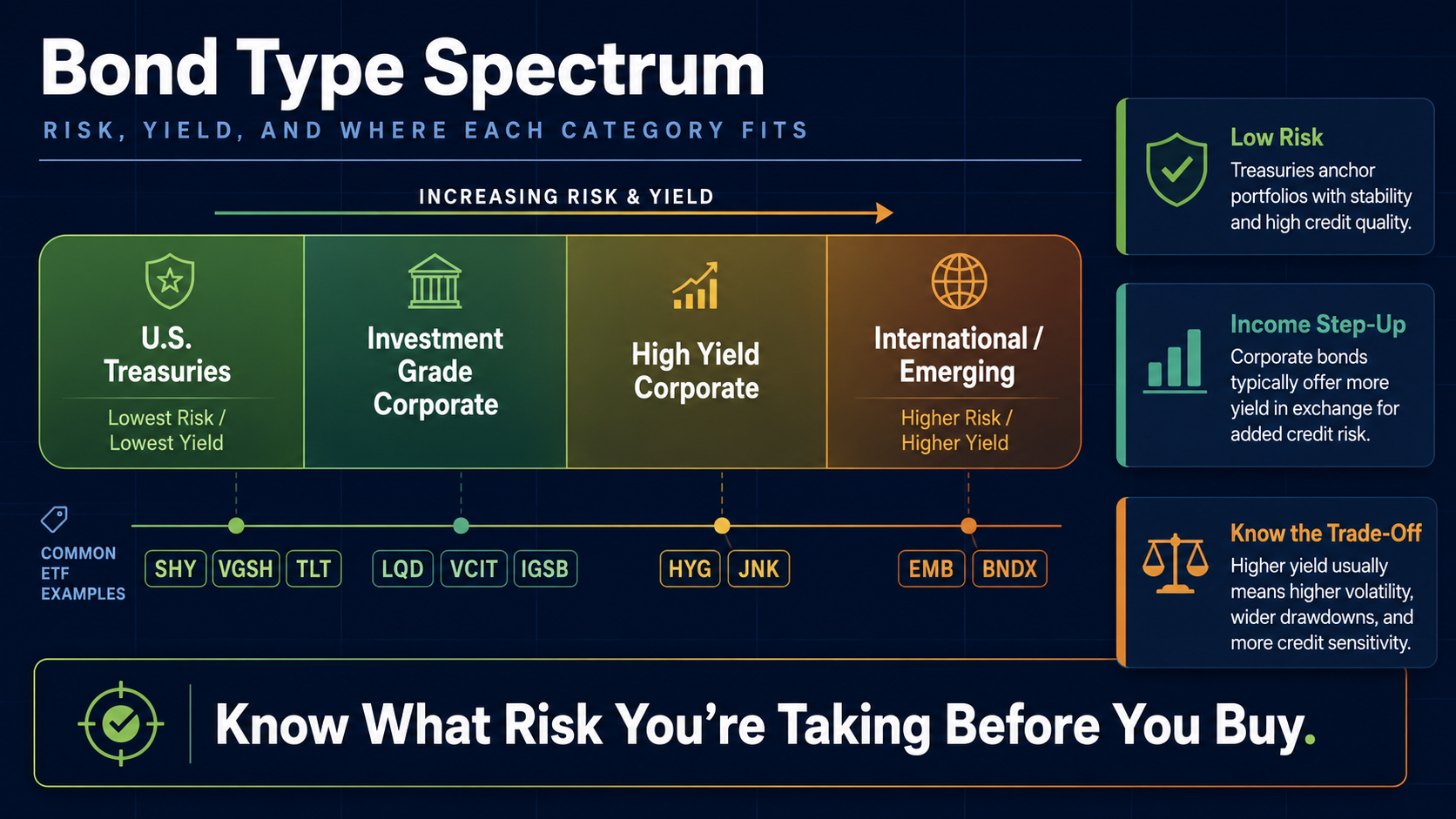
Issued by the U.S. federal government; backed by full faith and credit; zero credit default risk. T-bills (under 1 year), T-notes (2-10 years), and T-bonds (20-30 years) form the risk-free rate benchmark against which all other bonds are priced. Full interest rate risk — prices fall as rates rise — but no credit risk. Suited to: capital preservation, portfolio stability, the risk-free income layer in any portfolio.
Investment Grade Corporate Bonds
Issued by corporations rated BBB-/Baa3 (Moody’s) or above. Yield approximately 1-2% above equivalent Treasuries — the credit spread is the market’s compensation for taking on corporate default risk. Historical average annual default rate: approximately 0.1%. Suited to: income generation with low default risk, the income-and-stability layer in a diversified bond portfolio.
High Yield Corporate Bonds
Rated below investment grade — Ba1/BB+ and below. Yield 3-6%+ above Treasuries in normal markets, widening to 8-15%+ in credit stress. Historical default rates: 3-5% annually in normal environments, spiking above 10% in recessions. Behaves like equity during market stress — high correlation to equities. Suited to: income-focused investors who understand and accept the elevated credit risk and are not using these for portfolio stability.
Municipal Bonds
Issued by state and local governments. Interest income is federal tax-exempt — the primary defining advantage. For investors in the 32%+ federal tax bracket, the after-tax yield of a municipal bond often exceeds a higher-stated-yield taxable corporate bond. The tax-equivalent yield calculation: muni yield ÷ (1 − federal tax rate) = taxable equivalent. A 4% muni yield at 37% bracket equals approximately 6.35% taxable equivalent.
TIPS (Treasury Inflation-Protected Securities)
Treasury bonds with principal adjusted semi-annually for CPI inflation. The real yield is lower than nominal Treasury yields — you pay for inflation protection. Suited to: long-term investors specifically concerned about purchasing power erosion. Major ETFs: TIP (iShares TIPS Bond, ~0.19% ER), SCHP (Schwab U.S. TIPS, ~0.04% ER).
International Bonds
Issued by foreign governments and corporations. Add currency risk on top of credit and rate risk. Provide geographic diversification and access to yield from different rate environments. Accessible through BNDX (Vanguard Total International Bond, ~0.07% ER) and EMB (iShares JP Morgan USD Emerging Markets Bond, ~0.39% ER). Currency-hedged versions are available but carry their own costs.
How to Buy Bonds: The Three Access Methods
Method 1: TreasuryDirect.gov (U.S. Government Bonds Only)
TreasuryDirect.gov is the U.S. government’s direct purchase portal for Treasury bonds, notes, bills, TIPS, and I-Bonds. There are no fees or broker markups — you buy at the competitive market rate. Minimum purchase: $100. New Treasury auction dates are published in advance and accessible through TreasuryDirect. Limitation: selling before maturity requires transferring to a brokerage account, which can take time. Best for: investors who plan to hold to maturity and want zero-fee government bond access.
Most major brokerages also allow participation in Treasury auctions at no additional fee — combining TreasuryDirect’s market-rate pricing with the convenience of managing everything in one account.
Method 2: Brokerage OTC Market (Individual Corporate and Municipal Bonds)
Corporate and municipal bonds trade in the over-the-counter dealer market — not on exchanges. Accessible through most full-service and online brokerages. Face value is typically $1,000 per bond, but practical minimum for reasonable bid-ask spreads is $5,000-$10,000 per bond. The broker’s compensation is embedded in the spread between bid and ask price — not a stated commission.
Secondary market liquidity varies significantly by issuer and bond size. Well-known investment grade corporate bonds from large issuers (Apple, JPMorgan) are relatively liquid; small municipal bond issues can be illiquid. For most retail investors, the OTC market for individual bonds is an expensive and friction-heavy experience compared to bond ETFs.
Method 3: Bond ETFs (All Categories, All Budgets)
Bond ETFs are the most practical access method for most retail investors. They provide: instant diversification across hundreds or thousands of bonds, full exchange liquidity, no minimum beyond the cost of one share ($80-$130 for most), and expense ratios of 0.03-0.50% depending on category.
What to Evaluate Before Investing in Any Bond
Four metrics define any bond investment — ignoring any one of them creates blind spots that can be expensive.
1. Yield to Maturity (YTM)
YTM is the annualized return you receive if you buy the bond at its current market price and hold to maturity — accounting for all coupon payments and any premium or discount to face value. It is the most accurate single measure of a bond’s expected return. When market interest rates rise, bond prices fall and YTM rises; when rates fall, prices rise and YTM falls. The coupon rate (stated at issuance) is different from YTM if you buy the bond in the secondary market at a price other than face value.
2. Duration
Duration measures the bond’s price sensitivity to interest rate changes. A bond with 7-year duration will lose approximately 7% of its market value for every 1% rise in interest rates. Longer maturity and lower coupon = higher duration = more price risk. Short-duration bonds (1-3 years) are appropriate in rising rate environments; long-duration bonds (10-20+ years) are appropriate when rates are declining or stable at high levels. Duration management is the most important active decision in bond portfolio construction.
3. Credit Quality
Credit quality divides the bond universe into investment grade (BBB-/Baa3 and above) and high yield (below investment grade). Investment grade = low default risk, lower yield. High yield = higher default risk, higher yield. The credit spread — the yield above equivalent Treasuries — is the market’s real-time assessment of default risk. Widening spreads signal rising perceived credit risk; narrowing spreads signal improving credit conditions.
4. Tax Treatment
Corporate bond income is taxed as ordinary income at federal and state levels. Municipal bond income is federally tax-exempt. This difference is significant: compare after-tax yields before choosing between corporate and municipal bonds for taxable accounts. In tax-advantaged accounts (IRA, 401k), the tax treatment difference is irrelevant and corporate bonds’ higher pre-tax yield wins.
Bond ETFs: The Most Practical Route for Most Investors
| Data Note
All ETF expense ratios are approximate and require verification at fund provider websites. Durations change over time. |
The bond ETF universe covers every category and duration. The right selection depends on which portfolio role you need filled and the current interest rate environment.
| Ticker | Category | Index / Focus | Approx. ER | Key Use Case |
|---|---|---|---|---|
| AGG | Total Bond Market | Bloomberg U.S. Aggregate | ~0.03% | Core diversified bond holding |
| BND | Total Bond Market | Bloomberg U.S. Aggregate | ~0.03% | Vanguard total bond alternative |
| TLT | Long-Term Treasury | ICE 20+ Year Treasury | ~0.15% | Rate decline / deflation hedge |
| SHY | Short-Term Treasury | ICE 1-3 Year Treasury | ~0.15% | Capital preservation, rate protection |
| LQD | IG Corporate | Bloomberg IG Corp Bond | ~0.14% | Income above Treasuries, low credit risk |
| VCIT | IG Corporate | Bloomberg IG Corp Interm | ~0.04% | Low-cost intermediate IG corporate |
| HYG | High Yield | Bloomberg High Yield | ~0.48% | Income premium, higher credit risk |
| MUB | Municipal | S&P National AMT-Free Muni | ~0.07% | Federal tax-exempt income |
| TIP | TIPS | Bloomberg TIPS | ~0.19% | Inflation protection |
| BNDX | International | Bloomberg Intl Aggregate (hedged) | ~0.07% | Geographic diversification |
The ETF vs Direct Bond Trade-Off
Bond ETFs do not mature — they continuously roll their holdings to maintain a target duration. This means ETF investors take full interest rate risk through NAV price changes. A direct bond held to maturity returns par value regardless of what rates do in the interim — the rate risk only matters if you sell before maturity. For investors with a defined time horizon and $50,000+ to allocate to bonds, direct bonds provide par value certainty that ETFs cannot. For everyone else, ETFs are the practical default.
Duration Management in Practice
In rising rate environments: shorten duration by shifting from AGG or LQD toward SHY, IGSB (short-term IG corporate), or BIL (T-bills). Reduces NAV volatility significantly.
In falling rate environments: extend duration by adding TLT or long-duration corporate bonds. NAV appreciation from falling rates amplifies total return beyond coupon income.
How Much of Your Portfolio Should Be in Bonds?
The appropriate bond allocation is highly context-dependent — the most honest answer to this question is: it depends on your phase.
Accumulation Phase (20+ Years to Retirement)
Minimal bond allocation is typically appropriate. With decades of time, the superior long-run returns of equities compound significantly. Bonds in accumulation serve as emotional insurance — reducing volatility enough to prevent panic-selling during drawdowns — rather than mathematical necessity. A typical range: 10-20% investment grade bonds, preferably short to intermediate duration to limit NAV volatility.
Transition Phase (5-15 Years Before Retirement)
Bond allocation grows meaningfully. Building toward 30-50% investment grade bonds reduces the portfolio’s exposure to a bad sequence of returns entering retirement. Shift toward intermediate to long duration as interest rates allow — this builds the income layer needed for distribution phase without excessive rate risk.
Distribution Phase (Retirement)
Bonds serve two critical functions: income generation (reducing required asset sales) and capital preservation (the 2-3 year cash/short-duration buffer for near-term withdrawals). A typical range: 40-60% in a combination of short-duration (preservation) and intermediate/long-duration (income) investment grade bonds.
The 60/40 Framework
The 60% equity / 40% bond portfolio has produced strong risk-adjusted returns historically. The bond component’s negative correlation with equities cushions portfolio declines. In lower-rate environments the income contribution from bonds is reduced, but the diversification benefit persists — particularly for investment grade bonds.
When Bond Investing Works Well — and When It Doesn’t
Favorable Environments
Bonds outperform expectations in falling rate environments (NAV price appreciation amplifies income), deflationary/recessionary periods (flight to Treasury safety drives prices higher), and high-rate environments where income generation justifies holding despite price risk.
The 2022 Warning
The 2022 rate-hiking cycle is the most important recent lesson in bond risk. The Federal Reserve raised rates from approximately 0% to 5%+ in under 12 months. The Bloomberg U.S. Aggregate Bond Index (AGG) declined approximately 13% — the worst calendar-year performance in decades. Long-duration Treasury ETFs (TLT) declined approximately 30%. Investors in ‘safe’ investment grade bonds experienced losses that approached equity bear market severity.
The 2022 lesson: bond risk is real, it is primarily rate risk, and duration is the lever. Investors in short-duration bond ETFs (SHY, BIL) experienced minimal losses. Long-duration investors were significantly harmed. The key variable was duration, not credit quality.
The Correlation Caveat
The traditional 60/40 portfolio relies on bonds and equities moving in opposite directions during stress. In 2022, both declined because the shared driver — rising rates — was negative for both. This correlation can shift in inflationary environments. The historical negative correlation between Treasuries and equities holds in deflationary recessions; it may not hold when the primary market risk is inflation.
Build Your Bond Allocation With a Complete Framework
Investing in bonds rewards investors who understand the full picture: which type serves which portfolio role, how to buy each type efficiently, what metrics to evaluate before buying, and how the allocation should evolve across the investment journey.
The framework in brief:
- Three roles — income, stability, capital preservation — and the right bond type for each (not interchangeable)
- High yield bonds are income vehicles, not stability vehicles — do not confuse the two
- gov for direct government bonds at zero fees; bond ETFs for everything else
- Evaluate YTM (true return), duration (rate sensitivity), credit quality, and tax treatment before every bond purchase
- The ETF table: AGG/BND for total market, TLT for long-duration, SHY for short-duration, LQD/VCIT for IG corporate, HYG for high yield, MUB for tax-exempt
- Duration management is the most important bond portfolio decision — the 2022 decline showed what happens when duration is not managed in a rising rate cycle
- Phase-appropriate allocation: accumulation 10-20%, transition 30-50%, distribution 40-60%
| Build Your Complete Portfolio Framework With ATGL
At AboveTheGreenLine.com we give investors the complete system for every asset class — from fixed income allocation and ETF selection to the active equity strategies that generate additional return potential. If you want the full framework, join us Above the Green Line. |
Frequently Asked Questions
Is investing in bonds a good idea?
Bonds are appropriate for specific portfolio goals — income generation, reducing overall volatility, and cushioning against equity market declines. They are not an appropriate vehicle for maximising growth over long periods: equities outperform bonds over most 20+ year horizons. Bonds make the most sense in the transition and distribution investment phases, in 60/40 portfolio construction as the stability component, and for income-focused investors who need predictable cash flows.
How much money do I need to invest in bonds?
The minimum depends on the method. U.S. Treasury bonds can be purchased for as little as $100 through TreasuryDirect.gov. Individual corporate and municipal bonds have a $1,000 face value per bond, but practical secondary market buying requires $5,000-$10,000. Bond ETFs (AGG, BND, LQD, etc.) have no meaningful minimum beyond the cost of one share — typically $80-$130. For most retail investors, bond ETFs are the most accessible starting point.
What bonds are the safest to invest in?
U.S. Treasury bonds are the safest available — backed by the U.S. government with no credit default risk. Among other types, investment grade corporate bonds from financially strong issuers (BBB-/Baa3 and above) carry low but non-zero default risk. ‘Safe’ always involves a trade-off: safer bonds offer lower yields; all bonds carry interest rate risk. Even Treasuries lose market value when rates rise — safety from credit risk does not mean safety from rate risk.
What is the best way to invest in bonds?
For most retail investors, low-cost bond ETFs provide the best combination of diversification, liquidity, and accessibility. Total bond market ETFs (AGG, BND) for broad exposure; duration-specific ETFs (TLT for long-term, SHY for short-term) for targeted rate exposure; category-specific ETFs (LQD for investment grade corporate, MUB for municipal) for targeted credit or tax exposure. Direct bond purchases are appropriate for investors with $50,000+ specifically allocated to bonds who want certainty of par value return at a defined maturity.

Related Articles
[pt_view id=”9b64b383ox”]