By Andrew Stowers
Updated April 28, 2026
Day trading has two reputations: it’s either a guaranteed path to financial freedom or a guaranteed way to lose your savings. Both are wrong.
The reality is more useful. Day trading is a learnable skill with real edge for those who approach it systematically — and a money-destroying trap for those who approach it emotionally. The difference is not talent or luck. It is whether you have a rules-based framework before you risk your first dollar.
This guide, in addition to our Investment Strategy Guide, gives you everything you need to make an informed decision: what day trading actually is, the regulatory rules that govern it, a 5-step framework for starting correctly, the strategies that work for beginners, the risk management rules that keep you in the game, and the honest picture of what profitability actually requires.
What Is Day Trading? (And How It Differs From Every Other Approach)
| Quick Answer
Day trading means buying and selling financial instruments — stocks, ETFs, options, futures — within the same trading session, closing all positions before the market closes. Unlike swing trading (holding for days to weeks) or investing (holding for months to years), day trading profits entirely from intraday price movements and requires active management throughout the session. |
Day traders seek to profit from short-term price movements — movements that occur within minutes to hours, not the days, weeks, or decades that swing traders and investors rely on. The edge in day trading comes from reading price action, volume, and market microstructure accurately and repeatedly throughout the session.
What day traders primarily trade: stocks and ETFs are the most common vehicles for beginners, offering high liquidity, tight spreads, and broad news coverage. More experienced day traders also use options (for leverage and defined risk), futures (for index and commodity exposure), and forex (for 24-hour access). For beginners, stocks and liquid ETFs are the right starting point.
Day Trading vs Swing Trading vs Investing
The time horizon is the defining distinction: day traders hold for minutes to hours and close everything by end of session; swing traders hold for 2–10 days, riding multi-day momentum; investors hold for months to years, building wealth through fundamental value and compounding. Each requires a different skill set, different tools, and a different psychological profile.
Day trading relies almost exclusively on technical analysis — chart patterns, volume, momentum indicators, and price action. The underlying business quality of a company is irrelevant to a trade that opens and closes within the same session. Swing trading blends technical and fundamental analysis. Investing is primarily fundamental.
The PDT Rule: What Every Beginner Must Know Before Opening an Account
| The PDT Rule
The Pattern Day Trader (PDT) rule requires a minimum account balance of $25,000 to execute 4 or more round-trip day trades within any 5 consecutive business days in a U.S. margin account. Traders who trigger the PDT designation with less than $25,000 face a 90-day restriction on day trading activity in that account. |
This is the most important regulatory fact for any U.S.-based beginner — and the one most often buried or skipped in beginner guides. The PDT rule is enforced by FINRA and applies to all U.S.-regulated margin accounts. Understanding it before you start will save you from a costly compliance violation.
Who the PDT Rule Applies To
The PDT rule applies to U.S. margin accounts. A round-trip day trade means opening and closing the same position on the same day. Four or more of these in a rolling 5-business-day window triggers PDT status. Once triggered, your broker requires you to maintain $25,000 in account equity at all times. Fall below that threshold and you lose day trading privileges for 90 days.
Cash accounts are not subject to the PDT rule — but trades in cash accounts settle T+2 (two business days), limiting how quickly you can redeploy capital within the same week.
Your Options If You Don’t Have $25,000
Being undercapitalized is not a reason to avoid active trading — it is a reason to structure your approach differently. Four legitimate approaches:
- Cash account trading: no PDT rule, but capital is temporarily tied up during the 2-day settlement period after each trade. You can still day trade, just with a smaller effective capital pool.
- 3-trade discipline: stay under 4 round trips per week in your margin account while building toward $25,000. Execute your best setups selectively rather than actively trading every day.
- Offshore brokers: some international brokers are not subject to the PDT rule (Interactive Brokers Canada, some Caribbean-based brokers). These carry their own regulatory and counterparty considerations — research thoroughly.
- Swing trade instead: consider whether swing trading — which has no PDT restrictions and allows multi-day holds — is the better vehicle while you build capital toward the $25,000 threshold.
One final note: day trading income has specific tax implications — particularly the wash-sale rule and the possibility of trader tax status. Review the ATGL day trading taxes guide before your first live trade.
How to Start Day Trading: Your 5-Step Framework
| 5 Steps to Start Day Trading
1. Understand the PDT rule and confirm your account meets requirements 2. Choose a broker and direct-access trading platform 3. Learn 1–2 core strategies deeply before diversifying 4. Paper trade for a minimum of 30 consecutive trading days 5. Go live with strict position sizing and stop-loss rules from trade one |
The order of these steps matters. Most beginners skip to step 5 and wonder why they lose money. The framework exists because each step builds the foundation the next one requires.
- Choose your broker and account type: The major U.S. day trading brokers — Interactive Brokers, TD Ameritrade (now Schwab), Webull, and TradeStation — all offer direct access routing, competitive commissions, and Level 2 quotes. Evaluate based on commission structure (per-share vs per-trade), platform quality, and PDT policy. Avoid retail apps designed for long-term investing — their routing and execution speed are inadequate for active day trading.
- Set up your platform and tools: Direct access routing (DAS Trader, Lightspeed, or broker-native platforms) allows you to route orders directly to specific exchanges and ECNs for faster fills. Level 2 quotes show the depth of the order book — the bids and asks queued from multiple market makers. Both are standard tools for professional day traders and should be part of your setup from day one.
- Choose 1–2 strategies to master: Depth before breadth. Select one primary strategy (momentum trading is the most beginner-accessible) and one secondary strategy (breakout trading pairs well with momentum). Learn the exact entry criteria, stop placement, and profit target rules for both before you consider any others. Having rules for 2 strategies you know well is worth infinitely more than having a vague awareness of 10.
- Paper trade for 30+ days — seriously: Paper trading is not optional, and it is not a formality. Treat every paper trade with the same rules, discipline, and position sizing you intend to use with real money. Log every trade: setup type, entry price, stop, target, outcome, and what you observed. Review your journal weekly. The goal of paper trading is not to prove you can be profitable in a risk-free environment — it is to find and eliminate every procedural flaw before it costs real money.
- Go live at half size: When you consistently execute your strategy correctly — not just profitably, but correctly — in paper trading for 30+ days, go live at 50% of your intended position size. This reduces the emotional amplification of real money while you calibrate to live market conditions. Scale to full size only after 60 additional days of documented consistent execution.
Four Day Trading Strategies Every Beginner Should Know
Start with one strategy. Master its entry rules, stop placement, and exit criteria before learning a second. The traders who build real skill are those who go deep on the basics — not wide across every setup they find online.
1. Momentum Trading
Momentum trading is the most beginner-appropriate day trading strategy. You identify a stock moving strongly in one direction — up or down — on significantly above-average volume, wait for a brief consolidation or pullback that does not break the primary structure, and enter in the direction of the dominant move.
What makes momentum work: large institutional orders create persistent directional flow that sustains price movement for meaningful intraday distances. Volume is the confirmation signal — a price move without volume is a false move.
Entry criteria: price moving with conviction on 2x+ relative volume, brief consolidation holding above a key level (for longs) or below (for shorts), entry on the resumption candle with stop below the consolidation low.
2. Breakout Trading
Breakout trading involves entering when price moves above a defined resistance level — a prior high, a consolidation range ceiling, or a key technical level — with volume confirmation. The setup is clean, the entry criteria are objective, and the stop placement (below the breakout level) is logical.
Entry criteria: price consolidating below a clearly defined resistance for 2+ hours (or days, for gap-up setups), breakout candle closes above resistance with above-average volume, entry on close of breakout candle or first retest of breakout level with stop below prior resistance.
3. Reversal Trading
Reversal trading means entering against the prior trend when you identify exhaustion at a key support or resistance level. A morning sell-off that reaches a major support zone with a reversal candlestick on declining volume is a classic reversal setup. Harder to execute than momentum or breakout because you are trading against prevailing momentum — requires strong pattern recognition and volume analysis skills.
Recommendation: avoid reversal trading until you have 3+ months of profitable momentum and breakout trading documented. The skill ceiling is meaningfully higher.
4. Scalping
Scalping involves many small, fast trades throughout the day — each capturing a tight price movement of cents to a dollar or two, repeated many times. The appeal is frequent opportunities and small risk per trade. The requirement is fast execution (hot keys, direct access routing), emotional control under rapid-fire conditions, and a very tight spread to remain profitable after commissions.
Recommendation: scalping is not a beginner strategy despite its perception as ‘low risk per trade.’ The psychological speed and execution precision required make it the hardest of the four for new traders. Start with momentum.
Risk Management: The Three Rules That Keep You in the Game
Most beginner day traders do not fail because they chose the wrong strategy. They fail because they had no risk management rules — or had them and broke them. The three rules below are not optional. They are the architecture that allows you to stay in the game long enough to develop real skill.
Rule 1: The 1–2% Position Sizing Rule
Never risk more than 1–2% of your total trading capital on any single trade. On a $25,000 account, that is $250–$500 maximum risk per trade. On a $10,000 cash account, it is $100–$200.
Position size is calculated from your risk amount and your stop distance — not from how much you ‘want to make.’ If your risk per trade is $250 and your stop is $0.50 below entry, your maximum position size is 500 shares. If your stop is $1.00 below entry, your maximum is 250 shares. The stop determines the size — not excitement, not conviction, not how good the setup looks.
This rule single-handedly prevents the scenario that destroys most new traders: a string of normal losses that compounds into a catastrophic drawdown because each individual position was too large.
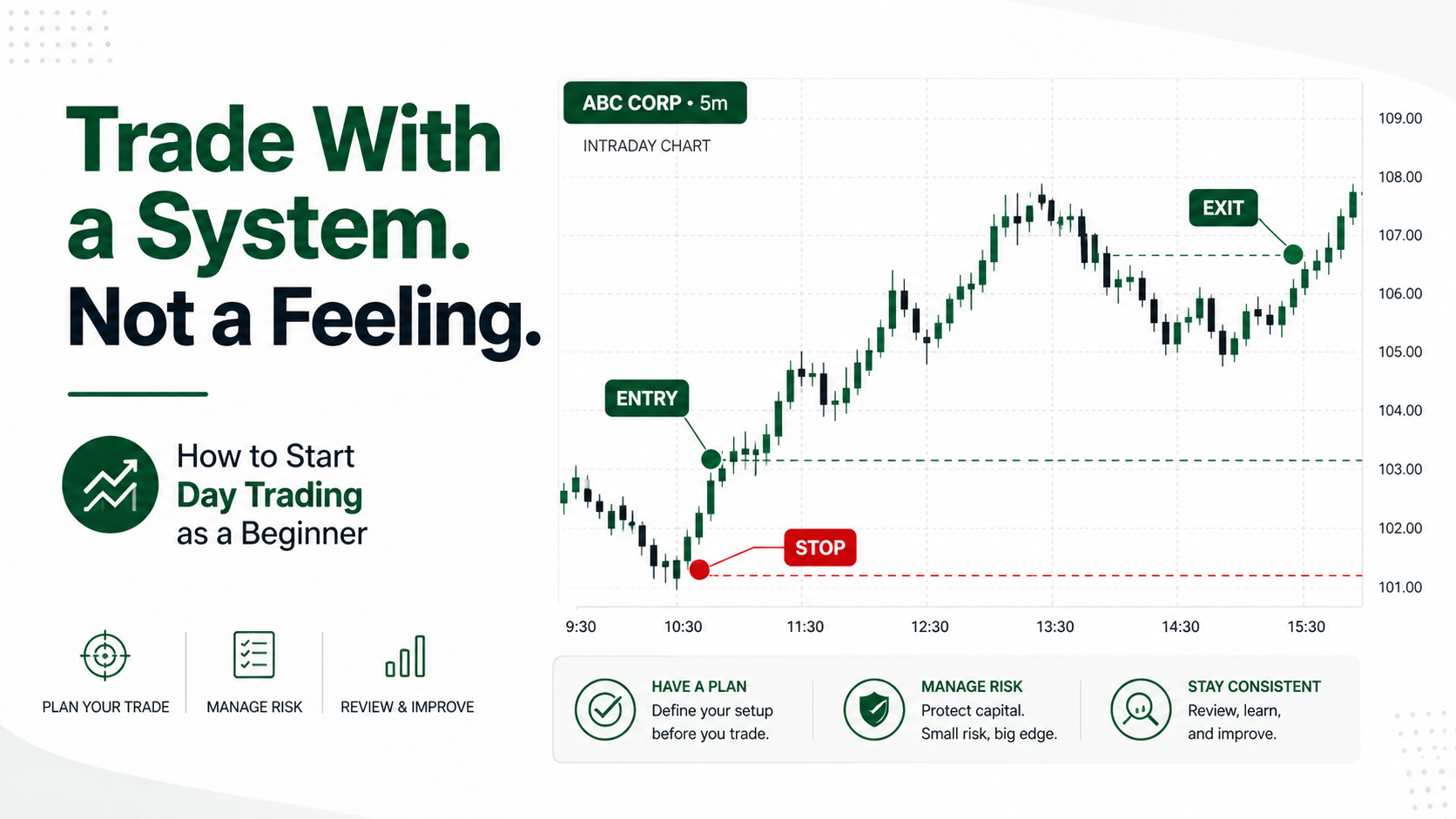
Rule 2: Pre-Defined Stop-Losses (Set Before Entry, Never After)
A stop-loss is the price at which your trade is wrong — not the price at which you’ve lost enough to feel uncomfortable. Set it before you enter the trade, based on the technical structure of the setup. Once it is set, do not move it further from your entry to give the trade ‘more room.’
Moving a stop after entry is the single most common and most destructive habit in day trading. It converts a position with defined risk into a position with undefined risk. A bad trade plus a moved stop is how trading accounts die.
Pre-defined stops also solve the psychological problem of watching a losing position: once the stop is set, your only job is to execute it when hit. The decision has already been made — you are simply following a plan.
Rule 3: Minimum 2:1 Risk/Reward Ratio
Before entering any trade, identify both your stop (the risk) and your price target (the reward). The ratio between them must be at least 2:1 — for every $1 you risk, the trade must have a clear path to $2 in profit.
The mathematics of this rule are what most beginners miss: with a 2:1 R/R ratio, you can lose 60% of your trades and still be profitable.
The math: 10 trades at 2:1 R/R | 4 winners × $200 = $800 | 6 losers × $100 = $600 | Net: +$200 — positive result with a 40% win rate.
This is why risk/reward ratio matters more than win rate. Most beginners obsess over being right. Professionals obsess over the ratio between what they make when right and what they lose when wrong.
| Daily Loss Limit
Add a fourth rule: set a maximum daily loss (e.g. 3% of account). When you hit it, stop trading for the day — no exceptions. Bad days compound into bad weeks when traders attempt to ‘make it back.’ The daily loss limit is the emergency brake that keeps a difficult day from becoming a catastrophic week. |
The Tools Every Day Trader Needs
Tools amplify strategy quality — they do not substitute for it. A great scanner with a bad strategy produces a bad outcome faster. But the right tools in the hands of a trader with a tested system are a genuine edge.
1. Direct Access Broker and Platform
Retail investing apps are not day trading platforms. Speed of execution matters in day trading — a 0.5-second execution delay costs real money on tight setups. Direct access routing platforms (DAS Trader, Lightspeed, IBKR Pro, TradeStation) route orders directly to exchanges and ECNs, bypassing the slower internal routing of retail apps. Hot keys — keyboard shortcuts for instant order submission — are standard practice on active trading platforms and should be configured before you place your first live trade.
2. Stock Scanner
A scanner filters the entire market in real time for stocks meeting your specific setup criteria: above-average relative volume, gap-up or gap-down from the prior close, price above a moving average, or any combination of technical filters. Without a scanner, you are manually searching for setups in a universe of thousands of securities. With one, you are reviewing a curated short list.
Free options include Finviz for end-of-day scanning. Intraday scanners with real-time feeds — Trade Ideas, Benzinga Pro, StocksToTrade — provide live alerts as setups develop throughout the session.
3. Level 2 Quotes
Level 2 shows the depth of the order book — the bids and asks queued from multiple market makers and ECNs at each price level. Reading Level 2 gives insight into near-term price direction: a large bid absorbing selling pressure signals support; a wall of asks at resistance signals difficulty breaking through. Available through most active trading platforms as a standard feature.
4. Trade Journal
The trade journal is the most underused and most valuable tool in day trading. Log every trade: date, ticker, setup type, entry price, stop, target, actual exit, P&L, and a one-sentence note on what you observed. Review it weekly. Over time, your journal reveals which setups you execute well, which you do not, and what psychological patterns show up in your decision-making.
Skill compounds through review. Traders who journal and review consistently close the gap between paper trading performance and live performance faster than those who trade without reflection.
The Mindset Every Day Trader Must Build
Trading psychology determines who survives far more than strategy knowledge does. You can have the best strategy in the room and blow up your account if you cannot manage your own reactions under real financial pressure. The three psychological pillars below are not soft concepts — they are measurable behaviors that separate profitable traders from unprofitable ones.
Process Over Outcome
A losing trade executed correctly according to your rules is a better trade than a winning trade made by breaking them. This is the hardest concept for new traders to accept — because the immediate feedback from a winning trade that broke the rules is positive (profit), and the immediate feedback from a losing trade that followed the rules perfectly is negative (loss).
Evaluating your trades on decision quality, not P&L, is the foundation of long-term skill development. If your rules said to exit and you exited, that was a good trade regardless of what happened next. If your rules said to exit and you held hoping for a recovery, that was a bad trade regardless of whether it worked.
Loss Acceptance
Every trader loses. The question is not whether you will take losses but what you do with them. Profitable traders review losses without shame, extract the information in them (what did I miss? was this a setup violation or just a losing trade?), and move forward without changing their entire system based on a handful of bad outcomes.
Revenge trading — immediately doubling down or taking a different position to ‘make back’ a loss — is one of the fastest ways to turn a normal losing day into a catastrophic one. Build the habit of walking away after hitting your daily loss limit and returning the next session fresh.
Patience for A-Grade Setups
Most beginners overtrade. They enter marginal setups because they are bored, because the market is moving, or because they feel compelled to ‘be in a trade.’ Discipline is learning to sit on your hands until your exact setup appears — and then executing it with full conviction.
A professional day trader might take 2–5 high-quality trades per day. A beginner might take 15–20 mediocre ones. Volume of trading activity is not correlated with profitability. Quality of setup selection is.
The Learning Timeline
Most serious day traders require 1–2 years of disciplined practice — paper trading, live trading with strict rules, weekly journal reviews, and continuous strategy refinement — before achieving consistent profitability. This is not discouraging information. It is a professional standard. Treat day trading as you would any skilled profession: expect a learning curve, build the habits, and measure progress against your process, not your P&L in week one.
Start Right. The Process Is the Edge.
Day trading is not passive investing. It demands active skill development, genuine discipline, and a rules-based framework applied consistently under real financial pressure. The majority of traders who approach it without that structure lose money. The minority who approach it systematically can develop a genuine edge.
The framework from this guide:
- Understand the PDT rule and structure your account correctly before placing your first trade
- Master the 5-step framework: account setup → tools → strategy selection → 30+ days paper trading → live at half size
- Start with momentum and breakout strategies; depth before breadth
- Apply the three risk rules on every trade: 1–2% position sizing, pre-defined stops, 2:1 minimum R/R
- Build the psychological infrastructure: process over outcome, loss acceptance, patience for A-grade setups
The edge in day trading does not come from knowing more strategies. It comes from executing fewer strategies with complete consistency. That is the principle ATGL’s entire system is built around.
| Get the Complete System With ATGL
At AboveTheGreenLine.com we give active traders the rules-based framework to go from beginner to consistently executing trader — strategies, risk management, trade reviews, and a community of investors who take process as seriously as you do. If you’re ready to build the system instead of guessing your way through it, join us Above the Green Line. |
Frequently Asked Questions
How much money do you need to start day trading?
In the U.S., the Pattern Day Trader (PDT) rule requires a minimum $25,000 account balance to make 4 or more day trades per week in a margin account. Traders with less capital can use cash accounts (no PDT rule, but T+2 settlement), stay under 4 round trips per week, or use offshore brokers not subject to the PDT rule. Each approach has trade-offs — evaluate them against your capital situation.
Can a beginner make money day trading?
Yes — but the majority of retail day traders lose money, particularly in the first year. Academic studies consistently show 70–80% of active retail day traders underperform over time. The traders who succeed share common traits: a tested rules-based system, strict risk management (position sizing, stop-losses, R/R discipline), consistent trade journaling, and the discipline to follow their process even during drawdowns. Beginners who treat day trading as a learnable skill — not a shortcut — have the best odds.
What is the best day trading strategy for beginners?
Momentum trading — buying stocks moving strongly in one direction on high relative volume — is the most beginner-accessible strategy. The signals are clear (directional price movement with volume confirmation), the entry criteria are objective, and the setup type occurs multiple times per session on most trading days. Master momentum and breakout trading before exploring reversal trading or scalping, both of which have significantly higher skill requirements.
How long does it take to learn day trading?
Most serious day traders require 1–2 years of disciplined practice before achieving consistent profitability. This includes extensive paper trading, daily trade journaling, weekly review sessions, and ongoing strategy refinement. The learning curve is steeper than most beginners expect because day trading combines technical skill with psychological discipline under real financial pressure. Treat it as a skilled profession — expect a meaningful apprenticeship before consistent results.

Related Articles
[pt_view id=”9b64b383ox”]