By Andrew Stowers
Updated March 30, 2026
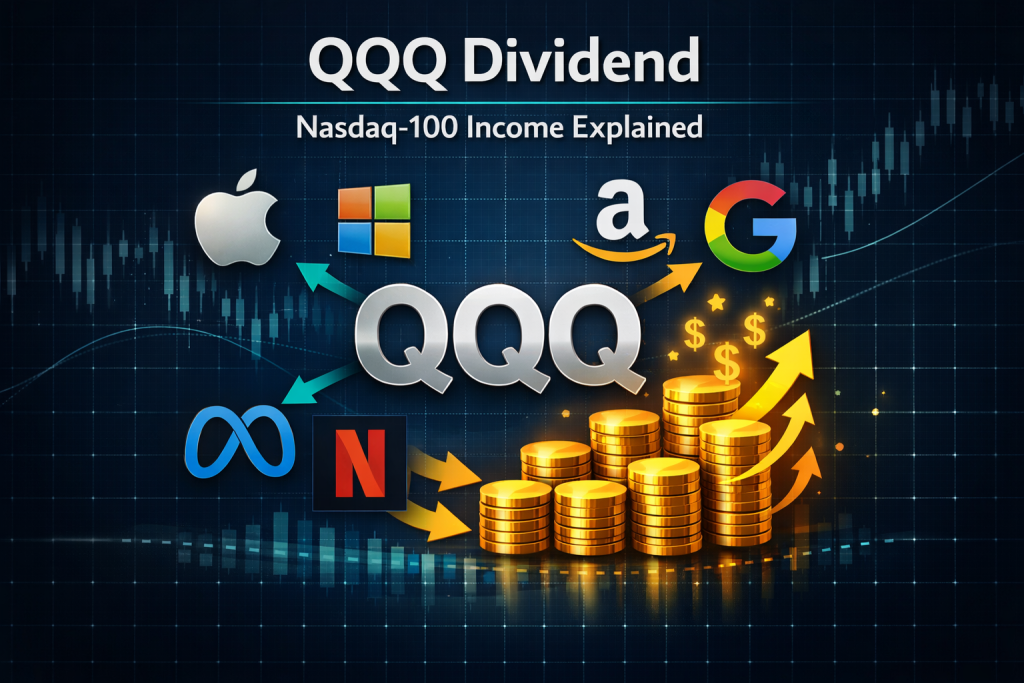
The Invesco QQQ ETF is one of the most widely traded exchange-traded funds in the world. It tracks the Nasdaq-100 Index, which includes many of the largest technology and growth companies in the United States. Because these companies are often associated with rapid growth and innovation, many investors assume that QQQ focuses entirely on capital appreciation rather than income. That assumption is only partially right. QQQ does pay dividends — but understanding what that yield looks like in practice, how it is taxed, and how it fits into a broader portfolio strategy requires a closer look. Investors building diversified portfolios around ETFs will find useful context in the ETF Investing Guide, which explains how index ETFs like QQQ contribute to long-term investment strategies.
What Is the QQQ ETF?
The Invesco QQQ ETF tracks the Nasdaq-100 Index, which consists of 100 of the largest non-financial companies listed on the Nasdaq exchange. The index is a modified market-capitalization weighted index, meaning larger companies receive a greater weighting than smaller ones. As a result, a small number of mega-cap technology firms — including Apple, Microsoft, Amazon, Nvidia, and Alphabet — have an outsized influence on the fund’s overall performance.
Because the Nasdaq-100 is dominated by companies in technology, communication services, and consumer innovation sectors, the index is heavily oriented toward growth and reinvestment. This focus shapes the fund’s dividend characteristics. Many of its largest holdings historically prioritized reinvesting profits over distributing them to shareholders, which is why QQQ’s dividend yield is lower than most traditional income-focused funds.
Which Companies Inside QQQ Pay Dividends?
Not every company in the Nasdaq-100 pays a dividend. Many of the index’s smaller and mid-sized growth companies reinvest all available earnings into expansion. However, several of the fund’s largest holdings do distribute dividends, and because of their enormous size and weighting within the index, their payments account for most of QQQ’s dividend income.
Apple and Microsoft are the two most significant contributors. Both companies generate substantial free cash flow and have maintained consistent dividend growth programs for years. Broadcom, Texas Instruments, and Costco are among the other dividend-paying constituents with meaningful index weightings. When these companies distribute dividends to their own shareholders, the ETF collects that income proportionally and later passes it through to QQQ investors as a quarterly distribution.
As many of these technology companies have matured into highly profitable global businesses, their ability to return capital to shareholders has increased. Companies that paid little or nothing in dividends a decade ago now distribute meaningful amounts. This trend is one reason QQQ’s dividend payments have grown gradually over time even as the fund remains fundamentally growth-oriented.
Does QQQ Pay Dividends — and What Does the Yield Actually Look Like?
Yes, QQQ pays dividends. The ETF distributes income on a quarterly basis — four payments per year — derived from the dividends collected across all Nasdaq-100 constituents, minus the fund’s operating expenses including its expense ratio. The exact amount of each payment varies depending on how much the underlying companies distribute in a given quarter.
In practice, QQQ’s dividend yield has historically ranged between roughly 0.5% and 0.8% annually — significantly lower than the 1.5% to 2.0% yield on a broad market fund like SPY, and far below the 3% to 4% range typical of dedicated dividend ETFs such as VYM or DVY. For investors evaluating dividends per share as a way to estimate income, QQQ’s per-share distributions reflect this modest yield profile. An investor holding $50,000 in QQQ would historically have received roughly $250 to $400 in annual dividend income — useful context for anyone trying to assess how much income the fund actually generates.
Investors who purchase shares after the ex-dividend date will not receive the next payment. The dividend goes to whoever owned shares before that cutoff. Most brokerage platforms display the upcoming ex-dividend date for each ETF, making it straightforward to determine eligibility before trading.
How QQQ Dividends Are Taxed
Dividend taxation is one of the more important — and frequently misunderstood — aspects of owning QQQ. The tax treatment depends on two factors: whether the dividends are classified as qualified or non-qualified, and whether the fund is held in a taxable account or a tax-advantaged retirement account.
Qualified dividends are taxed at the lower long-term capital gains rates — 0%, 15%, or 20% depending on the investor’s income level. To qualify, the investor must have held the ETF shares for more than 60 days during the 121-day window surrounding the ex-dividend date, and the dividends themselves must come from companies meeting IRS eligibility requirements. Most dividends distributed by QQQ’s large-cap U.S. holdings — including Apple, Microsoft, and Broadcom — qualify under these rules.
Non-qualified dividends are taxed as ordinary income, which can be significantly higher depending on the investor’s tax bracket. Some payments passed through QQQ may fall into this category depending on the source. Because the fund holds a mix of domestic and international companies, a portion of its distributions may not meet the qualified dividend threshold.
Investors can review the 1099-DIV they receive each tax year, which breaks down qualified and non-qualified dividend amounts. For investors evaluating capital gains vs dividends as part of a broader tax strategy, understanding this distinction matters — particularly for high-income investors in the top ordinary income brackets, where the gap between qualified and non-qualified treatment can be substantial. Holding QQQ inside a tax-advantaged account such as an IRA eliminates this complexity entirely, since dividends in those accounts are not subject to annual taxation.
How Often Does QQQ Pay Dividends?
QQQ distributes dividends on a quarterly schedule — typically in March, June, September, and December. The exact payment amounts are not fixed and vary with each distribution depending on what the underlying companies paid during the quarter. Investors should not expect identical amounts every period. Over time, the trend has been gradual growth in distribution amounts as the largest dividend-paying holdings within the index have increased their own payouts.
QQQ vs. QQQM — Which Is Right for Long-Term Investors?
Investors researching QQQ should be aware of QQQM, Invesco’s lower-cost alternative to QQQ. QQQM tracks the identical Nasdaq-100 Index and holds the same underlying companies, but it carries an expense ratio of 0.15% compared to QQQ’s 0.20%. That difference is small in absolute terms but adds up over long holding periods.
The practical distinction between the two funds is their intended audience. QQQ was designed with institutional and active traders in mind — it carries higher daily trading volume and tighter bid-ask spreads, which matters for investors who trade frequently or in large size. QQQM was introduced specifically for long-term buy-and-hold investors who want the same Nasdaq-100 exposure at a slightly lower annual cost. For most individual investors with a long time horizon, QQQM is the more cost-efficient choice. The dividend yield and distribution schedule for both funds are effectively identical.
QQQ’s Role in a Portfolio
Although QQQ pays dividends, most investors hold the fund for its exposure to large-cap growth companies rather than its income. Building a diversified ETF portfolio around QQQ typically means pairing it with funds that provide the income or stability characteristics QQQ lacks on its own — such as a broad bond ETF, an international equity fund, or a dedicated dividend ETF for investors who want higher yield.
The fund’s concentration in technology and growth sectors means it can experience significant volatility during market downturns. Its strong long-term performance has come alongside periods of sharp drawdowns, including a decline of more than 30% in 2022. Investors who use QQQ as a core holding should understand this risk profile and size the position accordingly within their broader asset allocation.
Dividend Growth and Reinvestment
For long-term investors, two dynamics are worth understanding: the gradual growth of QQQ’s dividend payments over time, and the effect of reinvesting those payments.
As the largest technology companies in the Nasdaq-100 have matured and generated more free cash flow, their dividend programs have expanded. Apple, for example, initiated its dividend in 2012 and has raised it consistently since. Microsoft has done the same. As these companies grow larger within the index and increase their distributions, the income passed through QQQ rises as well. This means the fund’s starting yield, while low, has historically increased in dollar terms over multi-year holding periods.
Dividend reinvestment compounds this dynamic. Many brokerage platforms offer dividend reinvestment plans — commonly called DRIPs — that automatically use each quarterly payment to purchase additional ETF shares. Those additional shares generate their own dividends in future quarters. Over long investment horizons, this compounding effect can meaningfully increase the total value of the investment beyond what share price appreciation alone would produce. For investors focused on long-term growth rather than immediate income, automatic reinvestment is generally the more effective approach.
The Low Down on QQQ Dividends
QQQ does pay dividends — quarterly, from income collected across the Nasdaq-100’s dividend-paying holdings. But with a historical yield in the 0.5% to 0.8% range, income is not the reason most investors own it. The fund’s primary appeal is long-term growth through exposure to the largest technology and innovation companies in the world. Investors who want that growth at a slightly lower cost should consider QQQM, which tracks the identical index at a lower expense ratio. For investors who need meaningful dividend income, QQQ is best viewed as a growth component within a broader portfolio that includes dedicated income-generating funds. If you want structured guidance on building disciplined investment strategies and understanding how different ETFs work together in a long-term portfolio, become a member today and join us Above The Green Line.
Because the question isn’t just whether QQQ pays dividends. It’s whether the combination of growth, income, and risk in your portfolio is built to support your long-term financial goals.

Related Articles
ETF =======>
iShares ETFs Explained: What They Are and How Investors Use Them

Consumer Staples ETF: Top Funds, Holdings, and When to Actually Use Them
Index Funds vs Mutual Funds: Key Differences, Costs, and Which Is Better

DBC ETF Guide: Is This Commodity Fund Worth the Risk?