By ATGL
Updated December 25, 2025
The inside bar trading strategy is one of the simplest price patterns on a chart—and one of the most misunderstood. At a glance, it’s just a smaller candle sitting neatly inside the range of the prior candle. But beneath that simplicity lies valuable information about market compression, indecision, and potential breakout energy.
Traders monitor inside bars because they often precede directional moves. When volatility contracts and price pauses within a defined range, the next expansion can be swift and decisive. Used correctly, inside bars can help traders enter trends earlier, define risk more precisely, and avoid chasing extended moves.
This article breaks down the inside bar pattern from the ground up: how it forms, what it signals psychologically, and how traders use it in real trading scenarios. We’ll cover entries and exits, confirmation tools, common mistakes that lead to false breakouts, and what actually influences the success rate of inside bar setups. Throughout, we’ll emphasize a systematic, rules-based approach that fits naturally with ATGL’s disciplined trading philosophy.
Inside Bar Pattern Basics Every Trader Should Know
An inside bar forms when the entire high-to-low range of a candle is contained within the range of the previous candle. That previous candle is often called the mother bar. For a valid inside bar, the inside candle’s high must be lower than the mother bar’s high, and its low must be higher than the mother bar’s low.
This structure matters because it visually represents compression. The market has gone from a wider range (the mother bar) to a narrower one (the inside bar), signaling a temporary balance between buyers and sellers. Neither side has enough conviction—yet—to push price beyond the prior extremes.
From a reliability standpoint, the inside bar pattern itself is neutral. It does not predict direction on its own. Its usefulness comes from context—trend direction, nearby support or resistance, and volume behavior. Inside bars that appear randomly in choppy markets are far less reliable than those that form within established trends or at meaningful technical levels.
So, how reliable is an inside bar pattern? The short answer: as reliable as the framework around it. Traders who treat it as a standalone signal often get inconsistent results. Those who integrate it into broader price action trading tend to see much more consistency over time.
How The Inside Bar Candle Pattern Forms And What It Signals
Inside bars form when volatility contracts. After a directional move or a strong impulse candle, the market pauses. Buyers and sellers reassess, orders stack up, and price begins to coil. This reduced range reflects indecision, but it also represents stored energy.
When price compresses, it rarely stays that way for long. The eventual resolution—up or down—often comes with increased momentum. That’s why inside bars are commonly associated with breakout strategies.
Not all inside bars are created equal. Higher-quality inside bars tend to share a few characteristics:
- They form after a strong directional move or within a clear trend.
- The mother bar is well-defined and meaningful, not a tiny or random candle.
- The inside bar is proportionally smaller, showing real compression rather than noise.
Lower-quality inside bars often appear repeatedly in sideways markets, cluster near heavy congestion, or form when volume is drying up. These conditions increase the odds of false breaks.
You’ll often see inside bars form near support or resistance, trendlines, or moving averages. While this can add significance, traders should avoid overloading charts with indicators. The goal is to understand why price is pausing—not to predict what must happen next.
The Inside Bar Trading Strategy: Entries, Stops, and Confirmation
At its core, the inside bar trading strategy is about waiting for confirmation. The pattern defines a range, and traders act only when price proves its intent by breaking that range.
Breakout Execution (Entry + Stop Placement)
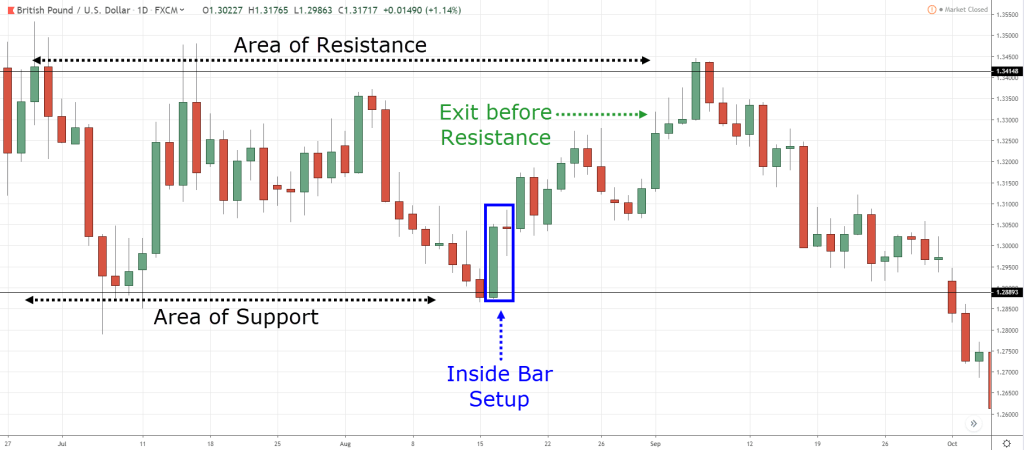
The most common execution method is a breakout entry. Traders place buy orders above the high of the mother bar and sell orders below the low of the mother bar. When price breaks out, the trade triggers in the direction of expansion.
Stops are placed logically on the opposite side of the pattern:
- For long trades, stops typically go below the low of the mother bar.
- For short trades, stops are placed above the high of the mother bar.
This structure keeps risk clearly defined. If price breaks out and immediately reverses back through the range, the premise of the trade is invalidated quickly.
Many traders combine inside bars with broader breakout trading principles, using the pattern as a precise entry trigger rather than a standalone system.
Trend & Timeframe Filters for Cleaner Signals
One of the most important confirmations is trend direction. Inside bars work best as continuation patterns, not reversal tools. In an uptrend, traders favor upside breaks. In a downtrend, they favor downside breaks.
This directly answers two common questions:
- How do you confirm an inside bar signal? By aligning the breakout with the prevailing trend, confirming with volume, and ensuring the pattern is not forming into nearby resistance or support.
- What timeframe is best for inside bars? Inside bars can work on any timeframe, but higher timeframes (daily and weekly) tend to produce cleaner signals with fewer false breakouts. Lower timeframes can be traded, but they require tighter filters and faster execution.
Understanding and consistently applying identifying trends dramatically improves inside bar reliability.
How to Avoid False Breakouts When Trading Inside Bars
False breakouts are the primary frustration traders face with inside bar setups. Fortunately, most false breaks share common traits.
One major cause is choppy market conditions. When price is moving sideways with overlapping candles, inside bars lose their meaning. Compression without directional bias often leads to whipsaws.
Another frequent issue is low volume. Breakouts that occur without participation are less likely to follow through. Incorporating volume analysis helps traders filter out weak signals and focus on moves with institutional backing.
Inside bars that form directly into nearby support or resistance also carry higher failure risk. If price breaks out but immediately runs into a technical barrier, momentum can stall quickly.
Finally, poorly proportioned candles matter. If the inside bar is nearly the same size as the mother bar, there’s little real compression—and little edge.
What Influences the Success Rate of Inside Bar Setups?
Traders often ask about the success rate of inside bar patterns, but this question misses the bigger picture. There is no fixed win rate for inside bars because outcomes depend heavily on how they’re traded.
Success is influenced by:
- Trend alignment
- Quality of the mother bar
- Volume confirmation
- Market environment
- Risk-to-reward structure
Professional traders don’t rely on prediction. They rely on systematic evaluation. This means backtesting inside bar rules, tracking results in a journal, and refining filters over time. When evaluated as part of a repeatable process, inside bars can become a consistently profitable setup—even if individual trades still lose.
Inside bars can also appear in reversal contexts, but these are lower-probability scenarios. Traders interested in countertrend setups often combine inside bars with other tools for spotting reversals, rather than using the pattern alone.
Apply Inside Bar Strategy Insights To Improve Your Trading Approach
Inside bars are not magic. They are a framework for clarity—a way to define compression, structure risk, and wait for the market to reveal direction. When traded with discipline, they help remove emotion and replace guesswork with rules.
The real edge comes from context. Inside bars aligned with trend, confirmed by volume, and executed with defined risk offer traders a repeatable way to participate in market expansion phases without chasing price.
If you want to apply inside bar strategies the right way, ATGL Membership provides structured trading systems, trend filters, and rules-based frameworks designed to help traders identify high-quality setups and avoid low-probability noise. Explore how these tools fit together inside ATGL’s – join today.
With consistency and a process-driven mindset, inside bar setups can become a reliable building block in a confident, rules-based trading approach.

Related Articles
[pt_view id=”9517038dwu”]