By ATGL
Updated February 1, 2026
When examining individual stock charts, traders often focus on isolated price movements. However, financial markets operate as interconnected systems where changes in one asset class can signal shifts in another. Intermarket analysis examines relationships across stocks, bonds, commodities, and currencies to provide a comprehensive view of market conditions. By studying how different asset classes interact, you can anticipate trend reversals, confirm investment decisions, and identify opportunities before they become apparent through single-market stock analysis alone.
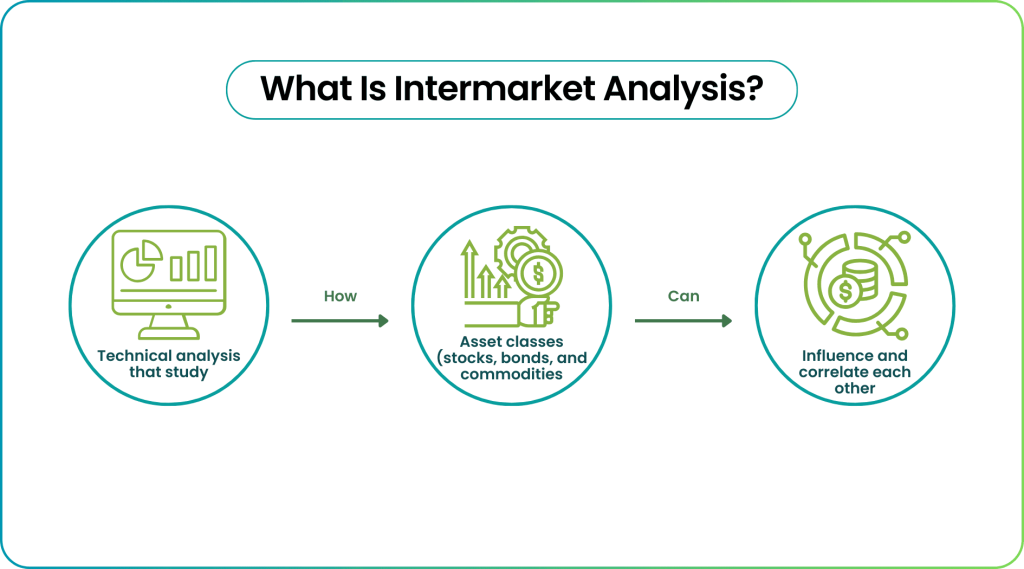
What Is Intermarket Analysis?
Intermarket analysis evaluates financial markets by studying relationships between stocks, bonds, commodities, and currencies. Rather than examining assets in isolation, this approach recognizes how interest rates and the stock market interact, currency strength affects commodity pricing, and risk sentiment shifts capital flows.
Intermarket signals can conflict with technical indicators. A stock may show bullish patterns while bonds signal economic weakness — divergences that often highlight critical inflection points where one market provides more accurate forward-looking signals.
Stocks vs. Bonds: The Foundational Relationship
Equities and fixed-income securities typically exhibit inverse correlation. When economic growth accelerates, investors favor stocks as corporate earnings expand, while bonds decline as capital redirects toward higher-returning equities. Rising interest rates push bond prices lower while potentially pressuring stock valuations.
During economic uncertainty, this reverses. Investors seek fixed-income safety, driving bond prices higher and yields lower while stocks decline. This flight to quality represents a fundamental capital allocation shift.
However, this relationship has limitations. Central bank policies can distort traditional correlations, and both asset classes can decline simultaneously during stagflation or rise together when inflation remains contained. Understanding these exceptions strengthens the analytical framework.
Commodities and Inflation Signals
Commodity markets provide critical signals about inflationary pressures and economic cycles. Energy prices, industrial metals, and precious metals each offer distinct insights that traders incorporate into timing decisions.
Crude oil serves as a barometer for global economic activity. Rising oil prices typically indicate strengthening demand from industrial production and transportation, suggesting economic expansion. However, sustained increases can signal inflationary pressures that may prompt central banks to tighten monetary policy. The effects of a weakening dollar often amplify commodity price movements, as many raw materials are priced in U.S. currency.
Industrial metals like copper demonstrate similar cyclical patterns. Often called “Dr. Copper” for its diagnostic properties, this metal’s price movements frequently precede changes in manufacturing activity. When copper prices rise ahead of equity markets, it may signal improving economic conditions not yet reflected in stock valuations.
Gold presents a different dynamic. As a traditional safe-haven asset, gold typically rises when investors anticipate currency debasement, geopolitical instability, or economic turmoil. When gold rallies while stocks decline, it confirms risk-off sentiment. Conversely, when both gold and equities rise together, it may indicate inflation concerns and not growth optimism.
Traders use these commodity signals for timing decisions by monitoring divergences. If stock markets rise while commodity prices weaken, it may suggest the equity rally lacks fundamental support. Alternatively, when commodities strengthen before stocks, it often provides an early signal that cyclical sectors may outperform.
Currencies and Global Risk Appetite
Currency markets reflect global capital flows, trade dynamics, and risk sentiment. The relationship between currency trading and intermarket analysis proves particularly valuable for understanding international market conditions.
The U.S. dollar functions as the primary global reserve currency, making its strength a critical intermarket indicator. A strengthening dollar typically signals risk-off sentiment, as investors seek safety in U.S. assets. This movement often coincides with declining equity markets, particularly in emerging economies where dollar-denominated debt becomes more expensive to service. Conversely, dollar weakness frequently accompanies risk-on periods when investors pursue higher-returning assets internationally.
Emerging market currencies provide additional insight into risk appetite. When these currencies strengthen against the dollar, it suggests investors are comfortable with higher-risk assets and expect stronger growth in developing economies. A broad selloff in emerging market currencies often precedes equity market declines, serving as an early warning signal.
The Japanese yen and Swiss franc act as funding currencies in carry trades. When these currencies strengthen rapidly, it indicates unwinding carry trades and rising risk aversion. This dynamic frequently correlates with stock market weakness and increased volatility.
Using Intermarket Signals To Confirm or Contradict Trades
The practical application of intermarket analysis involves using cross-asset signals to validate or challenge individual trade setups. This approach adds confirmation that strengthens investment decisions or highlights potential weaknesses.
When stocks rally alongside rising commodity prices and weakening bonds, it confirms a risk-on environment driven by growth expectations. This alignment suggests the equity advance rests on solid fundamental support. However, if stocks rise while bonds also strengthen and commodities weaken, it creates a divergence that warrants caution. This scenario might indicate the rally is driven by liquidity instead of genuine economic improvement.
Traders also monitor sector rotation patterns through an intermarket lens. When cyclical sectors like energy and materials outperform while defensive sectors lag, and this rotation aligns with strengthening industrial commodities, it validates the cyclical trade. These patterns connect with broader market internals to provide a comprehensive view of market health.
Divergences between intermarket signals and price action often present valuable insights. A stock breaking to new highs while bonds signal deteriorating economic conditions may indicate vulnerability. These contradictions prompt deeper analysis, not automatic trade rejection.
Intermarket Tools for the Individual Trader
Charting platforms that display multiple asset classes simultaneously facilitate visual comparison. Overlaying the S&P 500 with the 10-year Treasury yield and a commodity index shows how these markets move relative to one another. Many platforms offer correlation indicators that quantify relationships numerically.
Exchange-traded funds provide liquid instruments for tracking each asset class. Bond ETFs, commodity ETFs, and currency ETFs allows you to monitor intermarket relationships without specialized accounts.
Above the Green Line’s memberships provide structured approaches incorporating these intermarket principles. By monitoring multiple asset classes systematically and identifying the strongest opportunities across market conditions, you can develop a more complete understanding of market dynamics and position yourself accordingly.
Intermarket analysis transforms isolated price movements into a coherent narrative about market conditions and risk appetite, supporting more informed investment decisions.

Related Articles
[pt_view id=”9517038dwu”]