
By Andrew Stowers
Updated March 23, 2026
Most investors misunderstand consumer staples ETFs. They assume these funds are simply “safe” or “boring.” They hear that staples are defensive and think they should always have exposure. But that mindset is incomplete—and in many cases, it leads to underperformance. Consumer staples ETFs are not about always being invested. They are about being invested at the right time.
Investors often learn how these sector-based allocations fit into a broader portfolio through frameworks like the ETF Investing Guide, which explains how different sectors contribute to overall performance. The key is not just owning sectors—but knowing when to rotate into them.
Understanding when these ETFs outperform—and when they lag—is what separates passive investors from disciplined ones. Once you see how capital rotates through the market, consumer staples stop being a “default holding” and start becoming a strategic tool.
What Is a Consumer Staples ETF?
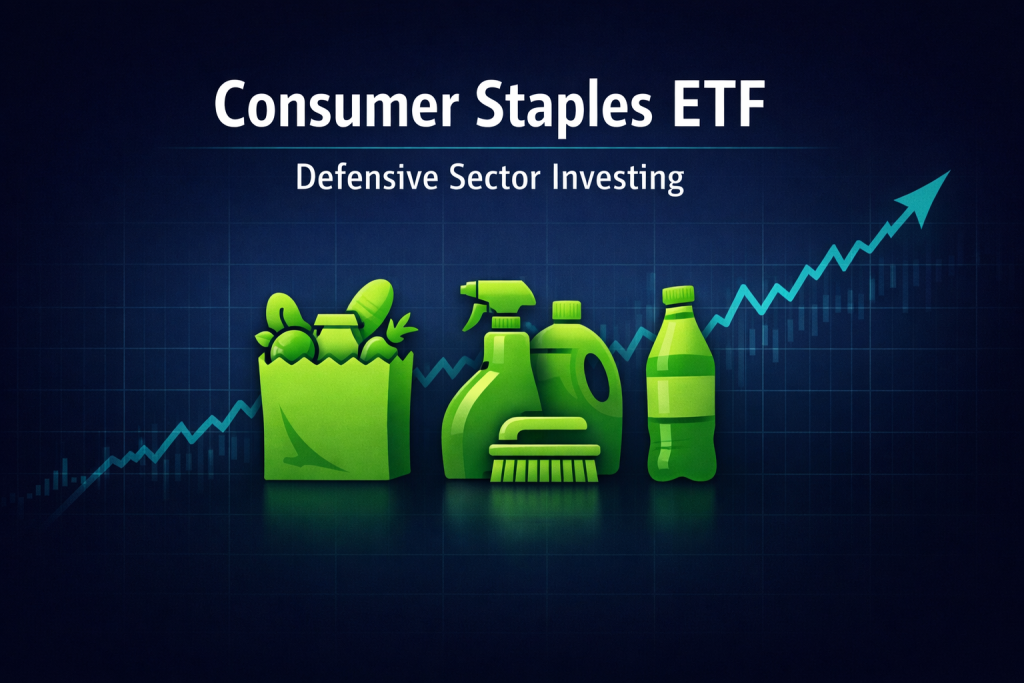
A consumer staples ETF is a fund that invests in companies producing essential goods such as food, beverages, household products, and personal care items. These companies operate in industries where demand remains relatively stable regardless of economic conditions. Because consumers continue buying these products during downturns, the sector tends to behave differently than growth-driven industries. These ETFs allow investors to access dozens of companies through a single position, simplifying diversification. Instead of selecting individual stocks like Procter & Gamble or Coca-Cola, investors gain exposure to the entire sector. This makes consumer staples ETFs an efficient way to participate in defensive market positioning.
Why Investors Use Consumer Staples ETFs
Consumer staples ETFs serve a very specific purpose in a portfolio. They are not designed to maximize returns during bull markets. Instead, they are designed to preserve capital and reduce volatility when conditions deteriorate.
Stability During Market Stress
When markets decline, investors shift capital toward sectors with predictable earnings. Consumer staples companies continue generating revenue because their products remain essential. This creates relative stability compared to sectors that depend on discretionary spending. This behavior makes staples one of the primary “defensive rotations” during downturns. It is not that staples surge dramatically, but rather that they fall less than the broader market.
Dividend Income Component
Many consumer staples companies generate consistent cash flow and distribute dividends. This adds a layer of income to the investment, which can help offset volatility. While yields are typically moderate, they are more reliable than those in high-growth sectors. However, income is only part of the equation. The real advantage comes from timing the allocation correctly.
How Consumer Staples Perform vs the Market
To understand the true role of consumer staples ETFs, you need to look at how they perform across different market environments.
During Market Crashes
In 2008, consumer staples significantly outperformed the S&P 500 as investors rotated into defensive sectors. The same pattern appeared during the early stages of the 2020 COVID crash. When uncertainty spikes, capital flows toward stability. This is where consumer staples provide their greatest value. They act as a buffer when risk assets are declining.
During Bull Markets
In strong bull markets, consumer staples tend to underperform. When economic growth accelerates, capital shifts into sectors like technology and consumer discretionary. These sectors offer higher growth potential, which attracts investor demand. As a result, holding staples during these periods often leads to opportunity cost.
The Performance Reality
Consumer staples are not a “set and forget” investment. They are a rotation-based tool. Their performance depends entirely on market conditions, not just their underlying fundamentals.
Popular Consumer Staples ETFs
Not all consumer staples ETFs are identical. Understanding their structure helps you choose the right exposure.
Major ETFs in the Sector
The most widely used consumer staples ETFs include:
- XLP (Consumer Staples Select Sector SPDR)
- VDC (Vanguard Consumer Staples ETF)
- IYK (iShares U.S. Consumer Staples ETF)
Each of these funds tracks the same general sector but differs in construction.
Holdings and Concentration
XLP is highly concentrated in large-cap companies such as Procter & Gamble and Coca-Cola. VDC offers broader diversification across mid-cap and smaller companies within the sector. IYK provides similar exposure with slight differences in weighting methodology. These differences matter because concentration can influence performance during different market conditions.
Expense Ratios and Cost Efficiency
Expense ratios across these ETFs are generally low, though Vanguard funds tend to offer slight cost advantages. Understanding how the expense ratio impacts long-term returns is critical, especially for investors holding ETFs over extended periods. Even small cost differences can compound into meaningful performance gaps over time.
When Consumer Staples ETFs Actually Make Sense
This is where most investors get it wrong. They focus on what consumer staples are—but not when to use them.
ATGL Rules-Based Rotation Framework
At Above the Green Line, we approach this differently. We do not hold consumer staples ETFs continuously. Instead, we rotate into them when objective signals indicate that capital is flowing into defensive sectors.
We look for:
- Relative Strength (SCTR > 90)
- Sector momentum vs the S&P 500
- Institutional money flow patterns
When these signals align, consumer staples become a high-probability opportunity. When they weaken, we rotate out. This is not opinion-based investing. This is Rules-Based Investing applied to sector rotation.
Simple Allocation Framework
A practical allocation model looks like this:
- 10–20% exposure during volatile or uncertain markets
- 5–10% exposure during neutral conditions
- 0% allocation when staples show weak relative strength
This approach prevents investors from holding defensive sectors when they are likely to underperform.
What Most Investors Miss About Sector Rotation
This is where the real edge comes from. Most investors understand that consumer staples are “defensive,” but they fail to act on that information in a structured way. They either hold staples all the time or avoid them entirely. Both approaches ignore how capital actually moves through the market.
Sector rotation is not random. It follows identifiable patterns driven by institutional capital flows. When uncertainty increases, large investors reduce exposure to risk and shift into defensive sectors like consumer staples. When confidence returns, that capital rotates back into growth sectors.
The key insight is that these shifts are measurable. Relative strength improves before price outperformance becomes obvious. Momentum begins to build before the broader market recognizes the move. This creates a window where disciplined investors can position themselves ahead of the crowd.
Without a structured system, most investors react too late. They buy defensive sectors after the move has already occurred or hold them long after capital has rotated out. This is why simply “knowing” about defensive sectors is not enough.
At Above the Green Line, this is where Rules-Based Investing creates a measurable advantage. By focusing on objective indicators such as sector strength, momentum, and capital flow, the system removes guesswork from the process. Instead of predicting what might happen, it responds to what is already happening in the market.
This approach transforms consumer staples from a passive holding into an active tool. Rather than asking whether staples are “good,” the better question becomes: Are they strong right now?
That shift in thinking is what allows investors to consistently align with market conditions rather than fight against them.
When NOT to Use Consumer Staples ETFs
Understanding when to avoid staples is just as important as knowing when to use them.
Strong Bull Markets
During strong bull markets, staples typically lag behind growth sectors. Capital flows toward innovation-driven industries, leaving defensive sectors behind.
Low Volatility Environments
When markets are stable and trending upward, investors seek higher returns rather than safety. This reduces demand for defensive sectors.
The Hidden Cost
The biggest risk of holding staples at the wrong time is not loss—it is missed opportunity. Capital tied up in underperforming sectors cannot participate in stronger trends elsewhere.
How Consumer Staples Fit Into a Portfolio
Consumer staples ETFs are most effective when used as part of a broader, dynamic strategy.
Building a Diversified ETF Portfolio
Investors often include staples within a diversified etf portfolio that also includes growth-oriented funds. This allows portfolios to balance upside potential with downside protection.
Combining Sector ETFs
By combining staples with other sector etfs, investors can shift exposure based on market conditions. This dynamic approach allows portfolios to adapt rather than remain static.
Using Consumer Staples ETFs as a Strategic Tool
Here’s the key takeaway.
Consumer staples ETFs are not just “safe investments.” They are strategic tools designed for specific market conditions. They outperform during uncertainty and underperform during strong growth cycles. Knowing when to rotate into and out of the sector is what determines whether they help or hurt your portfolio.
At Above the Green Line, we use Rules-Based Investing to identify when capital is rotating into defensive sectors like consumer staples, allowing investors to position themselves based on real market signals rather than guesswork. If you want to follow a structured system that identifies these rotations and highlights high-probability opportunities in real time, you may be interested in becoming a member.
Because successful investing isn’t about being right all the time.
It’s about being aligned with the market when it matters most.

Related Articles
ETF =======>

QQQ Dividend: Does the Nasdaq-100 ETF Pay Dividends?
iShares ETFs Explained: What They Are and How Investors Use Them
Index Funds vs Mutual Funds: Key Differences, Costs, and Which Is Better

DBC ETF Guide: Is This Commodity Fund Worth the Risk?