By Andrew Stowers
Updated April 28, 2026
Your GPU is sitting idle for 12 hours a day. NiceHash promises to turn that idle compute into Bitcoin. But before you run the installer, there’s a calculation most guides skip entirely: does the revenue actually exceed the costs — and how does the return on your hardware compare to simply using that capital a different way?
NiceHash profitability is not a yes-or-no question. It is a calculation — one with three key variables, a hardware cost component that most crypto guides ignore entirely, and a comparison against opportunity cost that even fewer people run. This guide, in addition to our Investment Strategy Guide, works through all of it.
What Is NiceHash and How Does It Generate Income?
| Quick Answer
NiceHash is a hash power marketplace where GPU owners sell their computing power to buyers who use it to mine various cryptocurrencies. Miners are paid in Bitcoin regardless of what is being mined. NiceHash charges approximately 2% on miner payouts, making setup straightforward compared to traditional mining pools. |
Founded in 2014, NiceHash operates a two-sided marketplace: on one side, buyers purchase hash power to mine specific algorithms and coins; on the other, GPU owners (miners) rent out their hardware’s computing capacity and earn Bitcoin in return.
The key distinction from traditional mining is that NiceHash miners do not choose what to mine, do not manage coin wallets for individual algorithms, and are not paid in the altcoin being mined. They simply point their GPU at the NiceHash software and receive BTC for whatever hash power they provide.
How NiceHash Maximises Your Returns Automatically
NiceHash’s proprietary algorithm continuously monitors which mining algorithm is paying the most to hash power buyers at any given moment and automatically switches your GPU to that algorithm. This dynamic switching — essentially a form of automated optimisation — is the core value proposition NiceHash offers over manually setting up a traditional mining pool for a single coin.
Fee structure: NiceHash charges approximately 2% of miner earnings on each payout. Payouts occur when your accumulated balance reaches the minimum threshold (typically 0.001 BTC for internal wallet, higher for external withdrawal). This fee structure is competitive with most mining pool alternatives.
Two software options are available: NiceHash QuickMiner (simplified, Windows-based, good for beginners) and NiceHashOS (Linux-based dedicated mining OS, better for multi-GPU rigs). For a single GPU on a gaming PC, QuickMiner is the natural starting point.
The Real Cost Equation: What Actually Determines Your Profit
| The Three Variables
NiceHash profitability is determined by: (1) GPU hashrate efficiency — how many hashes per watt your card produces, (2) Your electricity cost per kWh — the single most controllable profitability lever, (3) Current BTC price — all revenue is denominated in Bitcoin, so dollar returns fluctuate with BTC regardless of mining performance. |
The profitability formula is straightforward once you have the three inputs:
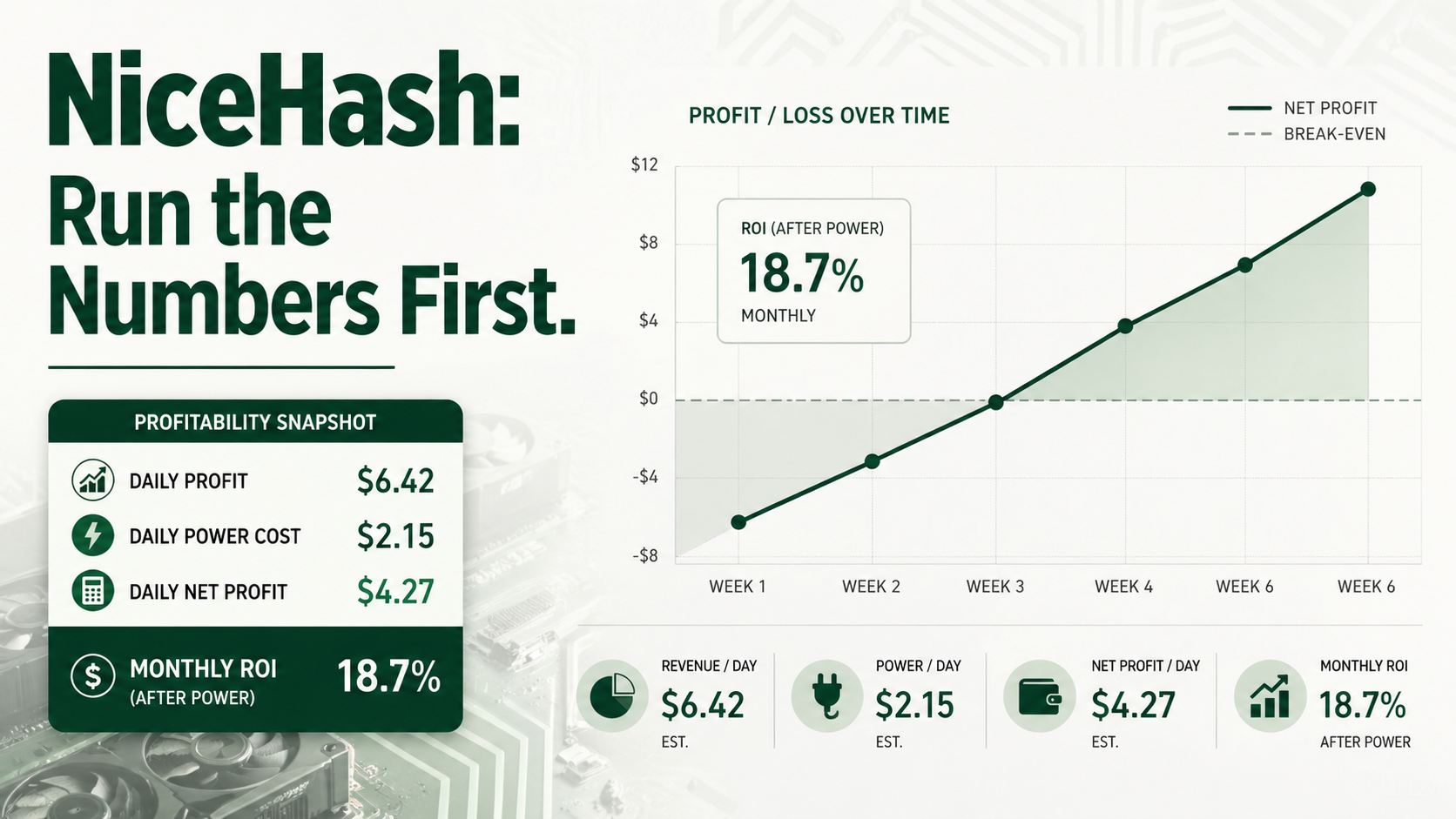
Daily Net Profit = Daily BTC Revenue − Daily Electricity Cost − NiceHash Fee (~2%)
Variable 1: GPU Hashrate Efficiency
Hashrate efficiency is measured in megahashes per second per watt (MH/s per watt) — not raw hashrate alone. A GPU that produces 80 MH/s while consuming 180W is more efficient than one producing 90 MH/s at 300W. Higher efficiency means more revenue generated per dollar of electricity consumed.
Variable 2: Electricity Cost — The Most Critical Factor
Electricity cost is the single variable that most powerfully determines whether NiceHash is profitable for you — and it is the only one entirely within your control. A miner with a $0.05/kWh electricity rate (industrial, rural, or subsidised) and a mid-range GPU will nearly always be profitable under normal market conditions. A miner paying $0.15/kWh or more (common in many U.S. states and European countries) may be net negative on the same hardware.
The U.S. national average electricity rate in 2026 is approximately $0.12–0.16 per kWh for residential customers. If you are above $0.12/kWh, profitability for consumer GPU mining is marginal at best under most BTC price conditions.
Variable 3: BTC Price
All NiceHash income is paid in Bitcoin. This means your dollar-denominated income rises and falls with BTC price even if your hashrate and electricity cost are completely unchanged. A mining operation that clears $3/day profit when BTC is at $60,000 may be negative when BTC is at $30,000 — not because anything changed in your setup, but because the BTC you earned is worth less in dollar terms.
The break-even table below illustrates the daily and monthly net profit range for a mid-range GPU under three electricity cost scenarios. All figures are illustrative — verify your specific hardware with the NiceHash profitability calculator before making any decision.
| GPU Profile (Illustrative) | $0.05/kWh | $0.08/kWh | $0.12/kWh | $0.16/kWh |
|---|---|---|---|---|
| Daily Gross Revenue (est.) | ~$2.50 | ~$2.50 | ~$2.50 | ~$2.50 |
| Daily Electricity Cost (200W GPU) | ~$0.24 | ~$0.38 | ~$0.58 | ~$0.77 |
| NiceHash Fee (~2%) | ~$0.05 | ~$0.05 | ~$0.05 | ~$0.05 |
| Daily Net Profit | ~$2.21 | ~$2.07 | ~$1.87 | ~$1.68 |
| Monthly Net Profit | ~$66 | ~$62 | ~$56 | ~$50 |
Note: Illustrative estimates assuming BTC price in a moderate bull market environment, single mid-range GPU at ~200W. Actual figures depend on specific GPU model, current BTC price, and network difficulty. Use the NiceHash calculator with your hardware for real-time estimates.
Hardware Costs and the Break-Even Timeline
Any profitability analysis that stops at daily electricity costs is incomplete. If you purchased a GPU specifically to mine NiceHash, that hardware cost is capital deployed — and it must be recovered before you have generated any genuine return on investment.
The relevant question is not ‘am I making money today?’ but ‘how long until I recover the hardware cost and start generating real return on capital?’
New GPU: The Hardest Case
At current GPU pricing, a new mid-range GPU (e.g. in the $400–$700 range) generating $50–$66 per month net profit at a favourable electricity rate will take approximately 6–14 months to break even — assuming BTC price and mining difficulty remain stable. Both assumptions are aggressive; BTC price and network difficulty have historically been highly volatile.
Critical consideration: GPU prices and BTC prices are often correlated. During crypto bull markets when NiceHash profitability peaks, GPU prices surge as miners buy hardware — increasing acquisition cost at exactly the moment demand is highest. Buying hardware at the top of a mining profitability cycle has historically been one of the most reliable ways to enter at peak cost and mine into declining margins.
Used GPU: The Better Case
A used GPU purchased at 40–50% of new MSRP dramatically changes the break-even calculation. A $200 used card generating $50–$66/month net profit at low electricity rates reaches break-even in 3–4 months — a materially better investment case than buying new.
Already Own the GPU: The Best Case
If you already own the GPU for gaming or other purposes, the hardware cost is sunk — it no longer enters the profitability calculation. In this scenario, the relevant analysis simplifies to: is the net revenue after electricity cost worth the wear and inconvenience of running your card at full load 24/7?
Continuous mining load does accelerate GPU wear — thermal cycling, fan degradation, and VRAM stress occur at higher rates under sustained 100% load than under typical gaming use. Factor a shortened useful GPU lifespan into your long-run analysis.
NiceHash vs Other Income Strategies: An Honest Comparison
Treated as an income-generating capital deployment decision, NiceHash competes with several other accessible strategies available to self-directed investors. The comparison below uses the ‘new GPU purchase’ scenario for NiceHash capital requirements — the most honest basis for comparison.
| Strategy | Capital Req. | Est. Annual Return | Risk Level | Liquidity |
|---|---|---|---|---|
| NiceHash (new GPU) | $400–$700 | Variable (highly BTC-dependent) | High (BTC + hardware) | Low (hardware tied up) |
| NiceHash (existing GPU) | ~$0 incremental | $600–$800/yr (low elec. rate) | Medium (BTC price) | N/A (no new capital) |
| Dividend ETF | Any amount | ~3–5% yield + growth | Low–Moderate | High (sell anytime) |
| Crypto Staking | Varies by coin | 3–15% (highly variable) | Medium–High | Varies by protocol |
| Algorithmic Trading | $5,000+ recommended | Highly variable | Medium–High | High |
The comparison reveals a clear hierarchy: NiceHash mining with existing hardware at low electricity rates is a genuinely compelling idle-resource monetisation strategy. NiceHash mining with newly purchased hardware competes poorly against liquid, scalable alternatives — the capital and returns are similar or worse, and the flexibility is significantly lower.
The opportunity cost question: if you have $600 to deploy, does it generate better risk-adjusted return as a GPU for NiceHash or as $600 in a dividend ETF? At current margins and average U.S. electricity rates, the ETF typically wins on both return predictability and capital flexibility.
Risk and Volatility: What Every NiceHash Miner Must Understand
Like any income-generating strategy, NiceHash carries specific risks that every participant should evaluate clearly before committing capital or operational resources.
1. BTC Price Volatility
All NiceHash income is denominated in Bitcoin. A 40% decline in BTC price reduces your dollar-denominated mining income by 40% even if your hashrate, electricity cost, and mining efficiency are completely unchanged. This means NiceHash profitability is partly a bet on BTC price — an important consideration for investors who want predictable, stable income.
2. Network Difficulty Adjustment
As more mining hardware comes online globally, network difficulty increases and individual miner share of total revenue declines. NiceHash earnings can erode over time even if BTC price stays flat — because you represent a smaller fraction of total hash power as the network grows. This dynamic is particularly relevant when a new generation of more efficient GPUs arrives, increasing total network hashrate and reducing returns for older hardware.
3. Platform Security Risk
In December 2017, NiceHash suffered a significant security breach resulting in approximately $65 million in Bitcoin stolen from user accounts. The company subsequently repaid affected users and has since overhauled its security infrastructure. NiceHash is a legitimate, established platform — but as with any platform holding cryptocurrency, best practice is to enable two-factor authentication, use a strong unique password, and withdraw earnings to your own wallet regularly rather than accumulating large balances on-platform.
4. Regulatory and Tax Treatment
Crypto mining income is generally treated as ordinary income in the United States and most other jurisdictions — meaning it is taxed at your marginal income tax rate in the year received. This is a meaningful consideration: a miner generating $600/year in net mining income who pays 22% federal income tax effectively earns $468 after federal tax. Consult a tax professional familiar with cryptocurrency for guidance specific to your situation.
5. Hardware Wear
Running a GPU at 100% load continuously for months accelerates thermal cycling, fan wear, and VRAM stress beyond what typical gaming or workstation use produces. Most modern GPUs are built for sustained load, but lifespan is shortened — factor this into your long-run return calculation, particularly if hardware replacement would be necessary sooner than expected.
Evaluating NiceHash as an Investment — Not Just a Hobby
| The Conditional Verdict
NiceHash profitability makes financial sense when: you already own the GPU (hardware cost = zero), your electricity rate is at or below approximately $0.08–0.10/kWh, and you are comfortable with BTC price exposure on your income stream. For miners considering purchasing hardware specifically for NiceHash, the investment case is significantly weaker at current margins and average electricity rates. |
Applying a standard investment evaluation framework to NiceHash clarifies the decision quickly.
Annualised Return on Hardware Capital
For a GPU purchased specifically for mining: divide annual net profit by hardware cost to get annualised hardware ROI. At $50/month net profit on a $600 GPU, annualised hardware ROI is approximately 100% — which sounds extraordinary until you account for BTC price volatility, hardware depreciation, and the risk-adjusted comparison against liquid alternatives.
That 100% figure assumes BTC price stability, no hardware failure, and consistent electricity rates for 12 months — three assumptions that have historically not all held simultaneously in the crypto market.
The Existing Hardware Calculus
If the GPU is already owned, the calculation is fundamentally different. The question becomes purely: is the hourly net revenue worth the electricity cost, the hardware wear, and the opportunity cost of the GPU’s time? At $0.10/kWh electricity, a mid-range GPU generates approximately $45–60 per month net — a legitimate return on a resource that would otherwise be idle.
The Electricity Threshold
The break-even electricity rate for most consumer GPUs under typical NiceHash market conditions is approximately $0.10–$0.12 per kWh. Below this threshold, mining is generally net positive at moderate BTC prices. Above it, margins are thin and easily erased by BTC price declines. Knowing your exact electricity cost before evaluating NiceHash is the first step in any honest profitability assessment.
A Framework for the Decision
- Already own GPU + electricity below $0.10/kWh → NiceHash is likely worth running
- Already own GPU + electricity $0.10–0.15/kWh → Run the numbers carefully; profitable only at higher BTC prices
- Already own GPU + electricity above $0.15/kWh → Likely net negative; verify with calculator
- Buying GPU specifically to mine → Only viable at very low electricity rates; compare carefully against liquid investment alternatives
The Bottom Line on NiceHash Profitability
NiceHash profitability is real — but conditional. The platform is legitimate, the income is genuine, and for the right miner in the right circumstances, it is a worthwhile idle-resource monetisation strategy. The right circumstances are: existing hardware, below-average electricity cost, and comfort with BTC price exposure.
What separates an informed NiceHash decision from a hopeful one is running the full cost equation — not just the revenue side — and comparing the result to the opportunity cost of the capital involved. That is the same framework ATGL applies to every income strategy, whether it involves mining, trading, dividends, or anything else.
If you want a complete system for evaluating and executing income-generating investment strategies — from passive income sources like dividend investing to active strategies like swing trading — that is exactly what ATGL is built to provide.
| Build a Complete Income Strategy With ATGL
At AboveTheGreenLine.com we teach a systematic, rules-based approach to building income and wealth — covering passive strategies, active trading, and the analytical frameworks to evaluate any investment opportunity with clear ROI thinking. Join us Above the Green Line and get access to the full system, real-time trade alerts, and a community of investors who make decisions with numbers, not hope. |
Frequently Asked Questions
How much can you make with NiceHash per day?
Daily NiceHash earnings depend entirely on your GPU’s hashrate efficiency, your electricity cost, and the current BTC price. A mid-range GPU under typical market conditions might generate $2.00–$4.00 gross revenue per day, with net profit after electricity ranging from modestly positive to slightly negative depending on your electricity rate. Use the NiceHash calculator at nicehash.com/profitability with your specific GPU for a current estimate.
Is NiceHash safe to use?
NiceHash is a legitimate, established platform founded in 2014. It suffered a significant security breach in 2017 (approximately $65M stolen) and subsequently repaid affected users. Current security infrastructure is substantially improved. Best practices: enable two-factor authentication, use a unique strong password, and withdraw earnings to your own Bitcoin wallet regularly rather than accumulating large on-platform balances.
What is the best GPU for NiceHash mining?
Profitability on NiceHash is primarily determined by hashrate efficiency (hashrate per watt consumed), not raw hashrate alone. High-efficiency cards from NVIDIA’s RTX 30/40 series and AMD’s RX 6000/7000 series generally offer the best hash-per-watt ratios. The NiceHash profitability calculator allows you to search any GPU model and compare estimated earnings directly.
Does NiceHash pay in Bitcoin?
Yes. NiceHash pays all miners in Bitcoin (BTC) regardless of which algorithm buyers are running on your hardware. This means your NiceHash income is subject to BTC price volatility — if BTC declines significantly, your dollar-denominated income declines proportionally even if your mining performance and electricity costs are unchanged.

Related Articles
[pt_view id=”9b64b383ox”]