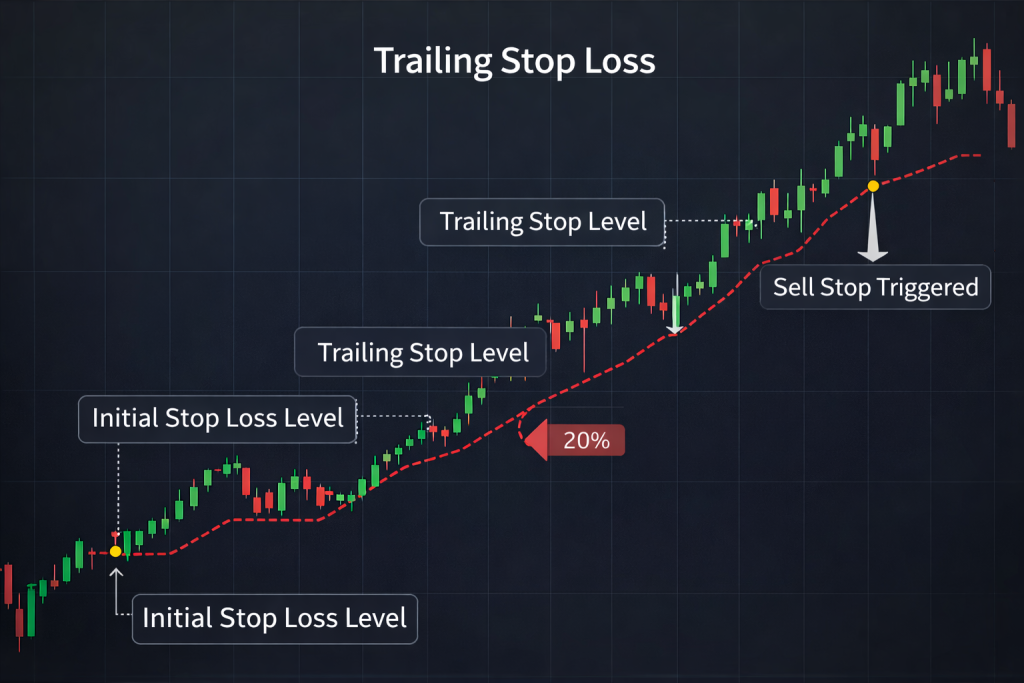
A Trailing Stop Loss is a dynamic risk-management tool designed to protect gains while allowing a winning position to continue moving in your favor. Unlike a fixed stop loss—which remains at a single price level—a trailing stop automatically adjusts upward (for long positions) as the stock price rises. The distance between the current price and the stop level is predefined, either as a percentage or a fixed dollar amount. When the price advances, the stop follows; when the price declines, the stop stays in place. This simple mechanism helps investors lock in profits without prematurely exiting strong trends. It’s a type of day trading order that lets you set a maximum value or percentage loss that you can incur on a trade. If the price of the stock rises or falls in your favor, the trailing stop goes with it, but if the price rises or falls against you, the stop stays in place.
The primary advantage of a trailing stop is that it removes emotion from exit decisions. Many traders struggle with the question, “When should I sell?”—especially after a position becomes profitable. Selling too early can cap potential gains, while holding too long can allow profits to evaporate during sudden reversals. A trailing stop provides a structured answer by defining the exit in advance. It ensures that capital is protected according to rules rather than impulse, which is particularly valuable in volatile markets where prices can change quickly.
Trailing stops can be configured in multiple ways. A percentage-based trail (for example, 8–12%) automatically widens or tightens with the stock’s price level, making it adaptable across different price ranges. A fixed-dollar trail (such as $3 or $5 below the current price) is simpler but may be less responsive for higher-priced securities. Some investors also align their trailing stop with technical indicators—such as moving averages or recent swing lows—to better reflect market structure rather than arbitrary numbers. The method chosen should match the asset’s volatility and the investor’s time horizon.
It is important to recognize that a trailing stop is not a guarantee of perfect exits. Rapid price gaps, illiquid markets, or extreme news events can trigger stops below the intended level. However, its purpose is not precision; it is consistency. Over time, a well-applied trailing stop helps preserve capital, smooth portfolio volatility, and maintain discipline across many trades rather than relying on one perfect decision.
In long-term investing as well as active trading, trailing stops serve as a bridge between growth and protection. They allow investors to participate in upward momentum while defining a clear boundary for acceptable downside. When integrated into a broader risk-management framework—alongside position sizing and portfolio diversification—a trailing stop becomes more than a tactical tool; it becomes a cornerstone of sustainable investing behavior.
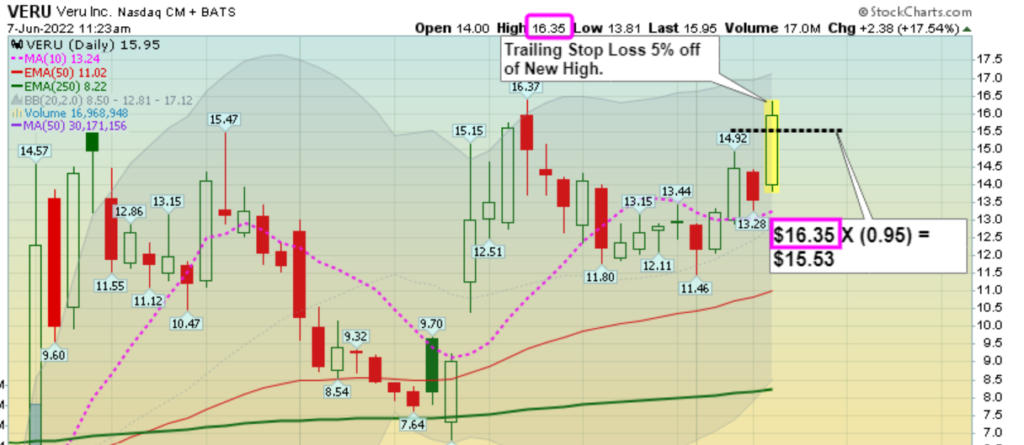
The chart below shows a 5% Trailing Stop Loss. This is extremely helpful because it allows traders to not have sit and monitor every stock they’re in and it prevents traders from incurring a huge loss.