By Andrew Stowers
Updated April 8, 2026
It’s 9:32 AM. Your setup is there. The signal just fired. The chart looks exactly right — and your finger is hovering over the buy button. Should you enter right now, or wait 15 more minutes?
If you don’t have a clear, rules-based answer to that question, you’re not alone. Most traders know what the stock market hours are. What they don’t know is how to use those hours strategically.
The NYSE and NASDAQ don’t open and close at arbitrary times. Those defined hours concentrate institutional order flow, produce repeatable intraday patterns, and — for the prepared trader — create specific windows where setups are far more likely to follow through than others.
This guide covers the full U.S. trading schedule, pre-market and after-hours sessions, the complete 2026 holiday calendar, and the part most competing articles never get to: the exact intraday windows where your entries carry the highest probability of working.
Standard U.S. Stock Market Hours
| Quick Answer
The U.S. stock market — including the NYSE and NASDAQ — is open for regular trading Monday through Friday from 9:30 AM to 4:00 PM Eastern Time. Both exchanges follow the same schedule and are closed on weekends and all federal holidays. |
Both the New York Stock Exchange (NYSE) and the NASDAQ operate on the same core schedule. The regular trading session opens at
Both the New York Stock Exchange (NYSE) and the NASDAQ operate on the same core schedule. The regular trading session opens at 9:30 AM Eastern Time and closes at 4:00 PM ET, Monday through Friday — six and a half hours of live market action. Other U.S. equity exchanges, including CBOE and BATS, follow the same window.
For the vast majority of stocks and ETFs that active traders focus on, this is the schedule that matters. It’s also the window where institutional order flow is most concentrated — which is precisely what creates the intraday patterns a rules-based trading system is designed to exploit. For more information on stock trading, we’ve published an entire Stock Trading Guide that is designed to help you hit the ground running.
| Session | Opens (ET) | Closes (ET) | Notes |
|---|---|---|---|
| Regular Session | 9:30 AM | 4:00 PM | Full liquidity, tightest spreads, most reliable signals |
| Pre-Market | 4:00 AM | 9:30 AM | Thin volume, wider bid-ask spreads, higher gap risk |
| After-Hours | 4:00 PM | 8:00 PM | Lower liquidity, limit orders only at most brokers |
Extended Hours: Pre-Market and After-Hours Trading
Yes, you can trade stocks outside the regular session — but you need to understand exactly what you’re stepping into before you do.
Pre-Market Trading (4:00 AM – 9:30 AM ET)
Pre-market trading is available at most major retail brokers starting as early as 4:00 AM ET, though some platforms don’t open their pre-market window until 7:00 AM ET. This is where overnight news gets priced in — earnings reports, economic data releases, and macro events often drive significant pre-market moves before the bell.
The challenge: volume is a fraction of what you’ll see during the regular session. Fewer participants means wider bid-ask spreads, which directly increases your slippage on every entry and exit. A single large order can move a stock dramatically in pre-market — and those moves frequently don’t hold once regular-session volume arrives.
After-Hours Trading (4:00 PM – 8:00 PM ET)
After-hours trading opens when the regular session closes at 4:00 PM ET and typically runs until 8:00 PM ET. Earnings releases and late-breaking news hit the tape here — a stock can move 10–20% in after-hours on a single earnings beat or miss. The same risks apply: thin volume, wide spreads, and erratic price behaviour. Most brokers restrict after-hours trading to limit orders, and for good reason.
| ATGL Rule of Thumb
Extended-hours sessions are best used for monitoring price reactions to news events — not for executing new swing trade entries. Use them for information gathering with a clearly defined risk parameter, not as a primary execution environment. |
Stock Market Holiday Schedule for 2026
The NYSE and NASDAQ are closed on the following federal holidays in 2026. No regular session or extended-hours trading takes place on full-closure days. Mark these on your trading calendar.
| Holiday | Date (2026) | Session Status |
|---|---|---|
| New Year’s Day | Thursday, January 1 | Full closure |
| Martin Luther King Jr. Day | Monday, January 19 | Full closure |
| Presidents’ Day | Monday, February 16 | Full closure |
| Good Friday | Friday, April 3 | Full closure |
| Memorial Day | Monday, May 25 | Full closure |
| Juneteenth | Friday, June 19 | Full closure |
| Independence Day (observed) | Friday, July 3 | 1:00 PM ET early close |
| Independence Day | Saturday, July 4 | Full closure |
| Labor Day | Monday, September 7 | Full closure |
| Thanksgiving Day | Thursday, November 26 | Full closure |
| Day After Thanksgiving | Friday, November 27 | 1:00 PM ET early close |
| Christmas Eve | Thursday, December 24 | 1:00 PM ET early close |
| Christmas Day | Friday, December 25 | Full closure |
Note: if you hold ETFs tracking international indices, those underlying markets may still have price exposure on U.S. holidays — but you won’t be able to trade the U.S.-listed ETF itself.
Beyond the scheduled holiday calendar, trading can also be interrupted mid-session. Circuit breakers halt all U.S. equity trading if the S&P 500 drops 7%, 13%, or 20% intraday. Individual stocks can experience trading halts due to news-pending reviews or volatility triggers. These are separate from the holiday schedule but are part of the full picture of when trading is and isn’t possible.
Opening Bell Volatility: Why the First 30 Minutes Are Dangerous
Here’s where a large number of retail traders give money back to the market every single day: treating 9:30 AM as a starting gun and immediately firing entries into the open.
The first 15–30 minutes after the bell are the most volatile — and the least reliable — period of the entire trading day. Overnight, orders accumulate from institutional desks, algorithmic systems, and retail traders reacting to pre-market news. The moment the bell rings, all of that pent-up order flow hits the market simultaneously. Spreads are at their widest. Pre-market gaps are resolving in real time. A stock that moved 5% pre-market on earnings can spike another 3% at the open — and then reverse the entire move inside 10 minutes.
This is the opening-range false move: an aggressive initial push in one direction that traps early entrants before reversing sharply. It’s not random — it’s the predictable result of competing order flows reaching equilibrium after overnight accumulation. Gap trading around specific catalysts is a legitimate strategy, but it requires a pre-defined system with explicit rules — not a reactive finger on the trigger at 9:31 AM.
| ATGL’s Rules-Based Approach to the Open
Observe for the first 15 minutes. Watch where the stock opens relative to the prior day’s range and pre-market levels. Is the pre-market move being confirmed by regular-session volume, or faded? Let the order flow settle before committing capital. A setup that’s valid at 9:32 AM is still valid at 9:48 AM — and by then you’ll have far more information about whether it’s actually working. |
The Best Times to Enter a Trade During Market Hours
| Quick Answer
The best times to enter a stock trade are 9:45–10:30 AM ET (opening volatility settles, directional momentum confirmed) and 3:00–3:45 PM ET (institutional volume surges into the close). Avoid the 11:00 AM–2:00 PM midday window — low volume produces choppy, unreliable price action. |
Now that you know when not to trade, here’s the framework for when to look for entries. The trading day breaks into three distinct windows, each with its own volume profile, volatility characteristics, and reliability as an execution environment.
Window 1: 9:45 – 10:30 AM ET | Early Momentum
This is ATGL’s primary entry window for intraday and short-term swing setups. By 9:45 AM, the opening frenzy has largely resolved. Stocks that were gapping up or down have either confirmed their direction or begun to fade. Volume is still elevated — high enough for reliable price discovery — but the worst of the spread widening and false moves is behind you.
What you’re looking for: stocks that held above or below a key level through the initial volatility and are now moving directionally with conviction. A breakout that holds through the first 15 minutes and continues pushing in this window is a significantly higher-quality signal than one that fires at 9:31 AM. Institutional desks are now fully active, their participation tightening spreads and adding directional fuel to legitimate moves.
Window 2: 11:00 AM – 2:00 PM ET | The Midday Lull
Volume falls off a cliff between 11:00 AM and 2:00 PM ET. Institutional desks step back. Algorithmic systems throttle down. The result is a low-volume, choppy, mean-reverting tape where breakouts frequently fail, trends flatten, and noise dominates signal.
Best uses of the midday lull:
- Monitor existing positions — do not add to them
- Review your watchlist for afternoon setups
- Adjust stops on open positions to protect morning gains
- Conduct research and trade planning for the next session
- Stay flat entirely if you’re in a drawdown period
Executing new entries during the midday lull is one of the most common — and most correctable — habits that quietly drain retail trading accounts.
Window 3: 3:00 – 3:45 PM ET | Closing Momentum
Volume picks up sharply as the session approaches the close. Institutional investors and fund managers execute the bulk of their end-of-day orders here. This participation creates genuine directional momentum on stocks that have trended throughout the day.
A stock that has trended upward all session and sees a volume surge heading into 3:00 PM is signalling institutional accumulation into the close — a constructive sign. Conversely, a stock that rallied in the morning and is now fading on rising afternoon volume is distributing into strength. The 3:00–3:45 PM window is also the key decision point for managing existing positions: hold overnight, or close into strength.
| The Three-Window Framework
9:45 – 10:30 AM → ENTER: Early momentum, directional confirmation, volume supporting the move |
One important caveat: these windows are probability filters, not absolute rules. A clean, rules-based setup with strong volume confirmation that triggers at 1:15 PM is still a valid signal — your system takes precedence. The framework shifts the odds in your favour; it doesn’t override objective criteria.How Time Zones Affect Stock Market Hours for Non-ET TradersIf you’re trading from outside the Eastern Time zone, here’s your quick-reference conversion for the regular session and all three intraday windows.
| Session / Window | ET | CT | MT | PT |
|---|---|---|---|---|
| Market Open | 9:30 AM | 8:30 AM | 7:30 AM | 6:30 AM |
| Early Momentum Window | 9:45 – 10:30 AM | 8:45 – 9:30 AM | 7:45 – 8:30 AM | 6:45 – 7:30 AM |
| Midday Lull | 11 AM – 2 PM | 10 AM – 1 PM | 9 AM – 12 PM | 8 AM – 11 AM |
| Closing Momentum Window | 3:00 – 3:45 PM | 2:00 – 2:45 PM | 1:00 – 1:45 PM | 12:00 – 12:45 PM |
| Market Close | 4:00 PM | 3:00 PM | 2:00 PM | 1:00 PM |
West Coast traders face a real structural challenge: the early momentum window opens at 6:45 AM Pacific Time. Many experienced PT-zone traders build their pre-market routine around a 5:30–6:00 AM start to be sharp and fully prepared for the morning session. It’s a structural disadvantage relative to ET traders, but one that consistent preparation can offset.
Futures, Crypto, and 24-Hour Markets: How They Compare
Stock market hours exist because the NYSE and NASDAQ are centralised exchanges with defined open and close times. Not every market operates this way — and understanding the contrast clarifies why session timing matters so much for equity traders.
U.S. equity index futures — including the E-mini S&P 500 (ES) and NASDAQ 100 (NQ) — trade on the CME Globex electronic platform nearly 24 hours a day, from Sunday evening at 6:00 PM ET through Friday at 5:00 PM ET with a brief daily maintenance break. Watching ES and NQ futures is a standard part of pre-market preparation for any serious equity trader — overnight futures action often signals where equities will open.
Cryptocurrency markets have no defined trading hours at all. Bitcoin, Ethereum, and other crypto assets trade 24/7/365 on decentralised and centralised platforms alike. No opening bell, no holiday closure, no midday lull.
For equity traders, this comparison reinforces a fundamental point: the intraday patterns described in this guide — the volatile open, the midday lull, the closing momentum surge — exist because stock market hours create defined start and end points. That structure concentrates institutional order flow into predictable windows. That concentration is what rules-based traders study, map, and build systems around.
| Feature | U.S. Stocks (NYSE / NASDAQ) | Equity Futures (CME Globex) |
|---|---|---|
| Regular Hours | 9:30 AM – 4:00 PM ET, Mon–Fri | Sun 6 PM – Fri 5 PM ET (near 24hr) |
| Extended Hours | 4 AM–9:30 AM / 4–8 PM ET | Continuous (brief daily break) |
| Holiday Closures | Yes — 9 full days + 3 early closes in 2026 | Reduced hours on select holidays |
| Weekend Trading | No | Limited Sunday evening session |
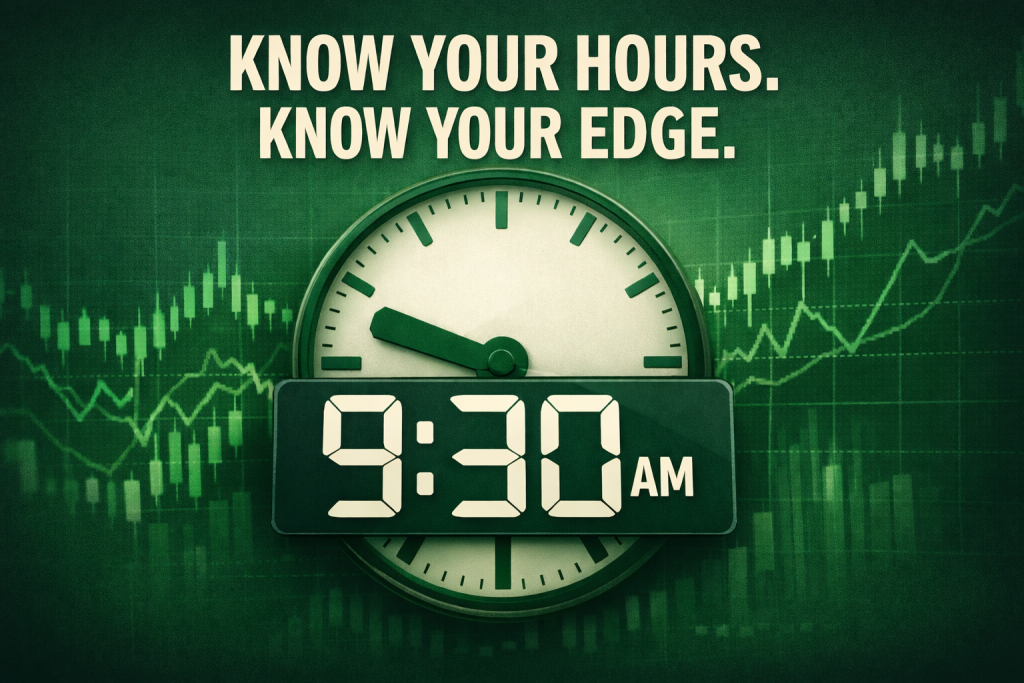
Know Your Hours. Know Your Edge.Stock market hours are not just a calendar fact — they’re a structural feature of the market that directly shapes how price moves throughout the day. Traders who understand this use session timing as a filter that sharpens every entry decision they make.The framework in plain terms:
- Regular session: 9:30 AM–4:00 PM ET, Monday–Friday
- Extended hours exist but carry elevated risk — use them for monitoring, not execution
- The first 15–30 minutes after the open are the most volatile and least reliable for entries
- 9:45–10:30 AM and 3:00–3:45 PM offer the highest intraday entry quality
- The 11 AM–2 PM midday lull is a low-probability environment for new positions
Timing is one layer of edge. The next layer is knowing exactly what to trade and how to structure the position when the window opens. That’s where a complete, rules-based trading system makes all the difference — one built on objective setup criteria, defined risk, and consistent execution across every session.
| Ready to Build Your Rules-Based Trading System?
At AboveTheGreenLine.com we teach a systematic approach to swing trading U.S. equities — clear setups, defined risk, disciplined execution. If you’re serious about taking your trading to the next level, join us Above the Green Line and get access to the full system, real-time trade alerts, and a community of traders who take process as seriously as you do. |
Frequently Asked Questions
What time does the pre-market open for stocks?
Pre-market trading typically begins at 4:00 AM ET and runs until the regular session opens at 9:30 AM ET. Most retail brokers offer access from 4:00 AM, though some limit the pre-market window to a shorter session starting at 7:00 AM ET. Volume is significantly thinner than during regular hours and bid-ask spreads are wider, increasing slippage risk on both entries and exits.
Is the stock market open on weekends?
No. The NYSE and NASDAQ are closed on Saturdays and Sundays. Cryptocurrency markets operate 24/7/365 and equity index futures have a limited Sunday evening session, but standard U.S. stock trading is strictly a Monday–Friday activity governed by the NYSE/NASDAQ holiday schedule.
What is the best time of day to buy stocks?
Most active traders favour the 9:45–10:30 AM ET window, after opening volatility settles and directional momentum becomes clearer. The 3:00–3:45 PM window is also strong, driven by institutional order flow heading into the close. Both are preferable to the 11 AM–2 PM midday lull, where low volume leads to choppy price action and a high rate of failed breakouts.
Do stock market hours differ by exchange?
The NYSE and NASDAQ both operate 9:30 AM–4:00 PM ET and all U.S.-listed equities and ETFs follow this schedule. Regional and international exchanges operate on different local schedules. For U.S. equity traders, the NYSE/NASDAQ window is the definitive reference for when stocks are fully liquid and institutional order flow is active.


Penny Stocks: How to Identify High-Probability Setups Using Rules-Based Investing
Margin Call Explained: What Triggers It and How to Avoid One

AMC Short Squeeze Explained: Timeline, Causes, and Trading Risks
Volatility Clustering in Financial Markets: Understand Why It Happens