Building Stability Through Structured Asset Allocation
By ATGL
Updated February 18, 2026
Portfolio diversification is one of the most frequently cited principles in investing, yet it is also one of the most misunderstood. Many investors believe diversification simply means owning multiple stocks. In reality, true diversification is not about quantity — it is about intentional distribution of risk across assets that behave differently under varying market conditions.
A well-diversified portfolio does not eliminate risk, nor is that its purpose. Instead, diversification aims to reduce the impact of any single asset, sector, or economic event on overall performance, allowing investors to pursue long-term growth with greater stability and emotional discipline. Many investors find that dividend growth investing provides a balanced foundation for diversification because consistent income streams can offset equity volatility over time.
At Above the Green Line, diversification is approached through a rules-based system. Rather than relying on intuition or headlines, structured asset allocation and periodic review help investors maintain balance while adapting to evolving market environments. Diversification is not a one-time decision — it is an evolving process aligned with financial goals and time horizons.
The Purpose of Diversification
The primary purpose of diversification is risk management. Markets move in cycles, industries expand and contract, and individual companies face unpredictable events. A portfolio concentrated in one area may perform well temporarily but remains vulnerable to sudden downturns.
Diversification distributes exposure so that weakness in one segment may be offset by strength in another. The goal is not maximizing short-term returns, but smoothing the long-term journey. Investors who understand this distinction are more likely to remain disciplined during volatility rather than reacting emotionally.
Diversification also improves psychological resilience. Knowing a portfolio is balanced reduces anxiety and impulsive behavior — benefits that often prove as valuable as financial returns.
Asset Class Diversification
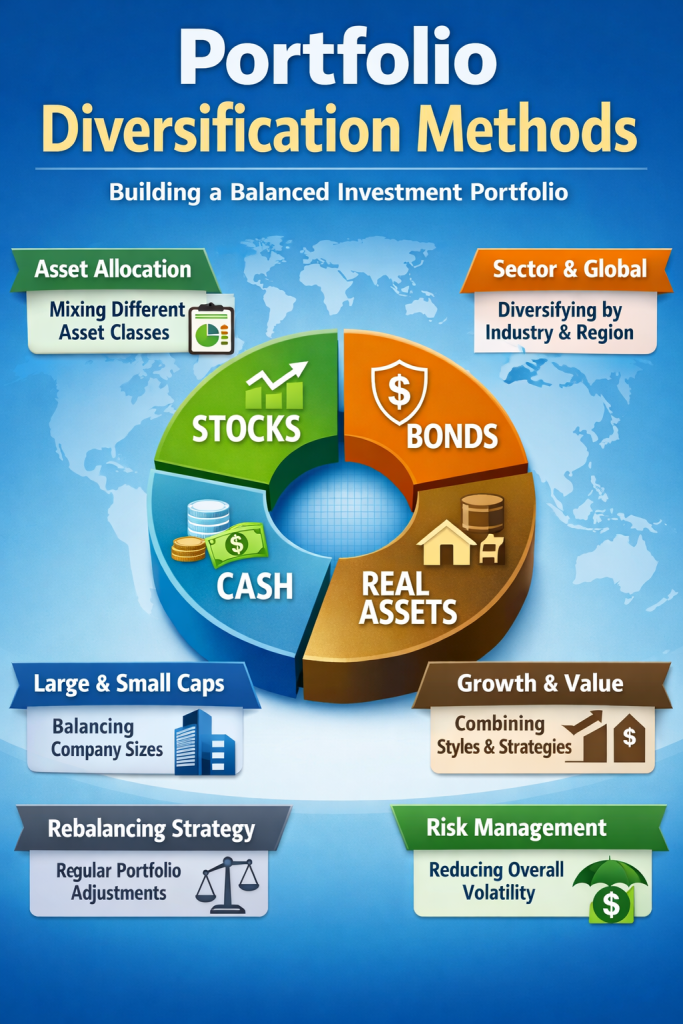
The foundation of diversification begins with distributing investments across major asset classes. Each asset class responds differently to economic forces, interest rates, and inflation.
Equities provide long-term growth but carry higher volatility.
Fixed income offers income and relative stability, often counterbalancing equity downturns.
Real assets such as real estate and commodities can hedge inflation and currency fluctuations.
Cash provides liquidity and strategic flexibility during market corrections.
Combining these asset classes creates a structural base designed to withstand varying economic climates rather than relying on a single performance driver.
Sector and Geographic Diversification
Even within equities, diversification is incomplete without sector and geographic balance. Industries respond differently to economic shifts — technology may thrive during innovation cycles, while healthcare and consumer staples often provide defensive stability during recessions.
Geographic diversification broadens this protection by spreading exposure across domestic and international markets. Economic cycles, political developments, and currency movements differ globally, and combining regions reduces dependence on a single economy.
Together, sector and geographic diversification help ensure that portfolios are not overly exposed to localized downturns or industry-specific disruptions.
Equity Diversification: Size and Style
Diversification within equities also involves blending company sizes and investment styles.
Large-cap companies typically provide stability and dividend consistency.
Mid-cap firms balance growth potential with moderate risk.
Small-cap stocks offer higher growth opportunities but increased volatility.
Investment style matters as well. Growth stocks focus on earnings expansion and innovation, while value stocks emphasize undervaluation and financial strength. These styles often perform differently across market cycles, making their combination an effective diversification technique.
By blending size and style, investors participate in innovation while maintaining structural stability.
Time Diversification and Dollar-Cost Averaging
Diversification is not limited to asset selection; it also includes timing strategies. Dollar-cost averaging involves investing fixed amounts at regular intervals rather than attempting to predict market entry points. This reduces the risk of investing large sums at unfavorable prices and smooths average purchase costs.
Time diversification acknowledges uncertainty. Consistency often proves more effective than prediction, particularly for long-term investors seeking gradual portfolio expansion.
Correlation and the Role of ETFs
True diversification depends on correlation — the degree to which assets move in relation to one another. Assets with low or negative correlation provide stronger diversification benefits because they respond differently to economic events.
Exchange-Traded Funds (ETFs) simplify achieving this balance by offering broad exposure to sectors, regions, or asset classes through a single instrument. While ETFs make diversification more accessible, investors must still avoid overlapping holdings that move in tandem and undermine intended balance. Modern ETF investing strategies allow investors to achieve sector and geographic diversification efficiently without purchasing dozens of individual securities.
Understanding correlation ensures diversification is functional, not superficial.
Rebalancing and Maintenance
Diversification requires maintenance. Market movements naturally alter portfolio weights, potentially increasing concentration risk over time. Rebalancing restores intended allocations by trimming outperforming assets and reinforcing underweighted areas.
This process enforces discipline and encourages buying low and selling high rather than chasing trends. Quarterly or annual reviews help maintain structural integrity without overreacting to short-term volatility.
Behavioral Considerations and Common Pitfalls
Diversification offers significant psychological advantages, but it is frequently misapplied. Some investors over-diversify, spreading capital so thin that meaningful returns become diluted. Others fall into false diversification, holding assets that appear different but share high correlation.
Behaviorally, diversified portfolios reduce panic selling and overconfidence, fostering emotional discipline. The greatest mistake is treating diversification as a one-time action rather than an ongoing strategy requiring periodic evaluation.
Integrating Diversification With Financial Goals
Diversification must align with personal objectives, not generic templates. Younger investors may emphasize growth-oriented allocations, while retirees often prioritize income and stability. Life stage, income needs, and risk tolerance influence allocation decisions more than market forecasts.
Structured planning ensures diversification supports long-term goals rather than reacting to short-term trends. Investors who understand their objectives can adapt allocation methods without abandoning discipline.
Diversification Within a Rules-Based Framework
At Above the Green Line, diversification is not treated as a passive guideline but as an active framework supported by measurable criteria. Asset allocation thresholds, sector weighting, and periodic review schedules reduce emotional interference and improve consistency.
A rules-based approach transforms diversification from concept to execution, allowing portfolios to evolve through objective metrics rather than impulse or market noise. By establishing predefined allocation thresholds and review intervals, investors reduce behavioral bias and maintain structural balance across market cycles. This disciplined framework promotes consistency, ensuring that portfolio adjustments are intentional, data-driven, and aligned with long-term financial objectives
Key Takeaway
Diversification is not about owning many assets — it is about owning assets that respond differently to economic forces. By combining asset classes, sectors, geographies, market capitalizations, and investment styles within a disciplined framework, investors reduce concentration risk and enhance long-term stability. The objective is not perfection, but balance that evolves with financial goals and market conditions.
Final Thoughts
Portfolio diversification is both an analytical strategy and a behavioral safeguard. It protects against unforeseen events, encourages emotional discipline, and supports steady progress toward financial independence. Rather than chasing the highest-performing asset at any given moment, diversified investors pursue resilience, adaptability, and structured growth.
Uncertainty is unavoidable in investing. Diversification does not eliminate that uncertainty — it transforms it into manageable variability. By approaching asset allocation with intention and periodic review, investors build portfolios designed not merely to survive market cycles, but to advance steadily through them.
Ready to put these principles into action?
Join Above the Green Line to access structured investing guides, real-time market insights, and rules-based strategies designed to help you build disciplined, diversified portfolios with confidence. Whether you are refining asset allocation or strengthening long-term income planning, you’ll gain practical tools and education to make informed, data-driven decisions.

Related Articles

How to Use Net Present Value (NPV) for Dividend Stocks

Free Cash Flow: The Ultimate Guide to Financial Strength and Dividend Sustainability

Dividend Reinvestment Plan (DRIP): How Automatic Reinvestment Builds Long-Term Wealth

Dividend Growth vs High Yield: Choosing the Right Income Strategy for Long-Term Investors