By Andrew Stowers
Updated March 12, 2026
Leverage can be a powerful tool in the stock market. By borrowing money from a brokerage firm, investors can increase the size of their positions and potentially amplify gains.
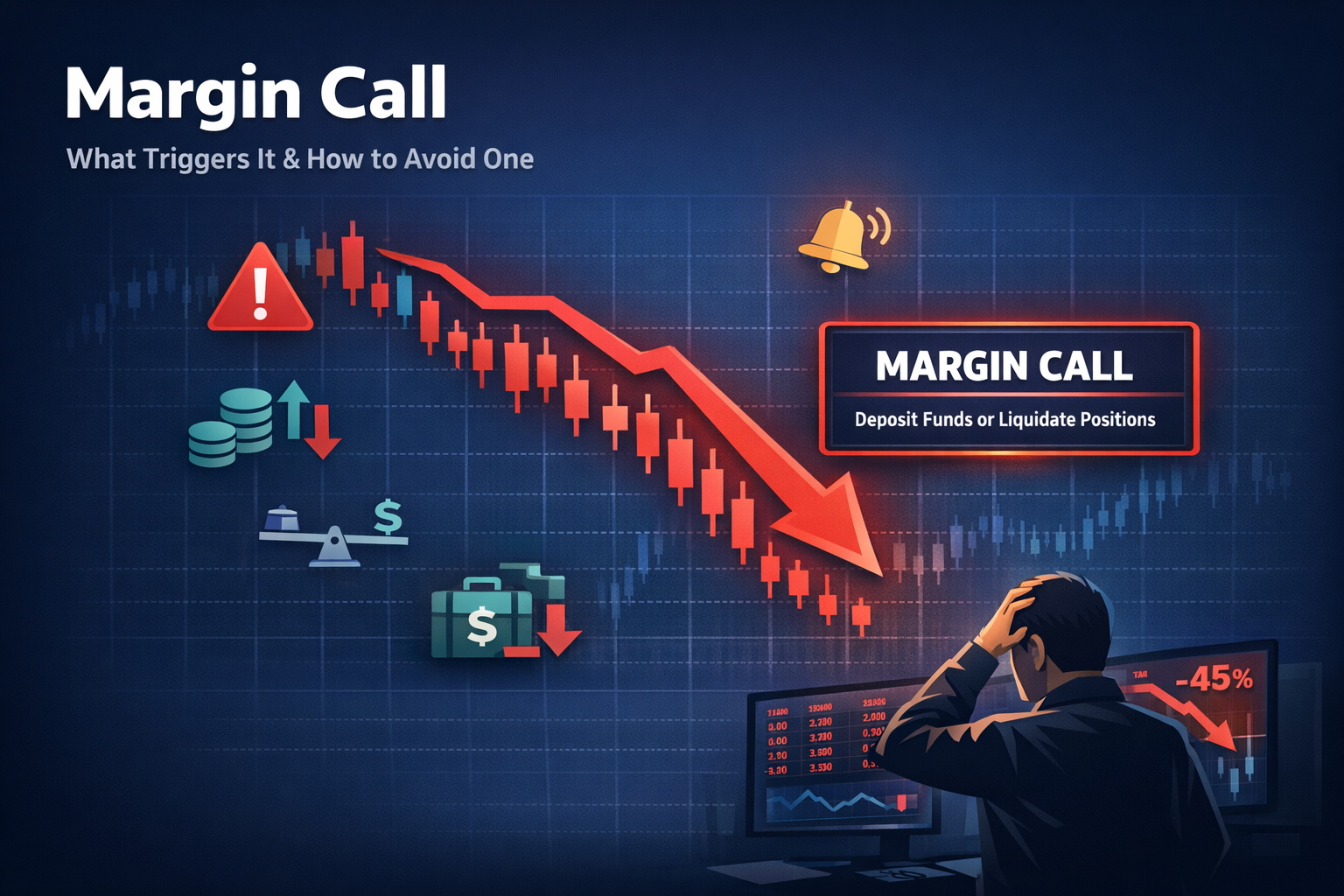
But leverage cuts both ways. When markets move against a leveraged position, losses accumulate faster. If those losses push an investor’s account below a required threshold, the brokerage firm may issue a margin call. Margin calls are one of the most important risks associated with margin trading. Understanding how they work—and how to prevent them—can help investors avoid forced liquidation and unexpected losses. This guide explains what a margin call is, how it happens, and the practical strategies traders use to manage margin risk.
What Is a Margin Call?
A margin call occurs when a brokerage firm demands that an investor deposit additional funds or securities into their margin account. This happens when the investor’s account equity falls below the broker’s required maintenance margin level. In simple terms, a margin call means the investor has borrowed money to invest, and their investment has lost enough value that the broker now requires additional collateral. If the investor cannot meet the margin call, the broker has the right to sell assets in the account to recover the borrowed funds. Because margin trading involves borrowed money, margin calls can occur quickly during market downturns.
Why Margin Trading Exists
Margin trading allows investors to borrow money from their brokerage to purchase securities. For example, an investor with $10,000 in their account might borrow an additional $10,000 to purchase $20,000 worth of stock. This leverage increases purchasing power. If the investment rises in value, the investor benefits from gains on the entire $20,000 position rather than just their initial capital. However, the reverse is also true. If the stock declines, losses are calculated based on the full leveraged position. That means margin trading magnifies both gains and losses. Understanding the risks associated with borrowing money to invest is essential before using leverage.
How Margin Calls Happen
Margin accounts operate under specific rules set by brokerage firms and regulators.
Two important requirements govern margin accounts:
- Initial margin requirement
- Maintenance margin requirement
The initial margin requirement determines how much of a purchase must be funded with the investor’s own capital. The maintenance margin requirement determines the minimum level of equity that must remain in the account after the investment is made. If the account falls below this threshold, the broker issues a margin call. These rules are part of broader margin account requirements, which define how leveraged trading works.
Maintenance Margin Explained
Maintenance margin represents the minimum percentage of account equity an investor must maintain relative to borrowed funds. In many cases, brokers require investors to maintain at least 25% equity, although some firms require higher levels depending on market conditions or the volatility of the securities involved.
For example:
An investor purchases $20,000 of stock using:
- $10,000 of their own money
- $10,000 borrowed from the broker
If the value of the stock declines, the investor’s equity shrinks. Once the account equity falls below the required maintenance margin level, the brokerage issues a margin call demanding additional funds.
Example of a Margin Call
Consider a simple example.
An investor deposits $10,000 into a margin account and borrows another $10,000 to purchase $20,000 worth of stock.
Initially:
- Total investment: $20,000
- Investor equity: $10,000
- Borrowed funds: $10,000
Now suppose the stock declines by 25%. The investment is now worth $15,000. However, the investor still owes the broker the original $10,000 loan. That means the investor’s equity has dropped to $5,000. If the brokerage requires a 25% maintenance margin, the account may now fall below the required threshold. At that point, the broker issues a margin call, requiring the investor to deposit additional funds or sell securities.
What Happens After a Margin Call?
When a margin call occurs, the investor must take action to restore the account balance. Typically, investors can respond in one of three ways:
- Deposit Additional Cash
The investor can transfer funds into the account to increase equity and satisfy the margin requirement.
- Deposit Additional Securities
Some brokers allow investors to transfer marginable securities into the account as collateral.
- Sell Positions
The investor may sell part of their holdings to reduce the borrowed balance.
If none of these actions are taken, the brokerage firm can sell securities automatically. This process is known as forced liquidation. During volatile markets, forced liquidation can occur quickly, often at unfavorable prices.
Can You Owe Money After a Margin Call?
Yes. If a brokerage firm liquidates positions and the proceeds are not enough to repay the borrowed funds, the investor remains responsible for the remaining balance. This is one reason margin trading carries significantly higher risk than traditional investing. Even after liquidation, investors may still owe money to the brokerage firm.
How Investors Avoid Margin Calls
Professional traders use several risk management strategies to reduce the likelihood of margin calls. One of the most important techniques is position sizing. Position sizing determines how much capital is allocated to each trade relative to the total portfolio. By limiting position size, traders ensure that losses in a single position do not threaten the stability of the entire account. Another important concept is evaluating the risk reward ratio before entering a leveraged position. If the potential downside outweighs the expected gain, leverage can amplify risk without improving returns.
Stop-Loss Strategies
Another common strategy involves using stop loss strategy trading techniques. A stop-loss order automatically sells a security when its price falls below a specified level. This prevents losses from growing large enough to trigger a margin call. For example, if a trader buys a stock at $50, they may place a stop-loss order at $45. If the price falls to that level, the position is automatically closed. While stop-loss orders cannot eliminate risk entirely, they help enforce discipline during volatile market conditions.
Margin Accounts vs Cash Accounts
Not every investor uses margin accounts. Many long-term investors prefer to avoid leverage entirely by using traditional brokerage accounts. Understanding the difference between a margin account vs cash account is essential. A cash account allows investors to purchase securities only with funds already deposited in the account. A margin account, on the other hand, allows investors to borrow money from their broker to increase purchasing power. While margin accounts provide flexibility, they introduce additional risks—including margin calls. For investors who prioritize capital preservation, avoiding leverage may be the safer choice.
Should You Trade on Margin?
Margin trading can be useful in certain situations. Professional traders sometimes use leverage to increase exposure to short-term opportunities or hedge other positions. However, margin trading is not necessary for most long-term investors. Many successful portfolios are built without borrowing money.
Leverage is most appropriate for investors who:
- understand market volatility
- use strict risk management rules
- maintain sufficient account equity
Without those safeguards, margin trading can increase the likelihood of large losses.
Why Margin Calls Matter for Investors
Margin calls are more than just technical account events. They can trigger rapid liquidation of positions across the market. During major market declines, margin calls often accelerate selling pressure. As investors are forced to sell positions to cover losses, prices may fall even further. This dynamic has contributed to several historic market crashes. Understanding margin mechanics therefore helps investors better understand market volatility.
Why Margin Calls Increase During Market Crashes
Margin calls often become more common during periods of extreme market volatility. When stock prices fall quickly, leveraged positions across the market begin losing value at the same time. As account equity declines, many investors simultaneously fall below required maintenance margin levels. Brokers then issue margin calls across thousands of accounts. This creates a chain reaction. Investors who cannot immediately add capital must sell assets to restore their margin balance. When many traders sell at the same time, the additional selling pressure can push prices even lower. This process is sometimes referred to as margin liquidation pressure. Historical market crashes—including the 1929 stock market crash, the 2008 financial crisis, and the 2020 pandemic selloff—all involved periods where forced margin liquidations accelerated market declines. For this reason, professional traders closely monitor leverage levels during volatile markets. When leverage across the financial system becomes too high, even small price movements can trigger large waves of margin calls.
Margin Calls and Options Trading
Margin calls can also occur when investors trade options strategies that require margin collateral. Certain strategies—such as selling uncovered options or writing spreads—require traders to maintain margin balances in their accounts. If market movements increase the potential risk of these positions, brokers may require additional collateral. This is particularly important because options positions can change in value rapidly as expiration dates approach. As a result, traders using options leverage must carefully monitor their margin balances to avoid unexpected margin calls. Understanding how leverage works across both stock and derivatives markets helps investors maintain better control over portfolio risk.
Bringing It All Together
Here’s the key takeaway.
Margin trading magnifies everything. It magnifies profits when trades move in your favor. But it also magnifies losses when markets decline. A margin call is the mechanism brokers use to control that risk. Understanding how margin works—and how to manage leverage responsibly—can help investors avoid forced liquidation and unnecessary losses. If you want to learn more, check out our free Stock Trading Strategy Guide. If you want structured guidance on applying disciplined investment strategies, you can learn more about our membership.
Because successful investing isn’t about using the most leverage. It’s about making the smartest decisions with the capital you already have.

Related Articles

Penny Stocks: How to Identify High-Probability Setups Using Rules-Based Investing

AMC Short Squeeze Explained: Timeline, Causes, and Trading Risks
Volatility Clustering in Financial Markets: Understand Why It Happens
Chaikin Money Flow (CMF): How to Use Volume to Spot Real Market Strength