By ATGL
Updated February 18, 2026
Dividend sustainability is the foundation of dividend growth investing. A dividend is only valuable if it can survive stress—recessions, margin compression, higher interest rates, and industry disruption—without forcing investors into a yield trap where the payout looks attractive right up until the cut arrives.
At Above the Green Line (ATGL), dividends are viewed as an engine rather than a paycheck. The objective is not merely to collect income today, but to build a portfolio that can reliably pay and consistently raise income over time while protecting principal. Sustainability is what makes that possible.
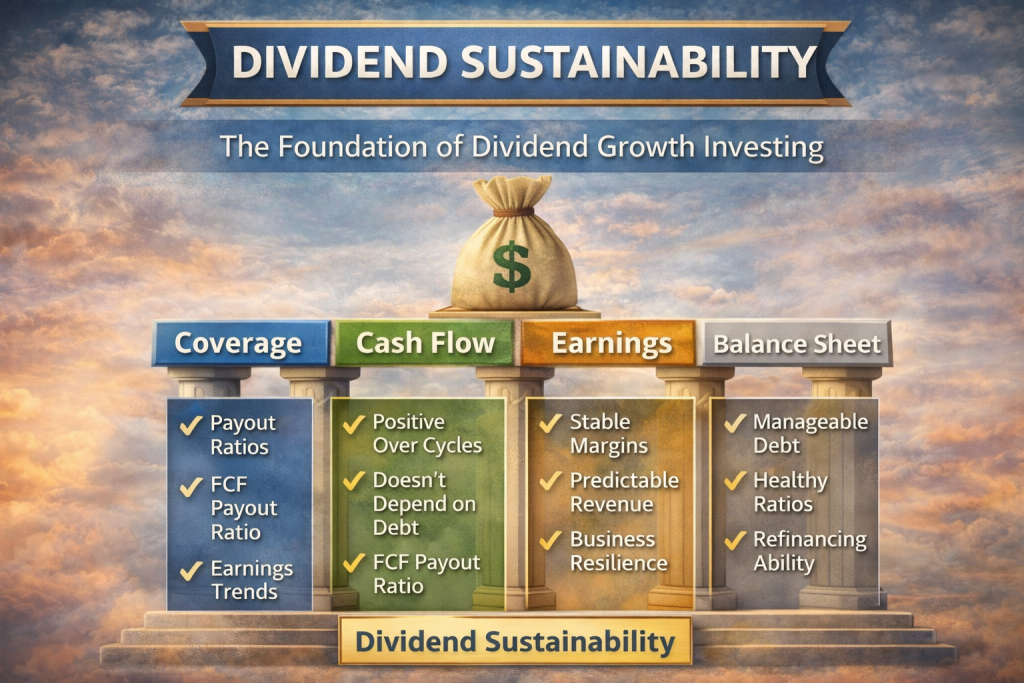
Dividend sustainability is not measured by a single ratio. It is a framework of aligned signals—coverage, cash flow, earnings durability, and balance-sheet flexibility. When these indicators reinforce each other, the dividend is more likely to endure multiple economic cycles. When they diverge—rising payout ratios, shrinking free cash flow, and increasing leverage—the dividend may be operating on borrowed time.
What Dividend Sustainability Really Means
A sustainable dividend is one a company can pay and defend through changing economic conditions without weakening the business itself. This implies that:
- The company generates sufficient cash after operating needs.
- The payout leaves room for reinvestment and debt service.
- Earnings are stable enough to support continued increases.
- The balance sheet can absorb unexpected shocks.
Investors often equate a long payment history with safety. In reality, sustainability is forward-looking. A dividend can appear reliable for years and still become fragile if the financial engine beneath it weakens. True sustainability is based on present financial strength and future earning power—not reputation.
The Four Pillars of Dividend Sustainability
Coverage Strength
Coverage addresses how easily the company can afford its dividend. A common starting point is the earnings payout ratio, calculated as dividends divided by earnings per share. Lower payout ratios generally provide a buffer, but context matters. Utilities and consumer staples often operate with higher ratios due to stable revenue streams, while cyclical or growth companies require more margin for reinvestment.
ATGL principle: A dividend should earn its place. If the payout is high, the business must be unusually stable and predictable.
Free Cash Flow Quality
Dividends are paid in cash, not accounting profits. Free cash flow (FCF) therefore becomes one of the strongest sustainability indicators. FCF is calculated as operating cash flow minus capital expenditures. A healthy company generates enough free cash flow to fund dividends while maintaining assets and growth initiatives.
Warning signs appear when dividends rise while free cash flow stagnates or declines. This often signals hidden strain that accounting earnings alone may not reveal.
Balance Sheet Flexibility
Debt quietly influences dividend safety. Companies with heavy leverage or near-term refinancing obligations may find dividends competing with interest payments for priority. Balance sheet flexibility allows management to navigate downturns without sacrificing shareholder returns.
Key metrics include debt-to-equity ratios, interest coverage, and the maturity schedule of outstanding obligations. A flexible balance sheet provides options; a stressed one forces difficult trade-offs.
Earnings Durability and Business Resilience
A sustainable dividend originates from a resilient business model. Companies with recurring revenue, pricing power, and essential products tend to maintain dividends more consistently through economic cycles.
Indicators of durability include stable revenue growth, consistent margins, and competitive advantages such as brand strength or switching costs. Investors are not buying a dividend in isolation—they are buying a business capable of funding that dividend for years to come.
The Dividend Sustainability Scorecard
A practical, rules-based checklist helps remove emotional bias:
Coverage Checklist
- Earnings payout ratio stable or declining
- Sector-appropriate payout level
- Dividend growth aligned with earnings growth
Cash Flow Checklist
- Consistently positive free cash flow
- Sustainable FCF payout ratio
- No repeated borrowing to fund dividends
Balance Sheet Checklist
- Stable or improving debt metrics
- Adequate interest coverage
- No imminent refinancing pressure
Business Quality Checklist
- Predictable revenue streams
- Stable profit margins
- Pricing power or durable demand
- Consistent capital allocation policy
A strong candidate typically satisfies most of these conditions rather than excelling in only one.
Common Dividend Sustainability Traps
The Yield Trap
A high yield often results from a declining stock price rather than improving fundamentals. When yield rises while payout ratios weaken, the market may be signaling elevated risk rather than opportunity.
The Borrowed Dividend
Some companies maintain dividends through increased borrowing. While this may preserve appearances temporarily, it reduces future flexibility and heightens risk during rising interest-rate environments.
The Cyclical Illusion
In cyclical industries such as energy or industrials, payout ratios can look safe at the top of a cycle and dangerous at the bottom. Sustainability must be evaluated across full cycles rather than single periods.
Sector-Specific Considerations
Real Estate Investment Trusts (REITs) rely on cash-flow measures like Funds From Operations (FFO) or Adjusted FFO instead of net income, which can be distorted by depreciation. Sustainable REIT dividends depend on property cash flow stability and manageable debt.
Utilities often maintain higher payout ratios due to regulated income streams. Their sustainability hinges on rate structures, interest coverage, and regulatory environments.
Technology dividend growers typically show lower yields but higher growth potential. Their sustainability is driven by strong margins, cash reserves, and continued innovation rather than yield size alone.
Dividend Sustainability and Dividend Growth
Dividend Sustainability is what transforms dividend growth from temporary to enduring. The strongest dividend growth stocks combine moderate payout ratios, expanding free cash flow, disciplined balance sheets, and consistent increases in dividends per share. When dividend growth aligns with genuine earnings expansion, investors benefit from both rising income and appreciating capital.
A Rules-Based Review Process
Dividend sustainability is not a one-time evaluation; it is monitored over time.
Quarterly Light Reviews focus on updated payout ratios, cash flow coverage, and early warning signs. Annual Deep Reviews reassess allocation, compare holdings against watchlists, and evaluate multi-year dividend growth trajectories.
This structured cadence replaces emotional reactions with systematic assessment, reinforcing discipline and consistency. Rules-based investing strengthens this process by defining objective thresholds and predefined actions before market stress occurs. Instead of reacting to headlines or price swings, investors follow measurable criteria—such as payout-ratio limits or cash-flow coverage bands—ensuring that decisions remain repeatable, transparent, and aligned with long-term strategy.
Practical Red Flags
Patterns that warrant immediate attention include steadily rising payout ratios paired with flat earnings, weakening free cash flow coverage, increasing debt alongside dividend growth, and sharp deceleration in dividend increases. Management language shifting from “growth” to “commitment” can also hint at mounting pressure.
A sustainable dividend should feel uneventful in the best sense—covered, stable, and repeatable.
Final Perspective
Dividend sustainability distinguishes an income stream that can support long-term financial planning from one that exists only until the next economic downturn. Successful dividend investors do not chase yield; they verify durability. They do not assume safety; they measure it. And they do not improvise during volatility; they rely on structured frameworks.
By evaluating dividends through the combined lenses of coverage, cash flow, balance sheet strength, and business resilience, investors reduce unpleasant surprises and align their portfolios with companies capable of paying through cycles rather than headlines. Sustainable dividends are not merely payments—they are evidence of financial strength, operational discipline, and enduring business quality.
Ready to apply these strategies in real time? Join Above the Green Line and receive rules-based stock ideas, technical charts, and disciplined entry and exit guidance delivered every week.

Related Articles
How to Use Net Present Value (NPV) for Dividend Stocks
Free Cash Flow: The Ultimate Guide to Financial Strength and Dividend Sustainability

Dividend Reinvestment Plan (DRIP): How Automatic Reinvestment Builds Long-Term Wealth
Dividend Growth vs High Yield: Choosing the Right Income Strategy for Long-Term Investors