
Dividend Growth Investing Guide
Building Long-Term Income Through Structured, Rules-Based Investing
Dividend growth investing centers on owning companies that not only distribute dividends but consistently increase those payouts over time. The objective is to blend recurring income with capital appreciation, creating a compounding portfolio designed for stability rather than speculation. Unlike short-term trading strategies that rely on price prediction, dividend growth investing emphasizes financial strength, earnings durability, and disciplined portfolio construction.
At Above the Green Line, this philosophy aligns naturally with rules-based investing. By applying repeatable evaluation criteria and measurable financial indicators, investors reduce emotional decision-making and focus on long-term consistency. For readers seeking a comprehensive deep dive into screening techniques, valuation metrics, and portfolio design examples, the Dividend Growth Master Guide provides an expanded framework that builds upon the principles introduced here.
Core Principles of Dividend Growth Investing
Consistency Over Yield
High yields can be appealing, but long-term success is often driven by steady dividend increases rather than the largest immediate payout. Companies that consistently raise dividends typically demonstrate disciplined capital allocation, reliable cash flow generation, and management confidence in future earnings.
Investors often evaluate:
- Historical dividend growth rate
- Frequency of increases
- Sustainability of payout ratios
The objective is not simply income today, but growing income over time.
Financial Strength
Dividend growth investing prioritizes companies with durable balance sheets and earnings stability. Strong financial foundations improve the likelihood that dividends can be maintained during economic slowdowns rather than reduced or suspended.
Key financial considerations include:
- Manageable debt levels
- Consistent revenue and earnings trends
- Positive free cash flow
- Capital allocation discipline
Financial resilience supports dividend reliability across market cycles.
Long-Term Compounding
Reinvested dividends can significantly accelerate portfolio growth over extended periods.
Compounding transforms small, recurring payouts into meaningful capital expansion when applied consistently and patiently.
Benefits of reinvestment include:
- Increased share accumulation
- Growing yield on original cost
- Enhanced total return contribution over time
Dividend growth investing rewards discipline and patience rather than rapid turnover.
Risk Awareness
No dividend is guaranteed, and even established companies can face economic or sector-specific pressures. Structured monitoring helps maintain portfolio balance and sustainability.
Risk awareness typically includes:
- Monitoring payout ratios
- Avoiding sector over-concentration
- Evaluating economic sensitivity
- Reviewing dividend coverage metrics
The goal is not eliminating risk, but managing exposure while preserving long-term income stability.
Key Metrics to Evaluate Dividend Stocks
Investors commonly evaluate several indicators when building or reviewing dividend growth portfolios:
- Dividend Growth Rate – Measures how consistently payouts increase.
- Payout Ratio – Indicates sustainability relative to earnings.
- Free Cash Flow – Supports dividend stability.
- Yield on Cost – Reflects income growth relative to the original purchase price.
- Earnings Stability – Signals the company’s ability to maintain dividends during volatility.
Using structured evaluation criteria rather than intuition helps maintain discipline and reduces reactive decision-making.
Portfolio Construction Considerations
Dividend growth investing is not simply stock selection; it is portfolio design. Important considerations include:
- Sector Diversification – Avoid over-concentration in utilities, energy, or financials.
- Reinvestment Strategy – Decide whether to compound dividends or use them as income.
- Risk Balance – Blend defensive holdings with moderate growth companies.
- Review Cadence – Periodic portfolio reviews help ensure dividend sustainability and alignment with long-term objectives.
Common Misconceptions
“Higher yield is always better.”
Not necessarily. An unusually high dividend yield can sometimes signal underlying financial stress rather than opportunity. Elevated yields may result from a declining share price or unsustainable payout ratios, which can precede dividend reductions. Long-term success is typically driven by sustainable growth and financial stability rather than the largest immediate payout.
“Dividend investing is only for retirees.”
Dividend growth strategies are often associated with income needs later in life, but younger investors may benefit even more from the power of long-term compounding. Reinvested dividends over decades can significantly accelerate portfolio expansion and increase yield on original cost, making dividend growth a powerful accumulation strategy rather than merely an income tool.
“Dividend stocks don’t grow.”
Many dividend-paying companies also deliver consistent capital appreciation. Businesses that regularly increase dividends often exhibit strong earnings discipline, durable competitive advantages, and prudent capital allocation — qualities that can support both income and price growth simultaneously. Dividend growth investing is therefore not a trade-off between stability and performance, but often a blend of both.
Core Articles & Foundational Topics
The concepts below form the intellectual framework of dividend growth investing and provide a structured path for deeper understanding. While this page introduces the philosophy and evaluation principles, investors seeking a comprehensive, start-to-finish deep dive into screening methods, valuation metrics, portfolio construction examples, and long-term compounding models can refer to the Dividend Growth Master Guide, which consolidates these topics into a single advanced reference.
Key foundational themes include dividend growth strategy development, payout ratio sustainability, the balance between yield and growth, reinvestment versus income distribution decisions, and portfolio diversification methods. Together, these subjects help investors move from theory to practical application by establishing repeatable criteria rather than intuition-based decisions.
Start With These Dividend Growth Concepts
- Dividend Growth Strategy Overview
- Payout Ratio and Sustainability
- Yield vs Growth Trade-Off
- Reinvestment vs Income Approach
- Portfolio Diversification Methods
Recent Dividend Growth Articles
How to Use Net Present Value (NPV) for Dividend Stocks
Free Cash Flow: The Ultimate Guide to Financial Strength and Dividend Sustainability
Dividend Reinvestment Plan (DRIP): How Automatic Reinvestment Builds Long-Term Wealth
Dividend Growth vs High Yield: Choosing the Right Income Strategy for Long-Term Investors
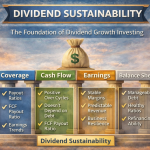
Dividend Sustainability
How Dividend Growth Fits Within a Broader Strategy
Dividend growth investing rarely operates in isolation. Instead, it often complements ETF allocation strategies, market-timing awareness, and rules-based stock selection frameworks. A balanced portfolio may combine dividend-producing assets with selective growth and technical strategies to manage both income generation and capital appreciation objectives.
When integrated thoughtfully, dividend growth holdings can provide portfolio stability and recurring cash flow, while other strategies contribute tactical flexibility and upside potential. This blended approach allows investors to pursue compounding income without sacrificing adaptability in changing market environments.
Closing Paragraph
Dividend growth investing emphasizes patience, structure, and disciplined evaluation rather than short-term prediction. By focusing on companies with sustainable earnings, manageable payout ratios, and consistent growth histories, investors can build portfolios designed for durability and compounding over time. This guide serves as a foundational overview, while the Dividend Growth Master Guide and related articles provide deeper insight into screening methods, valuation techniques, and portfolio construction strategies.
Dividend investing involves risk. Past performance does not guarantee future results.