By Andrew Stowers
Updated March 31, 2026
The phrase “tax-free” gets attached to municipal bonds so often that many investors take it at face value. The reality is more nuanced. While the interest income from most municipal bonds is exempt from federal income tax, whether a given bond is truly tax-free depends on the type of bond, where it was issued, and the investor’s individual tax situation. Understanding how these rules work can help investors determine whether municipal bonds offer genuinely tax-efficient income for their specific circumstances.
For investors building long-term portfolios, municipal bonds often play a role within broader fixed-income allocations. The Investment Strategy Guide explores how investors structure balanced portfolios and integrate different asset classes — including fixed income — to support disciplined, long-term strategies.
What Are Municipal Bonds?
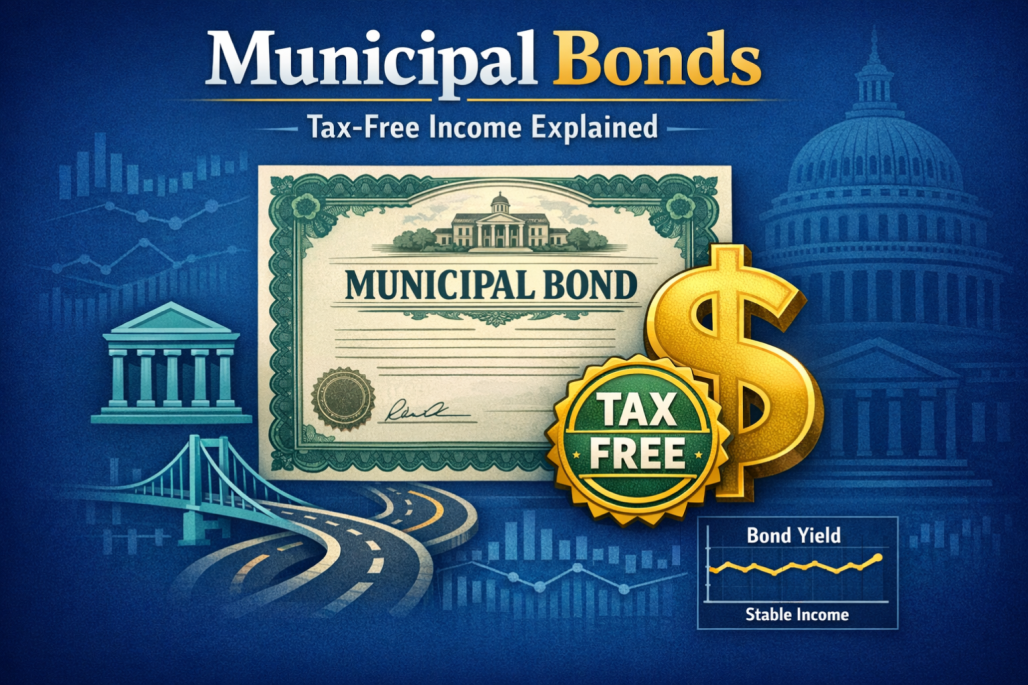
Municipal bonds are debt securities issued by state and local governments to fund public projects. These projects can include infrastructure such as highways, schools, hospitals, and water systems. When investors purchase municipal bonds, they are essentially lending money to the issuing government entity in exchange for interest payments over time.
Why Governments Issue Municipal Bonds
Governments issue municipal bonds as a way to raise capital for public projects without immediately increasing taxes. Instead of collecting funds directly from taxpayers, governments borrow money from investors and repay it gradually through interest payments and principal repayment.
This financing method allows governments to build infrastructure while spreading the cost over many years. Investors who purchase these bonds receive interest payments that are typically paid semiannually until the bond reaches maturity. At that point, the government repays the original principal amount.
Municipal Bonds vs Other Government Bonds
Municipal bonds are often compared with other fixed-income securities such as Treasury bonds and corporate bonds. Investors who are learning about fixed income markets may first study what are government bonds, which explains how different types of government-issued debt securities function. Unlike U.S. Treasury bonds, which are issued by the federal government, municipal bonds are issued by state and local entities. This difference plays a major role in the tax treatment of the interest income they generate.
Are Municipal Bonds Tax Free?
Municipal bonds are commonly referred to as tax-free investments because the interest income they generate is typically exempt from federal income tax. This tax advantage makes them particularly attractive to investors who are seeking income while minimizing tax obligations.
Federal Tax Treatment
The interest earned on most municipal bonds is exempt from federal income tax. This exemption exists because federal policy encourages investment in public infrastructure projects funded by state and local governments. Because of this tax advantage, municipal bonds often offer lower interest rates than comparable taxable bonds. Investors accept the lower yield because the income they receive may not be subject to federal taxation.
When Municipal Bonds Are Not Tax Free
Despite their reputation as tax-free investments, some municipal bonds may still be subject to certain taxes. One important category involves Private Activity Bonds — a specific class of municipal bonds issued to finance projects that primarily benefit private entities, such as airports, housing developments, or certain nonprofit facilities. The interest on Private Activity Bonds is generally subject to the Alternative Minimum Tax (AMT). High-income investors who have significant tax preference items and adjustments are most likely to be affected, and should verify whether any municipal bonds they hold fall into this category before assuming full tax-exempt treatment.
Additionally, capital gains taxes may apply if investors sell municipal bonds at a profit before maturity. While the interest payments themselves may be tax exempt, the profit from selling a bond at a higher price than the purchase price can still be taxable.
Investors purchasing municipal bonds at a discount should also be aware of the de minimis rule. Under this rule, bonds purchased below a certain discount threshold are treated as generating ordinary income rather than capital gains when the bond is sold or matures — which can result in a higher tax bill than anticipated. This is a nuance that many general-audience articles overlook, but it can meaningfully affect after-tax returns for investors who acquire discounted bonds on the secondary market.
Understanding these exceptions is important because the phrase “tax-free” can sometimes create unrealistic expectations about the tax treatment of municipal bond investments.
State and Local Tax Treatment
While municipal bonds are often exempt from federal taxes, the state tax treatment depends on where the investor lives and where the bond was issued.
In-State Municipal Bonds
In many cases, interest earned from municipal bonds issued within an investor’s home state may also be exempt from state and local taxes. For example, a resident of California who purchases bonds issued by the state of California may not have to pay state taxes on the interest income. This additional tax advantage can significantly increase the attractiveness of municipal bonds for investors in high-tax states. The combined federal and state tax exemptions may allow investors to retain more of their investment income.
Out-of-State Municipal Bonds
If an investor purchases municipal bonds issued by another state, the tax treatment may change. In these cases, the investor may still receive federal tax-exempt interest but may owe state income tax on that income. Because of this difference, some investors prefer to purchase municipal bonds issued within their own state. Doing so may allow them to maximize the tax benefits associated with these investments.
Why Investors Buy Municipal Bonds
Municipal bonds appeal to investors primarily because of their tax advantages and relatively stable income streams. These characteristics make them particularly attractive for investors who prioritize income and capital preservation.
Tax-Equivalent Yield
One of the key concepts investors use when evaluating municipal bonds is tax-equivalent yield. This calculation compares the after-tax return of a municipal bond with the return of a taxable bond, helping investors determine which provides the better effective income. Investors often learn how to find rate of return in order to evaluate whether tax-free municipal bonds provide a higher effective return than taxable alternatives.
The formula is straightforward:
Tax-Equivalent Yield = Municipal Yield ÷ (1 − Tax Rate)
For example, an investor in the 32 percent federal tax bracket evaluating a municipal bond yielding 3.5 percent would calculate: 3.5 ÷ (1 − 0.32) = approximately 5.15 percent. This means the municipal bond would need to be compared against a taxable bond yielding more than 5.15 percent to produce a better after-tax return. In higher tax brackets, the tax advantage widens further, which is why municipal bonds are especially valuable to high-income investors.
Portfolio Diversification
Municipal bonds can also play a role in diversifying investment portfolios. Because bonds typically behave differently from stocks during market volatility, adding fixed-income securities may help stabilize portfolio performance. Many investors incorporate municipal bonds as part of broader asset allocation strategies.
Risks of Municipal Bonds
Although municipal bonds are generally considered relatively safe investments, they still carry certain risks that investors should understand.
Credit Risk
Municipal bonds carry credit risk — the possibility that the issuing government entity may be unable to meet its debt obligations. While defaults are relatively rare compared to corporate bonds, they do occur. Detroit’s 2013 bankruptcy, the largest municipal bankruptcy in U.S. history at the time, resulted in significant losses for bondholders. Puerto Rico’s prolonged debt crisis, which led to a restructuring process beginning in 2017, is another prominent example of the real-world consequences of municipal credit risk. Investors should review the credit ratings of individual bond issuers and understand that bonds from financially stressed municipalities carry meaningfully higher risk than those from stable state governments.
Interest Rate Risk
One of the most significant risks associated with bonds is interest rate risk. When interest rates rise, the market value of existing bonds typically declines. This occurs because newer bonds are issued with higher interest rates, making older bonds with lower rates less attractive. As a result, investors who sell bonds before maturity may experience price fluctuations. Understanding interest rate dynamics is an important part of evaluating fixed-income investments.
Reinvestment Risk
Another factor investors must consider is reinvestment risk. This occurs when investors receive interest payments but cannot reinvest those payments at the same interest rate as the original bond. For example, if interest rates decline after an investor purchases a bond, future interest payments may have to be reinvested at lower yields. Over time, this can reduce the overall income generated by the investment.
When Municipal Bonds Make Sense for Investors
Municipal bonds are not appropriate for every investor, but they may provide significant advantages in certain situations.
High Tax Brackets
The tax benefits of municipal bonds become more valuable for investors in higher tax brackets. Because these investors pay higher federal income tax rates, tax-free interest income can significantly improve their after-tax returns. For individuals in lower tax brackets, taxable bonds with higher yields may sometimes provide better overall returns.
Income-Focused Investors
Municipal bonds may also appeal to investors who prioritize stable income over aggressive capital growth. Retirees and conservative investors often seek predictable interest payments that can supplement other sources of income. Although municipal bonds may not offer the highest growth potential, they can provide steady income streams that contribute to long-term financial stability.
Comparing Municipal Bonds With Corporate Bonds
When evaluating fixed-income investments, many investors compare municipal bonds with corporate bonds to determine which provides the better overall return. Corporate bonds are issued by private companies and generally offer higher interest rates than municipal bonds. However, the interest income from corporate bonds is fully taxable at the federal level and often at the state level as well. Because municipal bond interest is typically exempt from federal taxes, the effective return may actually be higher for some investors even if the stated yield appears lower.
For example, an investor in a high tax bracket may find that a corporate bond yielding 6 percent produces a similar after-tax return to a municipal bond yielding 4 percent. The difference comes from the tax savings associated with municipal bond interest. Calculating this comparison requires evaluating the tax-equivalent yield, which helps investors determine how a tax-free bond compares with a taxable alternative. In practice, many investors analyze both types of bonds when building diversified fixed-income portfolios.
Another factor that influences this comparison is credit risk. Municipal bonds issued by stable state or local governments are often considered relatively safe investments, while corporate bonds may vary widely in risk depending on the financial health of the issuing company. Understanding the differences between these two types of bonds helps investors decide how to balance income potential and risk within their portfolios.
Municipal Bond Funds and ETFs
In addition to purchasing individual municipal bonds, many investors gain exposure to this market through mutual funds or exchange-traded funds that hold diversified portfolios of municipal securities. These funds allow investors to access hundreds of municipal bonds through a single investment. Diversification helps reduce the risk associated with any individual bond issuer experiencing financial difficulties.
Two of the largest and most widely used municipal bond ETFs are MUB (iShares National Muni Bond ETF) and VTEB (Vanguard Tax-Exempt Bond ETF). Both provide broad exposure to investment-grade municipal bonds from across the country and are frequently used by investors seeking tax-efficient income without the complexity of managing individual bond positions.
Municipal bond funds also simplify portfolio management because professional managers or index strategies handle bond selection and monitoring. Rather than researching individual municipalities, investors can rely on diversified funds to provide broad exposure to the municipal bond market. This approach is particularly useful for investors who want tax-efficient income without managing a large portfolio of individual bonds.
However, municipal bond funds also introduce additional considerations. Bond funds do not have fixed maturity dates like individual bonds. Instead, they maintain a rotating portfolio of securities. As a result, the value of the fund may fluctuate based on interest rate changes and overall market conditions. Investors who understand these dynamics can better evaluate whether individual bonds or diversified funds are the more appropriate choice for their investment goals.
Municipal Bonds in Summary
Municipal bonds are often described as tax-free investments because the interest income they generate is typically exempt from federal income tax. In many cases, investors may also avoid state taxes when purchasing bonds issued within their home state. These tax advantages make municipal bonds particularly attractive for investors in higher tax brackets who are seeking stable, tax-efficient income. If you want structured guidance on building disciplined investment strategies and understanding how different asset classes fit into long-term portfolios, become a member today and join us Above The Green Line.
Because successful investing isn’t just about maximizing returns. It’s about understanding how taxes, risk, and diversification work together to support long-term financial goals.

Related Articles

Risk-Adjusted Returns: Why Smarter Investors Focus on More Than Performance
Retirement Investment Strategies: The Phase-by-Phase Framework That Changes How You Approach Every Stage

Best Indicators for Day Trading: The 7 That Elite Traders Actually Use (And Why Most Lists Get It Wrong)

Investing During a Recession: The Strategies That Actually Work (And the Mistakes That Cost Most Investors)