Choosing the Right Dividend Strategy for Your Financial Goals
By ATGL
Updated February 18, 2026
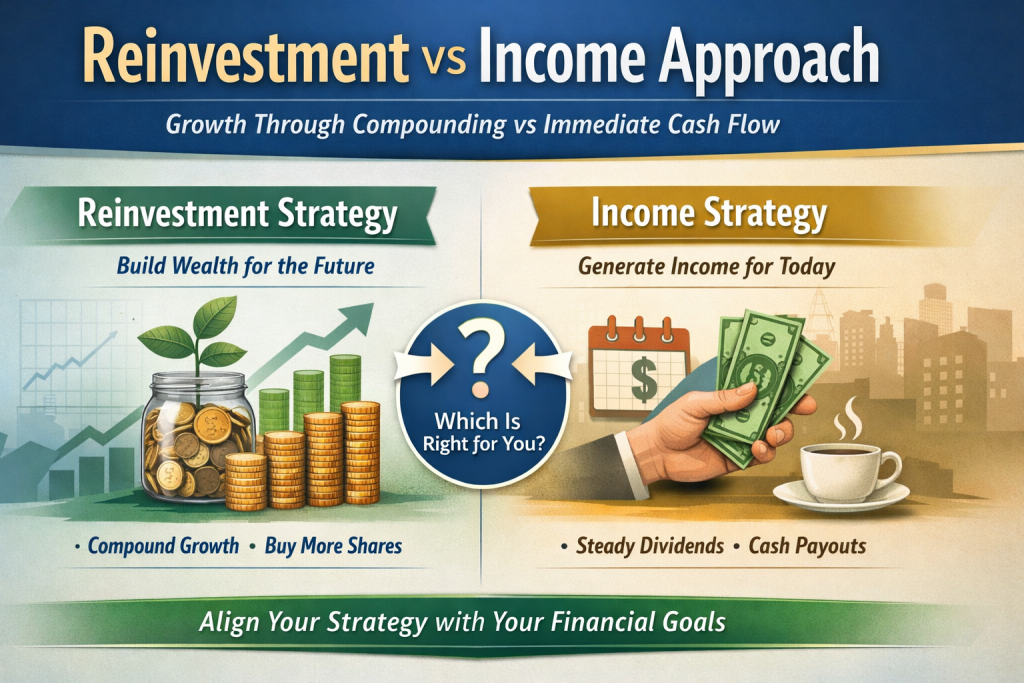
Dividend investing is often presented as a single strategy, but in reality it contains two distinct paths that serve very different objectives: the Reinvestment Approach and the Income Approach. Both rely on owning dividend-paying companies, yet the outcomes, timelines, and psychological experiences can differ dramatically.
Understanding the difference between reinvesting dividends and taking them as income is one of the most important decisions an investor can make, because it influences portfolio growth, risk tolerance, tax implications, and long-term financial independence.
At its core, this decision is not about which method is “better,” but rather which method aligns with your stage of life, financial goals, and investment philosophy. A disciplined investor can successfully use either approach — or a hybrid of the two — when applied with structure and consistency. Many investors find that dividend growth investing provides a balanced path between stability and long-term capital appreciation when applied with disciplined evaluation criteria, as outlined in the Dividend Growth Master Guide, which expands on screening methods, sustainability metrics, and portfolio alignment by life stage.
Understanding the Reinvestment Approach
The Reinvestment Approach focuses on compounding. Instead of withdrawing dividend payments as cash, the investor uses those dividends to purchase additional shares of the same stock or fund. Over time, this increases ownership without requiring new capital contributions.
This strategy is especially powerful because it turns dividends into a self-reinforcing growth engine. Each reinvested payout increases the number of shares held, which in turn produces larger future dividends. The cycle repeats, gradually accelerating portfolio expansion.
Why Reinvestment Works
The strength of reinvestment lies in mathematical compounding. Even modest dividend yields can produce meaningful results when consistently reinvested over long time horizons. The effect is subtle in the early years but becomes exponential later.
Example:
Consider a $10,000 portfolio yielding 3% annually. If dividends are taken as income, the investor receives $300 per year, and the principal remains largely unchanged. If those dividends are reinvested and the portfolio achieves a modest 6% total annual return, the account could grow to approximately $17,900 after 10 years. The difference is subtle in year one, but over time the gap widens significantly as compounding takes hold.
This example highlights why reinvestment is often favored by long-term investors who prioritize future income and capital expansion over immediate cash flow.
Key Advantages of Reinvestment
Reinvestment typically provides:
- Faster capital accumulation
- Increased share ownership without new deposits
- Growing yield relative to original cost
- Enhanced total return potential
These advantages make reinvestment particularly attractive to younger investors or those in the accumulation phase of their financial journey.
Understanding the Income Approach
The Income Approach prioritizes cash flow rather than compounding. Investors receive dividends and use them to fund expenses, supplement salary, or generate retirement income. Instead of expanding share count, the goal is to create a predictable revenue stream.
This method is common among retirees or investors approaching financial independence who value stability and liquidity over portfolio expansion. The emphasis shifts from growth to reliability.
Why Income Matters
Income-focused investors often view dividends as a paycheck replacement. Regular cash distributions can reduce the need to sell assets during market downturns, preserving long-term capital while still meeting financial needs.
Psychologically, this strategy also provides reassurance. Investors see tangible returns regardless of market fluctuations, which can help maintain discipline during volatility.
Key Advantages of the Income Approach
Taking dividends as income can provide:
- Immediate cash flow
- Reduced reliance on asset liquidation
- Psychological stability during market swings
- Support for lifestyle or retirement expenses
This approach is less about maximizing portfolio size and more about maintaining financial independence through predictable payouts.
The Power of Compounding vs the Value of Cash Flow
The debate between reinvestment and income is essentially a balance between future acceleration and present utility.
Reinvestment amplifies future earning potential but delays gratification. Income provides immediate benefits but may slow long-term portfolio growth. The right choice depends largely on time horizon and financial necessity.
A 30-year-old investor with steady employment may benefit significantly from reinvestment, allowing dividends to multiply over decades. A 65-year-old retiree, on the other hand, may prefer income to support living expenses without selling principal.
Neither approach is inherently superior — both are tools designed for different phases of financial life.
Yield on Cost: A Hidden Benefit of Reinvestment
One of the most compelling outcomes of reinvestment is yield on cost, which measures dividend income relative to the original purchase price. Over time, consistent dividend growth combined with reinvestment can dramatically increase this metric.
An investor who purchased a stock yielding 3% might find, after years of reinvestment and dividend increases, that their effective yield on original cost has risen to 7% or more. This phenomenon is rarely visible in short-term analysis but becomes powerful over extended horizons.
Tax Considerations
Tax treatment can influence strategy choice. In taxable accounts, dividends are often subject to annual taxation, whether reinvested or not. Investors focusing on reinvestment should be aware that compounding may still generate tax liabilities each year.
Conversely, income-focused investors must consider how withdrawals impact overall tax brackets. Utilizing tax-advantaged accounts such as IRAs or 401(k)s can mitigate these effects and allow either strategy to function more efficiently.
Portfolio Construction Differences
The reinvestment and income approaches often lead to different portfolio compositions.
Reinvestment portfolios typically emphasize companies with consistent dividend growth histories, moderate yields, and strong earnings expansion. The priority is sustainability and upward momentum.
Income portfolios may include higher-yielding assets such as utilities, REITs, or dividend-focused ETFs. Stability and predictability often take precedence over rapid growth.
Despite these tendencies, both approaches benefit from diversification across industries to reduce concentration risk. Maintaining proper portfolio diversification helps reduce concentration risk and ensures that income streams remain resilient across different market cycles.
Psychological Dimensions
Investment success is not purely mathematical; psychology plays a significant role. Reinvestment requires patience and delayed gratification, while income strategies offer immediate validation.
Some investors struggle with seeing dividends reinvested instead of deposited as cash, even when long-term growth would benefit them more. Others feel anxious relying on market income streams rather than guaranteed salary.
Recognizing these psychological tendencies helps investors choose a strategy they can consistently follow without emotional interference.
Hybrid Strategies: The Best of Both Worlds
Many investors eventually adopt a hybrid approach, reinvesting dividends during accumulation years and gradually transitioning toward income as financial independence approaches. This strategy allows compounding to work early while still providing flexibility later.
A hybrid model might involve reinvesting 70% of dividends and withdrawing 30%, or shifting allocation annually based on life stage and economic conditions. This adaptability reflects real-world financial evolution rather than rigid adherence to a single method.
How Reinvestment vs Income Fits Within a Broader Investment Framework
Dividend strategies rarely exist in isolation. Investors often pair them with ETF allocations, growth stocks, or technical swing-trading approaches to balance stability with opportunity. A diversified framework allows dividend income or reinvestment growth to complement other market strategies.
At Above the Green Line, structured, rules-based investing emphasizes repeatable criteria and disciplined evaluation. Whether reinvesting dividends or taking income, applying consistent analysis and portfolio review processes reduces emotional decision-making and enhances long-term results.
When to Choose Each Approach
While personal circumstances vary, general guidelines can help:
Reinvestment Approach May Be Suitable When:
- You are in the accumulation phase
- Income is not immediately needed
- Long-term growth is the primary objective
- You value compounding efficiency
Income Approach May Be Suitable When:
- You rely on portfolio cash flow
- You seek financial independence or retirement support
- Market volatility causes discomfort
- Liquidity is a priority
Common Misconceptions
A frequent misunderstanding is that reinvestment is always superior. In reality, compounding only benefits investors who can remain patient and financially stable without withdrawing funds. Likewise, income strategies are sometimes unfairly labeled as “slow growth,” even though stable dividend payers often appreciate steadily over time.
Another misconception is that switching strategies indicates failure. In truth, evolving from reinvestment to income often represents financial maturity, not inconsistency.
The Long-Term Perspective
The reinvestment versus income decision is not permanent. It is a strategic dial that can be adjusted as life circumstances change. The most successful investors remain flexible, aligning their dividend strategy with evolving financial objectives rather than rigid ideology.
Compounding thrives on time and discipline, while income thrives on stability and planning. Both paths, when executed with structured evaluation and diversified portfolios, can lead to financial resilience. The choice between reinvesting dividends or taking them as cash often reflects the classic yield vs growth trade-off faced by long-term investors.
Final Thoughts
Reinvestment and income represent two sides of the same dividend philosophy. One fuels expansion, the other supports sustainability. The optimal choice depends less on market conditions and more on personal goals, timeline, and psychological comfort.
Investors who understand these distinctions gain clarity and control over their financial trajectory. Rather than asking which method is superior, the more powerful question becomes:
“Which strategy best supports my current stage — and when should I evolve?”
By approaching dividend investing with structure, discipline, and adaptability, both reinvestment and income can become reliable tools for long-term financial success.
Ready to turn knowledge into action?
Join Above the Green Line today to access structured investing guides, real-time insights, and rules-based strategies designed to help you make confident, data-driven decisions. Whether you’re building long-term income or refining your trading approach, you’ll gain the tools and education needed to move forward with clarity and discipline.

Related Articles

How to Use Net Present Value (NPV) for Dividend Stocks
Free Cash Flow: The Ultimate Guide to Financial Strength and Dividend Sustainability
Dividend Reinvestment Plan (DRIP): How Automatic Reinvestment Builds Long-Term Wealth

Dividend Growth vs High Yield: Choosing the Right Income Strategy for Long-Term Investors