

Investment strategy is not about predicting the next market move—it is about building a repeatable framework that empowers investors to make informed decisions regardless of market conditions. A well-defined strategy reduces emotional reactions, improves discipline, and creates consistency across both rising and falling markets. Unlike traditional approaches that rely on intuition or headlines, a structured framework emphasizes measurable indicators, predefined entry/exit logic, and long-term process over short-term speculation.
At Above the Green Line, our philosophy centers on rules-based investing. By applying disciplined evaluation criteria, investors can navigate changing market environments with greater clarity and confidence. For readers seeking a comprehensive masterclass in professional execution, the Ultimate Swing Trading Guide: Rules-Based Framework serves as our definitive mega article, providing an 8-module deep dive into the technical setups, risk management, and “Green Line” logic required to achieve a true lifestyle advantage.
This guide provides an overview of core investment strategy concepts and connects you to deeper articles that explore techniques, tools, and risk considerations in more detail.
Without a defined strategy, investment decisions often become reactive.
A structured framework helps investors:
Markets will always fluctuate, but a rules-based strategy provides a steady reference point for decision-making.
Every investment strategy begins with defined purpose.
Objectives may include capital growth, income generation, or capital preservation.
When the goal is clear, decisions around asset selection, allocation, and time horizon become structured rather than reactive.
Risk is not eliminated — it is managed deliberately.
Position sizing, diversification, and predefined exit thresholds reduce downside exposure while preserving capital for future opportunities.
A disciplined strategy focuses on:
Successful strategies rely on repeatable decision frameworks, not subjective judgment.
Using technical indicators, valuation metrics, or macroeconomic signals ensures that each opportunity is assessed with the same logical process.
Consistency creates:
Short-term trading and long-term investing require different expectations and tools.
Aligning strategy with time horizon prevents premature exits, over-trading, or unrealistic performance expectations.
Time alignment influences:
Investment strategies vary in style, time frame, and objective. Common approaches include:
One of the practical implementations of a rules-based framework at Above the Green Line is the Top Pick of the Week (TPOW) strategy. This approach focuses on identifying a single high-probability stock setup each week based on momentum, relative strength, and technical breakout conditions.
Using the ATGL selection framework, a stock is selected before the start of the trading week and monitored for a defined performance target. Positions are typically entered Monday morning and managed through Friday’s close unless the predefined gain target is reached earlier.
The objective is not to predict the market but to apply consistent rules to identify strong technical opportunities with disciplined entry and exit logic.
You can learn more about the methodology and view historical performance on our Weekly Stock Pick Strategy page.
Indicators do not predict the future; they provide context and probability signals.
When used within a disciplined framework, they help investors evaluate market strength, momentum, and risk conditions.
Structured analysis focuses on:
The objective is not certainty, but informed probability.
Start With These Investment Strategy Foundations
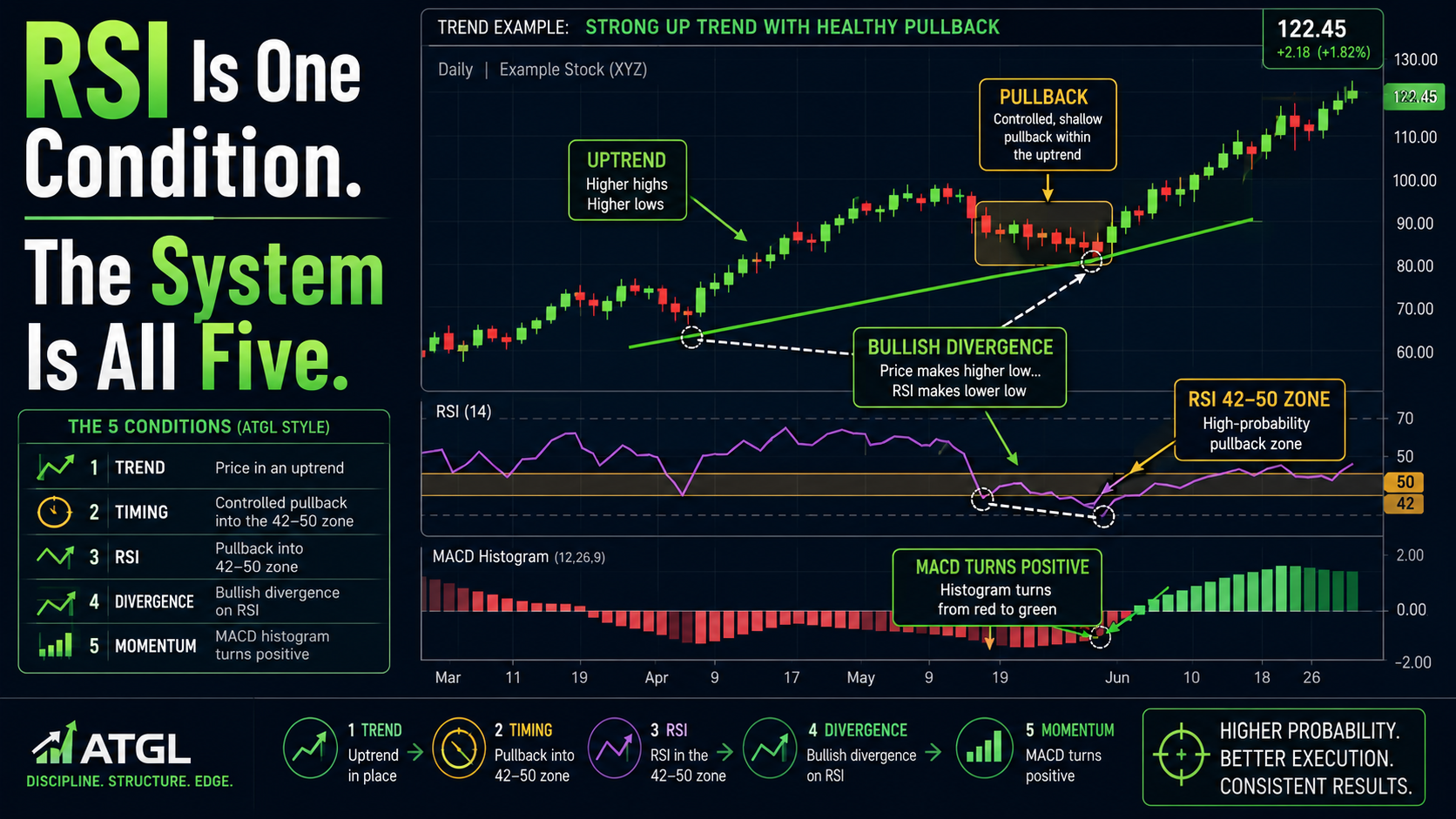

Investment strategy acts as the foundation for other approaches such as dividend growth, ETF allocation, and stock trading techniques. A clear framework allows investors to integrate multiple methods while maintaining discipline and consistency across decisions.
While investment frameworks provide the structure for decision-making, their value comes from real-world implementation. At Above the Green Line, these principles are applied through several structured approaches that help investors translate theory into disciplined action.
For example, our Weekly Stock Pick Strategy (Top Pick of the Week) applies momentum and relative strength analysis to identify a single high-probability trade each week. Positions are typically entered Monday morning and managed through Friday’s close unless a predefined gain target is reached earlier.
Other strategies explored across this site include dividend growth portfolio construction, ETF allocation methods, and rules-based swing trading techniques designed to identify opportunities using technical indicators and structured evaluation criteria.
These implementations demonstrate how a consistent framework can guide decision-making across different market conditions.
A successful investment strategy is less about forecasting and more about structure, discipline, and repeatability. By defining objectives, managing risk, and applying consistent evaluation criteria, investors can navigate changing market environments with greater clarity and confidence. This guide serves as a central reference point, while the linked articles provide deeper exploration into specific tools, frameworks, and decision-making techniques.
Investing involves risk. Past performance does not guarantee future results.
Please send some profits to help animals

A snapshot of the daily updates that help traders stay aligned with market direction.
Above The Green Line’s systematic approach has completely transformed my trading. I’ve gone from inconsistent results to reliable gains, even during market downturns.”
The systematic approach has been a game-changer for my portfolio. I no longer second-guess my trading decisions and have seen consistent returns even in volatile markets.”
Sarah K.
Michael R.
Engineer & Part-time Trader
The community aspect is invaluable. Being able to learn from experienced traders and discuss strategies in real-time has accelerated my trading knowledge tremendously.
David L.
Business Owner