By ATGL
Updated June 25, 2026
Exchange-traded funds (ETFs) carry ongoing costs that significantly reduce an investor’s returns, yet these costs draw far less attention than they deserve. Investors routinely evaluate ETFs by recent performance, underlying holdings, or the issuer’s reputation, while overlooking expense, even though it’s one of the few variables they can predict with certainty.
This oversight is largely a matter of visibility. Performance figures and brand names appear prominently on every fund page, while fees look small against double-digit returns. Costs are also deducted from fund assets rather than billed directly, and their effect accumulates gradually over time. The result is that investors neglect the very expense they can forecast most reliably.
For those willing to look past surface signals, fund costs concentrate on two figures that anchor every serious cost assessment: the management fee and the expense ratio. The terms are often used interchangeably, yet each measures a different aspect of what it costs to own a fund. Understanding how they differ is the foundation of evaluating products by objective metrics instead of marketing language or a single year of returns.
This ETF investing guide offers a useful broader context on fund selection before examining the individual cost components below.
What Is a Management Fee?
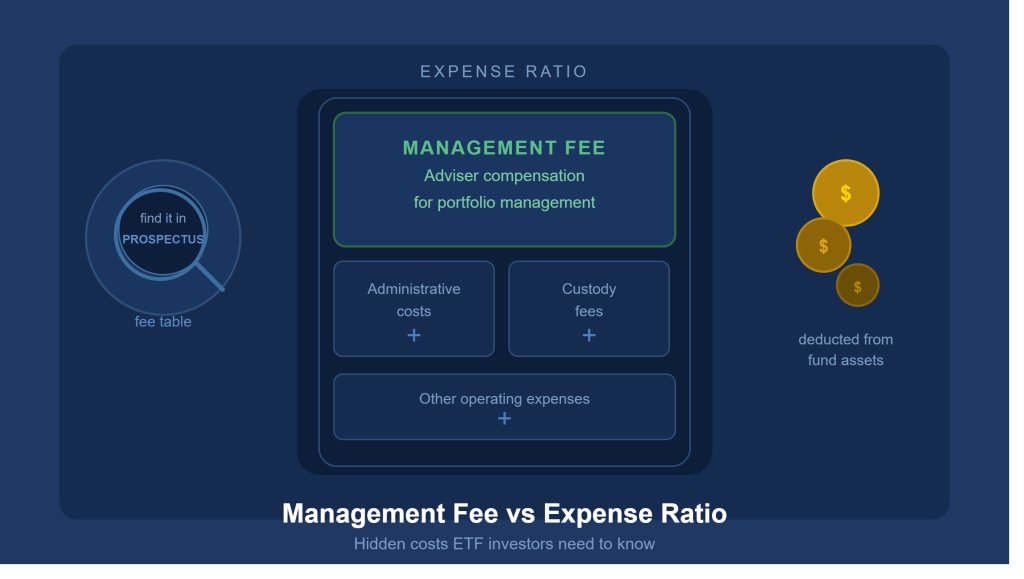
A management fee is the amount a fund pays its investment adviser for overseeing the portfolio. According to the U.S. Securities and Exchange Commission (SEC) investor education materials, this fee is paid out of fund assets to the adviser responsible for selecting securities and executing the fund’s stated strategy. It compensates the portfolio management team and, in many cases, covers associated administrative costs, research, technology, and analyst resources.
Investors can locate the management fee in the fund’s prospectus, specifically within the fee table under the heading “Annual Fund Operating Expenses.” The figure is expressed as a percentage of the fund’s average net assets. Management fees vary considerably by strategy.
Passively managed index ETFs, which track a benchmark rather than attempting to outperform it, typically carry the lowest management fees. Actively managed funds, which require analysts and frequent portfolio decisions, charge more. Fidelity reports that the average equity mutual fund management fee sits near 1.10%, while many index ETFs assess management fees well below that level.
What Is an Expense Ratio?
An expense ratio represents the total annual operating cost of a fund, expressed as a percentage of assets under management (AUM). While the management fee captures a single line item, the expense ratio aggregates all recurring costs required to operate the fund. The management fee is one component of this larger figure, not a synonym for it.
The expense ratio is deducted directly from fund assets before returns are passed to investors, rather than billed as a separate invoice. Because the deduction happens internally and continuously, many investors never see the charge as a discrete line on a statement, which is precisely why these costs are so easy to overlook.
The expense ratio you review may also be quoted as a gross expense ratio or a net expense ratio. The gross figure reflects total costs before any waivers, while the net figure accounts for temporary fee reductions the adviser has agreed to apply.
What Costs Are Included in an Expense Ratio?
The expense ratio bundles together the recurring costs of running a fund. The SEC’s fee-table framework groups these into management fees, distribution or service charges known as 12b-1 fees, and other operating expenses. That final category captures operational charges such as:
- Administrative expenses
- Custody fees
- Legal and accounting costs,
- Recordkeeping
Notably, 12b-1 fees generally apply to mutual funds instead of ETFs, which is one structural reason ETF expense ratios tend to run lower.
What Costs Are Not Included in an Expense Ratio?
Several meaningful costs fall outside the expense ratio:
- Trading commissions
- Bid-ask spreads
- Brokerage transaction fees
- Taxes generated by fund activity
- Redemption fees
- Sales loads
For investors who trade frequently or hold funds in taxable accounts, these excluded costs can rival or exceed the expense ratio itself. Evaluating the total cost of ownership, rather than the expense ratio alone, produces a more accurate picture, particularly for those applying active approaches such as swing trading strategies.
Management Fee vs Expense Ratio: What’s the Difference?
The main difference between a management fee and expense ratio comes down to the scope. A management fee compensates the portfolio manager for a specific function. An expense ratio measures the total annual cost of operating the fund, and the management fee is only one part of it.
The table below summarizes what each metric captures.
| Attribute | Management Fee | Expense Ratio |
| What it measures | Payment to the investment adviser for portfolio management | Total annual operating cost of the fund |
| Scope | A single component | All recurring fund expenses combined |
| Includes administrative and custody costs | No | Yes |
| How it is charged | Deducted from fund assets | Deducted from fund assets |
| Where to find it | Fund prospectus fee table | Fund prospectus fee table |
| Best used for | Understanding adviser compensation | Comparing total fund costs |
How Fees Can Affect Long-Term Investment Returns
The practical significance of these costs becomes apparent over extended holding periods, where compounding magnifies seemingly minor differences. Consider two hypothetical ETFs, one with an expense ratio of 0.10% and another at 0.75%, each holding a $100,000 investment that grows at an assumed 7% annual return before fees.
After 20 years, the lower-cost fund would grow to roughly $379,800, while the higher-cost fund would reach approximately $336,200. Extend the horizon to 30 years, and the gap widens considerably: about $740,200 for the 0.10% fund versus $616,400 for the 0.75% fund, a difference of over $120,000.
The disparity does not arise from superior investment selection. It results entirely from the fee differential compounding against the investor year after year. The SEC illustrates this same dynamic in its own analysis, demonstrating how an annual fee of 1.00% can erode a portfolio’s value over two decades.
This compounding effect is the strongest argument for treating expense ratios as a primary screening criterion. A fund’s strategy or recent performance may or may not deliver, but its cost burden is certain and persistent.
How To Compare ETFs and Mutual Funds More Effectively
Cost deserves close attention, but it is only one factor in a sound fund decision. Because recent performance is the most visible figure and a weak guide to future returns, disciplined evaluation considers several measurable factors side by side.
- Expense ratio – The total annual operating cost of the fund, and the most reliable cost figure an investor can predict in advance
- Tracking error – How closely the fund follows its benchmark, indicating how faithfully it delivers the exposure it promises
- Liquidity – The cost and ease of entering or exiting a position, which affects what an investor actually pays to trade
- Assets under management – The fund’s overall scale and stability, often a signal of its staying power
- Fund objectives and holdings – Whether the underlying strategy and portfolio align with the investor’s goals
ETFs frequently carry lower expense ratios than comparable mutual funds because many are passively managed and avoid 12b-1 fees. According to the Investment Company Institute, the average expense ratio for index equity ETFs held steady at 0.14% in 2025, while equity mutual funds averaged 0.40%. That structural cost advantage matters, but it should be weighed against each fund’s specific characteristics.
The same rigor applies to more specialized instruments. Investors using leveraged ETFs, for example, should pay particular attention to total ownership costs, which can run substantially higher than those of conventional index funds.
Build a More Cost-Conscious Investment Strategy
The difference between a management fee and an expense ratio is more than terminology. A management fee compensates the portfolio manager for a defined role, while the expense ratio captures the full annual cost of owning the fund. Treating the two as identical leads investors to underestimate what they actually pay, and as the compounding examples demonstrate, even modest fee differences reshape long-term outcomes. A complete assessment also accounts for costs that sit outside the expense ratio, including trading spreads, taxes, and sales charges.
The disciplined approach is to evaluate every prospective investment using objective, verifiable metrics rather than recent returns or brand familiarity. Total ownership cost, tracking error, liquidity, and alignment with portfolio objectives all deserve weight in the decision.
Investors seeking structured tools to apply these principles can turn to Above the Green Line, an investment education and research resource, whose memberships support a systematic framework for evaluating ETFs against measurable criteria.