Last week’s Top Pick of the Week (TPOW) trade was opened on January 5, 2026, and it proved to be another strong example of how a rules-based process can deliver consistent results in varying market conditions. The broader market environment was constructive, with SPY trending modestly higher for the week, reflecting steady participation without an aggressive risk-on surge. This type of tape continues to favor selective stock picking rather than broad index exposure.
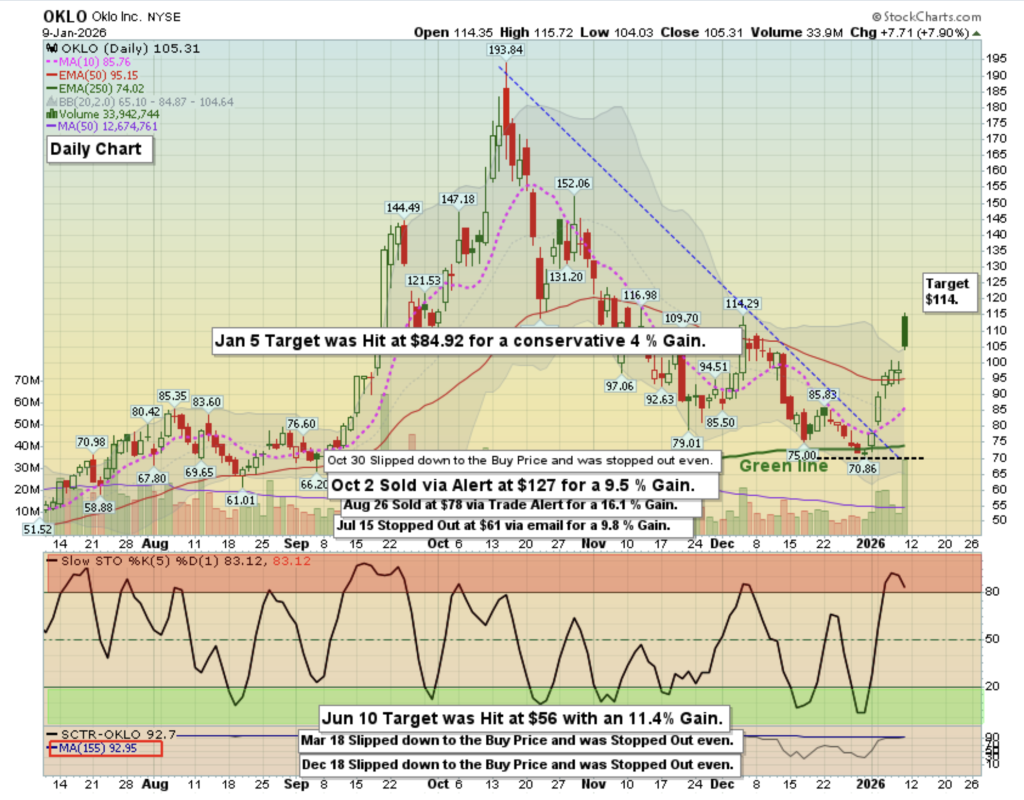
Our TPOW selection, OKLO, performed exceptionally well during the week. Shortly after entry, the stock began to move higher, confirming the technical setup that led to its selection. Price strength and sustained buying interest signaled strong demand, and OKLO quickly reached our conservative 4% profit target, triggering a disciplined exit per TPOW rules. Locking in gains at predefined levels remains a core principle of the strategy, helping remove emotion from the decision-making process.
It’s worth noting that OKLO continued to advance after our standard TPOW exit. For more aggressive members who chose to manage the position actively and held the stock through Friday’s close, the move was even more impressive, with gains approaching 15% for the week. While this highlights the stock’s exceptional momentum, it also reinforces an important distinction within our community: TPOW is designed first for consistency and risk control, while more aggressive traders may choose to pursue extended gains based on their own risk tolerance and trade management approach.
This trade is a great illustration of how both conservative and aggressive styles can coexist within the Above the Green Line framework. The TPOW strategy prioritizes repeatable outcomes and capital preservation, while advanced traders may elect to ride strong trends further when conditions allow. In both cases, decisions are guided by price action, technical structure, and risk management—not emotion.
As we look ahead, we remain focused on identifying high-probability setups that align with our rules-based methodology. Whether capturing a planned single-digit gain or managing a position for extended upside, the key remains the same: follow the process, respect risk, and let the charts guide the way.