By ATGL
Updated July 2, 2026
Most investors understand that risk and return are connected, yet fewer recognize how their personal capacity for risk should shape the way they construct a portfolio. Expected returns receive considerable attention, but the willingness to withstand fluctuations in account value is equally important to long-term success.
Many investors first discover their true comfort level after experiencing a significant market downturn, when paper losses become emotionally difficult to tolerate. Understanding this dimension of investing before volatility arrives allows for more disciplined decision-making.
For those seeking a structured framework, our investment strategy guide provides a foundation for aligning decisions with measurable objectives.
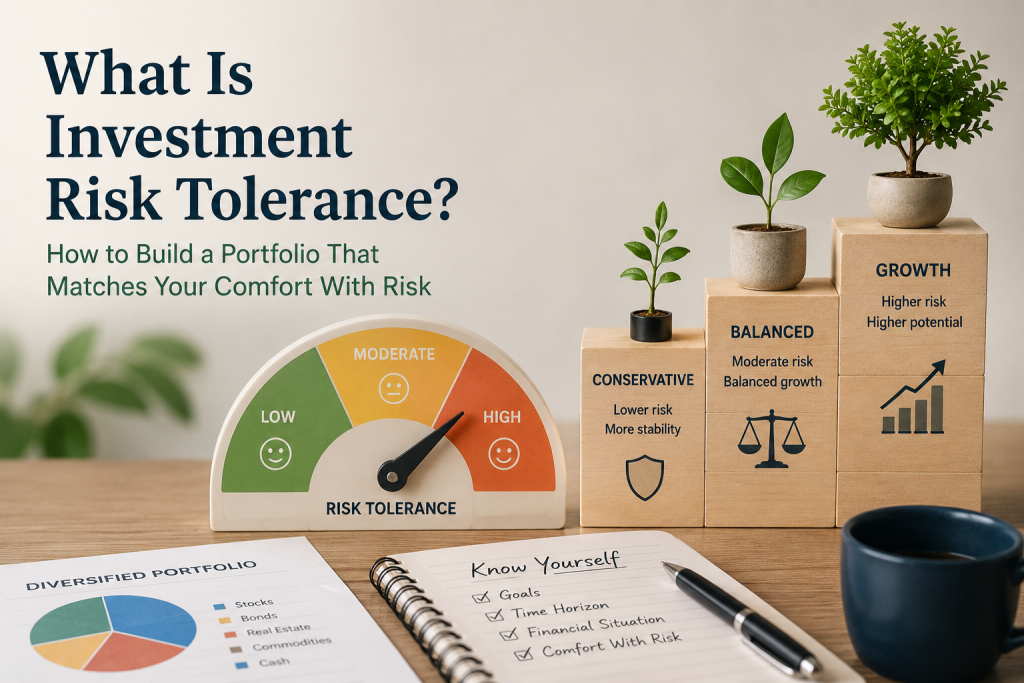
What Is Investment Risk Tolerance?
Investment risk tolerance refers to an investor’s willingness and ability to withstand fluctuations in the portfolio’s value. It represents the degree of variability in returns that an individual is prepared to accept in pursuit of financial goals. An investor with high risk tolerance can remain committed to a strategy during periods of substantial decline, while an investor with low willingness to accept risk may experience considerable distress under the same conditions.
This concept forms a foundational component of portfolio construction. Asset allocation, security selection, and rebalancing decisions all depend on an accurate assessment of how much volatility an investor can reasonably endure.
Constructing a portfolio that exceeds an investor’s tolerance frequently leads to premature selling during downturns, which can permanently impair long-term performance. Morningstar’s 2025 Mind the Gap study shows how costly poor timing can be. Over the ten years ending in 2024, the average investor earned about 1.2 percentage points less per year than the funds they owned actually returned—a gap traced to the timing of investors’ purchases and sales.
What Factors Influence Risk Tolerance?
Several factors shape an individual’s capacity for risk, and accounting for each one is essential to constructing a portfolio that an investor can actually maintain through volatile conditions.
- Age: Younger investors generally have more time to recover from losses, allowing for greater risk.
- Income stability: A dependable salary provides a cushion that supports more aggressive positioning.
- Investment objectives: A portfolio funding a near-term home purchase differs considerably from one accumulating wealth across decades.
- Financial obligations: Mortgage payments, education expenses, and dependents reduce the capacity to absorb losses without consequence.
- Previous investing experience: Investors who have navigated prior downturns often possess a more realistic understanding of their reactions.
- Emotional comfort with volatility: An investor may be financially positioned to accept risk yet find the experience of watching a portfolio decline genuinely unsettling.
Time Horizon and Financial Goals
Time horizon exerts a powerful influence on appropriate risk levels. Investors with longer horizons can generally accept greater volatility because they have sufficient time for markets to recover from temporary declines. A thirty-year retirement timeline, for example, can accommodate the periodic drawdowns that accompany equity ownership, since short-term losses tend to diminish in significance over extended periods.
Shorter-term goals, by contrast, typically warrant a more conservative posture. An investor saving for an expense three years away has a limited opportunity to recover from a sharp decline, making capital preservation a higher priority than growth.
Aligning the time horizon of each goal with a corresponding allocation helps protect funds needed soon while permitting growth-oriented positioning for distant objectives.
Emotional Response to Market Volatility
Investors respond to losses in markedly different ways. Some remain composed during steep sell-offs, while others feel compelled to act, often selling at precisely the wrong moment. Recognizing these emotional tendencies in advance is one of the most valuable exercises an investor can undertake.
Research in behavioral finance, including the work of Daniel Kahneman and Amos Tversky, demonstrates that the pain of a loss is felt more intensely than the satisfaction of an equivalent gain. This asymmetry helps explain why investors abandon sound strategies when markets fall.
An honest appraisal of one’s likely emotional response allows for the construction of a portfolio that can be maintained through difficult conditions. A strategy that is theoretically optimal but emotionally intolerable will ultimately fail, because the investor will not adhere to it when tested.
Risk Tolerance vs. Risk Capacity
Although closely related, risk tolerance and risk capacity are distinct concepts that merit separate consideration. Risk capacity refers to an investor’s financial ability to absorb losses, determined by factors such as income, net worth, time horizon, and existing obligations. Risk tolerance, by contrast, reflects personal psychological comfort with the possibility of loss.
These two measures often diverge. Consider an investor with substantial savings and decades until retirement; this individual possesses considerable risk capacity. Yet, if the same person experiences anxiety during market drawdowns and considers selling at every pullback, their risk tolerance is low despite ample financial capacity.
The reverse also occurs: an investor may feel emotionally comfortable with aggressive positions while lacking the financial resources to recover from a serious loss. A sound portfolio respects the lower of the two measures, accounting for both financial reality and emotional capability.
Common Investor Risk Profiles
Investors are commonly categorized into three broad profiles based on their willingness to accept risk:
- Conservative investors prioritize capital preservation and steady income over growth. Their portfolios typically emphasize bonds and cash equivalents, with a smaller allocation to equities, producing lower volatility and more modest returns.
- Moderate investors seek a balance between growth and stability. The traditional 60/40 allocation—sixty percent stocks, forty percent bonds—is the long-standing benchmark for this profile, accepting some volatility in exchange for greater long-term appreciation.
- Aggressive investors pursue maximum growth and accept substantial fluctuations in pursuit of higher returns. These portfolios concentrate heavily on equities, sometimes including small-capitalization stocks or specialized sectors.
Each profile marks a different point on the risk-reward spectrum, and pinpointing an investor’s category sets the direction for future allocation decisions.
How Risk Tolerance Affects Asset Allocation
Risk tolerance directly shapes asset allocation, the process of distributing investments across asset classes such as stocks, bonds, and cash. Because allocation is the primary determinant of both a portfolio’s expected return and its volatility, aligning it with risk tolerance becomes a central task. An investor with limited comfort with risk benefits from a larger fixed-income position that dampens volatility, while a more tolerant investor may favor a heavier equity weighting to pursue greater growth.
Diversification reinforces this alignment by spreading risk across less-correlated holdings. When an investor combines asset classes that respond differently to economic conditions, they reduce the impact of any single position underperforming.
Investors can refine allocations further by incorporating exposure across sectors, geographic regions, and market capitalizations. Disciplined strategies such as swing trading can complement a core allocation for those who wish to pursue shorter-term opportunities within a defined risk framework.
Review our weekly stock picks and the featured stock chart for additional perspective on how to identify positions consistent with individual objectives.
Why Reassessing Your Risk Tolerance Matters
Risk tolerance is not a fixed characteristic; it evolves throughout an investor’s life. Significant events such as marriage, the birth of a child, a career change, an inheritance, or approaching retirement can substantially alter both the willingness and the ability to accept risk. An allocation that was appropriate at age thirty-five may prove unsuitable at age sixty, when the priority shifts toward preserving accumulated wealth.
Risk tolerance questionnaires offer a useful starting point for assessment. Typically provided by brokerages, financial advisors, and investment platforms, these short surveys ask a series of questions about an investor’s age, income, investment goals, time horizon, and likely reaction to a hypothetical market downturn. The responses are scored to produce a suggested risk profile—conservative, moderate, or aggressive—that can guide an initial allocation.
However, these instruments capture only a single moment. Periodic reassessment, ideally on an annual basis or following major life events, helps confirm that a portfolio remains aligned with current circumstances and long-term objectives. This ongoing evaluation prevents the gradual drift that occurs when life changes outpace portfolio adjustments.
Build a Portfolio That Matches Your Risk Profile
A successful investment portfolio reflects both an investor’s genuine comfort with volatility and their long-term financial objectives. Aligning these two dimensions produces a strategy that can be maintained through varying market conditions, which is ultimately what separates lasting success from reactive decision-making.
The investors who fare best are those who establish parameters in advance and adhere to them, rather than responding emotionally to short-term market movements. This discipline lies at the center of a systematic approach to investing.
Above the Green Line applies predefined, objective criteria to investment decisions, removing the emotional impulses that so often undermine performance during periods of uncertainty. To build a portfolio grounded in your personal risk tolerance and supported by a structured methodology, explore Above the Green Line’s memberships and begin investing with greater discipline and clarity.