
Slow Stochastic Oscillator

The Slow Stochastic Oscillator is a smoothed version of the Fast Stochastic and is less sensitive to price fluctuations. It is calculated by applying a further smoothing process to the %K line of the Fast Stochastic. In the Slow Stochastic:

  1. %K is a 3-day moving average of the Fast Stochastic’s %K.
  2. %D is a 3-day moving average of the Slow Stochastic’s %K.

Because of this extra smoothing, the Slow Stochastic produces fewer signals, making it more appropriate for traders with a longer time horizon who want to avoid the noise of small, quick price movements. It’s generally more reliable in trending markets where volatility is lower.

The Slow Stochastic is scaled from 0 to 100. Readings above 80 are considered overbought, suggesting that the asset may be due for a price reversal or pullback while Readings below 20 are considered oversold, indicating that the asset may be undervalued and could experience a potential upward reversal.

The basic formula for the Slow Stochastic %K is:
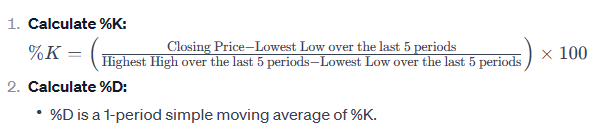
How to Use: The Slow Stochastic is used similarly to the Fast version, but with more emphasis on reducing false signals. Traders look for crossovers of %K and %D to indicate buying and selling opportunities. Because it produces fewer signals, it’s typically favored by swing traders or those who are aiming for medium-term trades rather than short-term scalps.

Crossings above 80 might suggest that the market is overbought and due for a pullback, while crossings below 20 might suggest that the market is oversold and due for a potential rebound.
The Slow Stochastic is a popular tool among technical analysts for its ability to help identify potential reversals in market momentum. Traders often use it in conjunction with other technical indicators and analysis methods for a more comprehensive understanding of market conditions.



Related Articles

Risk-Adjusted Returns

Risk-Adjusted Returns: Why Smarter Investors Focus on More Than Performance

Risk-adjusted returns measure investment performance relative to the amount of risk taken to generate it. While raw return figures are ...
Moving Average Crossover

Moving Average Crossover Strategy: Using Trend Confirmation to Reduce Emotional Trading

A moving average crossover strategy is a technical analysis method in which two or more moving averages of different timeframes ...
Retirement Investment Strategies

Retirement Investment Strategies: The Phase-by-Phase Framework That Changes How You Approach Every Stage

Retirement investing is not a single strategy you set in your 30s and maintain unchanged until you stop working. It ...
Best indicators for day trading

Best Indicators for Day Trading: The 7 That Elite Traders Actually Use (And Why Most Lists Get It Wrong)

Most lists of the best indicators for day trading share the same flaw: they describe what each indicator calculates without ...
Employee Stock Purchase Plan

ESPP Explained: The Employee Stock Purchase Plan Most Workers Leave Money On the Table By Ignoring

An employee stock purchase plan with a 15% discount and lookback provision is one of the only places in financial ...
Closed End Funds

Closed End Funds: The Misunderstood Income Vehicle Trading at a Discount (And What That Means for You)

Closed end funds offer something genuinely unusual in the investment world: the possibility of buying a dollar of assets for ...

⚠️ We're upgrading your experience.

Our site is currently being updated. You may notice some changes over the next week 

What to expect during this period:

  • Some pages may load slowly or look slightly different as updates are rolled out
  • Occasional brief interruptions may occur — we’ll do our best to minimise these
  • Your trading signals and core member resources will remain accessible throughout
 
Please reach out if you need any assistance. Thank you for your patience!